
Held on 11 Nov 2021
Intervals Intervals is a regular programme which premieres film work that lies beyond the Museo Reina Sofía’s mainstream circuit. This new edition centres on New Sevilles, a feature made by film-maker Gonzalo García-Pelayo (Madrid, 1947) and artist and researcher Pedro G. Romero (Aracena, Huelva, 1964) which was awarded the Prize for Best Film (Ex Aequo) in the New Waves – No Fiction section of the 18th Seville Film Festival and drifts around the Spanish city through history and to the contemporary beat of flamenco.
Nine Sevilles s a psycho-affective walk with nine characters and three companions who interpret themselves and speak of flamenco as an alternative way to live intrinsically joined to the city of Seville. The companions are: Amparo Bengala, a gypsy actress and matriarch from the Habichuela music clan; Javier García-Pelayo, a music producer, Gonzalo García-Pelayo’s brother and an actor in many of his films, and José Luis Ortiz Nuevo, a flamencologist and founder of the Flamenco Biennial of Seville. The walkers are: Javiera de la Fuente, a Chilean-born flamenco dancer; Yinka Esi Graves, a Ugandan-English flamenco dancer; Pastora Filigrana, a renowned lawyer and gypsy feminist activist; Gonzalo García-Pelayo, the film-maker playing himself; José Jiménez “Bobote”, a gypsy musician from the Sevilla slum Las tres mil viviendas; Vanesa Lérida Montoya, a non-binary gypsy bullfighter; Rocío Montero, a gypsy matriarch from the El Vacie (Seville) shanty town who is known for her role in the version of The House of Bernarda Alba by Atalaya TNT: the International Centre of Theatre Research; David Pielfort, a poet, and finally, Rudolph Rostas “Janek”, a Hungarian gypsy, street trader and specialist in northern European Romany traditions.
As a whole, these subjects all define a polyphony with geographical, temporary and spatial ramifications which are not only distanced from essentialist folklore, but also reveal why flamenco is a critical, marginal and subordinate art that flows out towards life. Among the walks we encounter bursts of music and choreography by artists such as Israel Galván, Rocío Márquez, Tomás de Perrate and Rosalía, among numerous others, in addition to a dialogue between both directors: the legendary figure of Spanish counter-culture Gonzalo García-Pelayo, whose feature Vivir en Sevilla (Living in Seville, 1978) is a clear precursor to this film, and the encyclopaedic artist and researcher Pedro G. Romero. There is also a tension that shapes the entire film and deliberately puts forward unresolved contradictions. Nine Sevilles could be defined as a fictional documentary, an anthropological-musical essay, expanded theatre and a film choir, yet, as Romero tells us, more than anything it is “a flamenco film, not because flamenco musicians feature but because it’s a way of making purely flamenco cinema”.
[dropdown]Gonzalo García-Pelayo (Madrid, 1947) is a film-maker, music producer and entrepreneur. A key figure in Spain’s counterculture in the 1970s and 1980s, he made a string of cult films such as Manuela (1976), Vivir en Sevilla (1978), Frente al mar (1979), Corridas de alegría (1982) and Rocío y José (1982). Previously, he was the owner of the Don Gonzalo music club in Seville, a point of encounter for musicians and artists in the early years of democracy, and is a meticulous and gifted music producer. His work in this area contributed to the emergence of Andalusian rock with Smash, Triana and Lole y Manuel, and he also introduced Quilapayún, Víctor Jara and Pablo Milanés to Spain and released the first albums of José Antonio Labordeta, Amancio Prada and Carlos Cano. In other areas, he is known for designing a predictive mathematical method for games of chance which led him into winning streaks in international casinos, depicted in the fictional film The Pelayos (2012). He currently directs the publishing company Gong,which he also founded.
Pedro G. Romero (Aracena, Huelva, 1964) is an artist, researcher, curator and editor. Since the late 1990s his practice has centred on two major instruments: Archivo F. X., a heterodox repository on iconoclasm, and Máquina P.H., through which he propels the Independent Platform of Modern and Contemporary Flamenco Studies (PIE.FMC). Romero analyses historical events, life and the circulation of images which have represented and narrated key events in Spain’s history during the 20th century, and in so doing draws on a sizeable archive of knowledge, disciplines and situations which bring together sacramental iconography, the iconoclastic expression of early avant-garde art movements in the 20th century, flamenco, the concepts and imaginaries of popular cultures, the economy, cultural policies and forms of urban speculation, among others. Moreover, he is the subject of the Museo Reina Sofía’s retrospective Versifying Machines (3 de noviembre, 2021 – 28 de marzo, 2022).
[/dropdown]
Programme
Thursday, 11 November – 5pm
Gonzalo García-Pelayo and Pedro G. Romero. Nine Sevilles
—Presentation and talk with Pedro G. Romero
Saturday, 13 November – 5pm
Gonzalo García-Pelayo y Pedro G. Romero. Nine Sevilles
—Presentation and talk with Gonzalo García Pelayo
Credits
Nine Sevilles Spain, 2020, colour, original version in Spanish, DA, 157’Direction:Gonzalo García-Pelayo and Pedro G. RomeroScript:Pedro G. RomeroCast:Javiera de la Fuente, Yinka Esi Graves, Pastora Filigrana, Gonzalo García-Pelayo, José Jiménez “Bobote”, Vanesa Lérida Montoya, Rocío Montero, David Pielfort and Rudolph Rostas “Janek”With the special participation of:Amparo Bengala, Javier García-Pelayo and José Luis Ortiz NuevoMusic performances:Israel Galván, Alfredo Lagos, Rocío Márquez y Fahmi Alqhai con Rami Alqhai y Agustín Diassera, Inés Bacán, Leonor Leal y Antonio Moreno, Raúl Cantizano, Tomás de Perrate y Proyecto Lorca (Juan Jiménez y Antonio Moreno), Niño de Elche con Susana Hernández y Raúl Cantizano, Rocío Molina y Sílvia Pérez Cruz con Eduardo Trassierra, Carlos Montfort, José Manuel Ramos “El Oruco” y Carlos Gárate, Rosalía con José Acedo, Los Mellis, Anna Colom and Claudia “La Chispa”Director of photography:Juan Manuel Carmona BatánEditing:Sergi DiesSound design:Roberto Fernández and Eva de la FuenteProducers:Roberto Butragueño, Nathalie Trafford and Joaquín VázquezProduced by:Elamedia Estudios, Hellish Producciones, BNV Producciones and Magnética CineAssociate producers:Amaranta Ariño, Filiep Tacq, Mariano Delís, Abraham Lacalle and María Barroso
Organized by
Museo Reina Sofía
Collaboration
illycaffèParticipants
Participants


Más actividades
![Tracey Rose, The Black Sun Black Star and Moon [La luna estrella negro y negro sol], 2014.](https://recursos.museoreinasofia.es/styles/small_landscape/public/Obra/AD07091_2.jpg.webp)
On Black Study: Towards a Black Poethics of Contamination
Monday 27, Tuesday 28 and Wednesday 29 of April, 2026 – 16:00 h
The seminar On Black Study: Towards a Black Poethics of Contamination proposes Black Study as a critical and methodological practice that has emerged in and against racial capitalism, colonial modernity and institutional capture. Framed through what the invited researcher and practitioner Ishy Pryce-Parchment terms a Black poethics of contamination, the seminar considers what it might mean to think Blackness (and therefore Black Study) as contagious, diffuse and spreadable matter. To do so, it enacts a constellation of diasporic methodologies and black aesthetic practices that harbor “contamination” -ideas that travel through texts, geographies, bodies and histories- as a method and as a condition.
If Blackness enters Western modernity from the position of the Middle Passage and its afterlives, it also names a condition from which alternative modes of being, knowing and relating are continually forged. From within this errant boundarylessness, Black creative-intellectual practice unfolds as what might be called a history of touches: transmissions, residues and socialities that unsettle the fantasy of pure or self-contained knowledge.
Situated within Black radical aesthetics, Black feminist theory and diasporic poetics, the seminar traces a genealogy of Black Study not as an object of analysis but as methodological propositions that continue to shape contemporary aesthetic and political life. Against mastery as the horizon of study, the group shifts attention from what we know to how we know. It foregrounds creative Black methodological practices—fahima ife’s anindex (via Fred Moten), Katherine McKittrick’s expansive use of the footnote, citation as relational and loving labour, the aesthetics of Black miscellanea, and Christina Sharpe’s practices of annotation—as procedures that disorganise dominant regimes of knowledge. In this sense, Black Study is approached not as a discrete academic field but as a feel for knowing and knowledge: a constellation of insurgent practices—reading, gathering, listening, annotating, refusing, world-making—that operate both within and beyond the university.
The study sessions propose to experiment with form in order to embrace how ‘black people have always used interdisciplinary methodologies to explain, explore, and story the world.’ Through engagements with thinkers and practitioners such as Katherine McKittrick, C.L.R. James, Sylvia Wynter, Christina Sharpe, Fred Moten, Tina Campt, Hilton Als, John Akomfrah, fahima ife and Dionne Brand, we ask: What might it mean to study together, incompletely and without recourse to individuation? How might aesthetic practice function as a poethical intervention in the ongoing work of what Sylvia Wynter calls the practice of doing humanness?
Intergenerationality
Thursday, 9 April 2026 – 5:30pm
This series is organised by equipoMotor, a group of teenagers, young people and older people who have participated in the Museo Reina Sofía’s previous community education projects, and is structured around four themed blocks that pivot on the monstrous.
The third session gazes at film as a place from which to dismantle the idea of one sole history and one sole time. From a decolonial and queer perspective, it explores films which break the straight line of past-present-future, which mix memories, slow progress and leave space for rhythms which customarily make no room for official accounts. Here the images open cracks through which bodies, voices and affects appear, disrupting archive and questioning who narrates, and from where and for whom. The proposal is at once simple and ambitious: use film to imagine other modes of remembering, belonging and projecting futures we have not yet been able to live.
Thinking with African Guernica by Dumile Feni
Wednesday 25th March, 2026 – 7.00pm
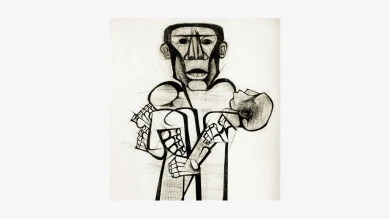
Curator Tamar Garb brings together a panel of specialists from different disciplines, ranging from Art and Social Anthropology to African Studies and the History of violence, on the occasion of the first edition of the series History Doesn’t Repeat Itself, but It Does Rhyme, starring African Guernica (1967) by Dumile Feni (Worcester, South Africa, 1942 – New York, 1991). The aim of this meeting is to collectively reflect on the points of convergence between the works of both Pablo Picasso and the South African artist.
African Guernica is the monumental drawing created by Dumile Feni in the 1960s. The piece is being shown for the first time outside South Africa, in dialogue with Picasso’s Guernica (1937). This provocative physical encounter invites us to consider both artworks as anti-war and anti-totalitarian manifestos, albeit relating to different places and moments.
For this panel, Siyabonga Njica presents the artistic and cultural context of 1960’s Johannesburg, contemporary to Feni’s work. Pumla Gobodo-Madikizela addresses the trauma of apartheid from both aesthetic and oneiric perspectives. Thozama April analyses the artist’s corpus in relation to archival practices and conservation. Finally, Elvira Dyangani Ose offers a reading of African Guernica through the lens of Pan-African modernity and the collapse of the centre-periphery duality.
These events, which form part of the core strands of the Public Programmes department, aim to provide deeper insight into and broaden public engagement with the Museum’s Collections and temporary exhibitions.
History Doesn’t Repeat Itself, but It Does Rhyme. Dumile Feni: African Guernica
Tuesday 24th March, 2026 – 6.30pm
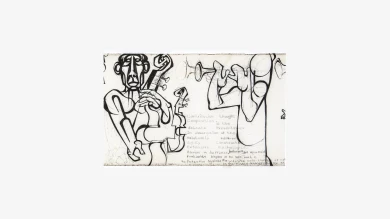
On the occasion of the exhibition History Doesn’t Repeat Itself, but It Does Rhyme. Dumile Feni: African Guernica, its curator Tamar Garb, introduced by Manuel Segade, Director of the Museo Reina Sofía, highlights the opportunities for reflection offered by the presentation at the Museum of African Guernica (1967), the African sibling to Pablo Picasso’s emblematic painting. The event concludes with the live premiere of a musical composition created especially for this event by the South African artists Philip Miller and Tshegofatso Moeng.
African Guernica, the monumental drawing produced by the South African artist Dumile Feni (Worcester, South Africa, 1942 – New York, 1991) in the 1960s, is presented for the first time outside South Africa in dialogue with Picassos’s Guernica (1937). Feni’s work is deeply connected to its place of origin, emerging from the context of state violence and institutionalised racial oppression under apartheid. Viewing both artworks side by side makes it possible to consider their shared references and strategies, their similarities and synergies, as well as the formal and figurative differences that largely result from their geographical and temporal separation.
The musical composition by Philip Miller and Tshegofatso Moeng intends to establish a parallel dialogue between traditional South African sounds and the classical repertoire for strings, voice and wind instruments. A full ensemble of performers from South Africa and Spain has been brought together for this purpose.
These inaugural conversations, which form part of the core strands of the Public Programmes Department, aim to explore in depth the content of the exhibitions organised by the Museum from the perspective of artists, curators and specialists.
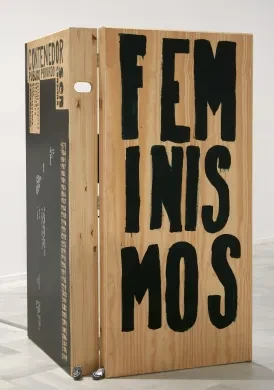
Remedios Zafra
Thursday March 19, 2026 - 19:00 h
The José Luis Brea Chair, dedicated to reflecting on the image and the epistemology of visuality in contemporary culture, opens its program with an inaugural lecture by essayist and thinker Remedios Zafra.
“That the contemporary antifeminist upsurge is constructed as an anti-intellectual drive is no coincidence; the two feed into one another. To advance a reactionary discourse that defends inequality, it is necessary to challenge gender studies and gender-equality policies, but also to devalue the very foundations of knowledge in which these have been most intensely developed over recent decades—while also undermining their institutional support: universities, art and research centers, and academic culture.
Feminism has been deeply linked to the affirmation of the most committed humanist thought. Periods of enlightenment and moments of transition toward more just social forms—sustained by education—have been when feminist demands have emerged most strongly. Awareness and achievements in equality increase when education plays a leading social role; thus, devaluing intellectual work also contributes to harming feminism, and vice versa, insofar as the bond between knowledge and feminism is not only conceptual and historical, but also intimate and political.
Today, antifeminism is used globally as the symbolic adhesive of far-right movements, in parallel with the devaluation of forms of knowledge emerging from the university and from science—mistreated by hoaxes and disinformation on social networks and through the spectacularization of life mediated by screens. These are consequences bound up with the primacy of a scopic value that for some time has been denigrating thought and positioning what is most seen as what is most valuable within the normalized mediation of technology. This inertia coexists with techno-libertarian proclamations that reactivate a patriarchy that uses the resentment of many men as a seductive and cohesive force to preserve and inflame privileges in the new world as techno-scenario.
This lecture will address this epochal context, delving into the synchronicity of these upsurges through an additional parallel between forms of patriarchal domination and techno-labor domination. A parallel in which feminism and intellectual work are both being harmed, while also sending signals that in both lie emancipatory responses to today’s reactionary turns and the neutralization of critique. This consonance would also speak to how the perverse patriarchal basis that turns women into sustainers of their own subordination finds its equivalent in the encouraged self-exploitation of cultural workers; in the legitimation of affective capital and symbolic capital as sufficient forms of payment; in the blurring of boundaries between life and work and in domestic isolation; or in the pressure to please and comply as an extended patriarchal form—today linked to the feigned enthusiasm of precarious workers, but also to technological adulation. In response to possible resistance and intellectual action, patriarchy has associated feminists with a future foretold as unhappy for them, equating “thought and consciousness” with unhappiness—where these have in fact been (and continue to be) levers of autonomy and emancipation.”
— Remedios Zafra