Homage to Tomàs Llorens
Held on 29 Sep 2021
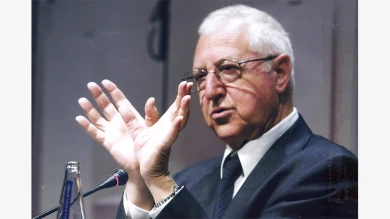
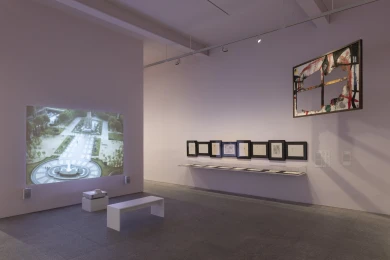
Tomàs Llorens (1936–2021), a key figure of art history and Spain’s museum landscape, passed away on 10 June this year in Dénia. His professional activity was decisive in founding the most salient modern art museums in Spain at the beginning of the democratic period.
Across a five-decade career, Llorens combined university lecturing with scientific research and cultural management, and from these three fronts turned his attentions to the persistence of realism in art’s avant-garde movements, the origins of modern art in the last third of the 19th century, the figure of sculptor Julio González, and aesthetic reflections on architecture. These same strands, which would form the subject of his teachings, publications and exhibitions, are the pivots upon which this homage turns.
Tomàs Llorens worked as a lecturer at the Universitat Politècnica de València (1969–1972), Portsmouth Polytechnic (1972–1984), the Polytechnic University of Barcelona (1978–1980), Universitat de Girona (1996–1998), Universitat de València (1998-1999) and Universitat d’Alacant (2000-2005), specialising in the areas of Aesthetics, Architectural Composition and Art History. He was also a contributor to and theoretical driving force behind Equipo Crónica, an historical artistic collective of critical pop-art made up of Rafael Solbes, Juan Antonio Toledo and Manolo Valdés and active between 1964 and 1981. Moreover, he curated, with Valeriano Bozal and many other contributors, the emblematic exhibition Spain, Artistic Avant-Garde and Social Reality, 1936–1976 for the 1976 Venice Biennale, in the wake of Franco’s death. In the 1980s and 1990s, Llorens was in charge of creating and directing museum centres that would shape art’s new ecosystem in democratic Spain, such as the Institut Valencià d’Art Modern (IVAM), where he worked as its founding director from 1986 to 1988, the Museo Reina Sofía, which he directed from 1988 to 1990 during its transition from art centre to national museum, and the Museo Nacional Thyssen-Bornemisza, where he occupied the position of head curator from 1991, one year before its opening, to 2005. Finally, of the vast number of temporary exhibition catalogues, mention must be made of the Julio González catalogue raisonné, a six-volume magnum opus he was working to finish in his final years.
This exemplary work resulted in his appointment, in 1998, as an academic at the San Fernando Royal Academy of Fine Arts and the publication of the collective volume Estudios de Historia del Arte en honor de Tomàs Llorens (Studies of Art History in Honour of Tomàs Llorens, Antonio Machado Libros, 2007).
This homage features a pre-eminent selection of interventions — both in-person and online – by figures linked to curatorship, art history, architecture and fine arts, all of which are representative of the professional and intellectual interests of Tomàs Llorens.
By order of intervention
Guillermo Solana, artistic director of Museo Nacional Thyssen-Bornemisza
Baronesa Carmen Thyssen-Bornemisza, vice president of the Museo Nacional Thyssen-Bornemisza’s Board of Trustees
Manuel Borja-Villel, director of Museo Reina Sofía
Nuria Enguita, director of Institut Valencià d’Art Modern (IVAM)
María Dolores Jiménez-Blanco, general director of Fine Arts, Spain’s Ministry of Culture and Sport
Valeriano Bozal, emeritus lecturer of Art History, Complutense University of Madrid
Maria Josep Balsach, lecturer of Contemporary Art, Universitat de Girona
Jaime Brihuega, emeritus professor of Art History, Complutense University of Madrid
Paloma Alarcó, head of Modern Painting Conservation, Museo Nacional Thyssen-Bornemisza
Kosme de Barañano, lecturer of Art History, Universitat Miguel Hernández d’Elx
Alex Katz, artist
María Teresa Ocaña, art historian and former director of Museu Picasso and Museu Nacional d'Art de Catalunya (MNAC), Barcelona
Francesc Torres, artist
Delfín Rodríguez, lecturer of Art History, Complutense University of Madrid
José Francisco Yvars, art critic and historian, and former director of Institut Valencià d'Art Modern (IVAM)
Participants
Participants
Más actividades
International Museum Day 2026 with Radio 3
22 MAY 2026
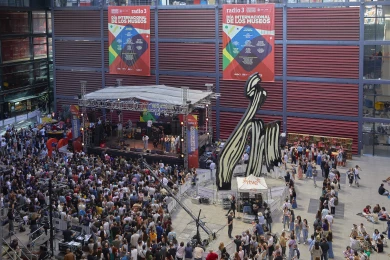
On Friday, 22 May 2026 the Museo Reina Sofía celebrates International Museum Day by way of a vibrant music programme conducted by Radio 3.
From 9am to 11pm, the Museo’s Nouvel Courtyard will host the live broadcast of Radio 3’s day-long programme —also available on a video streaming on the Radio3 website and app, on RTVEPlay and on the Museo’s social media accounts. The programme comprises more than twenty live acts, including artists such as Carlangas, Shego, Soleá Morente, Kokoshca, La Tania, La Pegatina, Pipiolas, Ángel Stanich, Triángulo de Amor Bizarro and Zahara, and many others.
With this programme the Museo Reina Sofía concludes its celebration of International Museum Day, which takes place on Monday, 18 May. Both on 18 May, from 10am to 9pm, and 22 May admission to the Museo will be free of charge.
Institutional Decentralisation
Thursday, 21 May 2026 – 5:30pm
This series is organised by equipoMotor, a group of teenagers, young people and older people who have participated in the Museo Reina Sofía’s previous community education projects, and is structured around four themed blocks that pivot on the monstrous.
This fourth and final session centres on films that take the museum away from its axis and make it gaze from the edges. Pieces that work with that which is normally left out: peripheral territories, unpolished aesthetics, clumsy gestures full of intent. Instead of possessing an institutional lustre, here they are rough, precarious and strange in appearance, legitimate forms of making and showing culture. The idea is to think about what happens when central authority is displaced, when the ugly and the uncomfortable are not hidden, when they are recognised as part of the commons. Film that does not seek to be to one’s liking, but to open space and allow other ways of seeing and inhabiting the museum to enter stage.
Miguel Falomir, Director of the Museo Nacional del Prado, in Conversation with Museo Reina Sofía Director Manuel Segade
18 MAY 2026
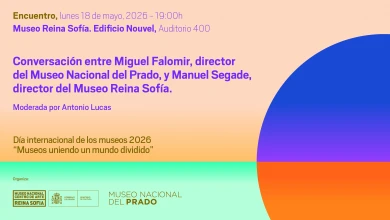
Museo del Prado and Museo Reina Sofía directors, Miguel Falomir and Manuel Segade, respectively,engage in conversation on Monday, 18 May in the Museo Reina Sofía’s Auditorium 400, in conjunction with International Museum Day 2026, the theme of which is “Museums Uniting a Dividing World”. The discussion, moderated by journalist and poet Antonio Lucas, will see the two heads of these major cultural institutions share their reflections on the role they play in today’s society.
In addition to addressing the management of art, the conversation seeks to explore in greater depth museums’ potential as meeting points to face today’s social tensions, thereby fulfilling the international mandate of this year’s edition.
The activity will be live-streamed and is available at this link.
Collection. Contemporary Art: 1975–Present
Miércoles 13 de mayo, 2026 - 19:00 h
In this lecture, Museo Reina Sofía director Manuel Segade outlines the key readings of the new presentation of the Collection on Floor 4 of the Sabatini Building. This new arrangement is framed inside an ambitious rehang that harnesses the uses of the Museo’s architecture, in a plan that will continue in 2027 with the opening of Floor 3 in the same building, culminating with Floor 2 in 2028.
The new rehang of the Collections, unveiled on 16 February 2026, sets forth a journey through contemporary art history over the past fifty years in Spain. Rather than an unambiguous narrative, the floor recounts the same period — from the Transition to democracy in Spain to the present — in three different ways, starting back at the 1970s time and again.
The exhibition route gets under way with a prologue that travels through the affections, material culture and institutionalism of the Spanish Transition, serving as a starting point for the three routes that follow. The first, A History of Affect in Contemporary Art, advances from affective systems in artmaking linked to the second wave of feminism, arriving at grief as a tool to interpret new realities. The second route, The Powers of Fiction: Sculpture, New Materialisms, and Relational Aesthetics, is conceived as a sculpture gallery in which the artworks engage with the public, focusing on the performance side of the discipline. This route shows, among other aspects, how Spanish sculpture has gained significant international visibility since the 1980s, with women artists playing a key role in this display. The third route, A New Framework. The Institution, the Market, and the Art that Transcends Both, zooms in on the origins of the Museo and its role in the process of art’s institutionalisation in Spain. In May 1986 the Centro de Arte Reina Sofía opened, occupying the first and second floors of the former hospital: the forty years that have elapsed since then enable a re-evaluation of the effects of the Museo on Spanish art and art on the institution.
This talk strengthens the goal of socially integrating the narratives produced by the Museo at a time when the Collections are under permanent review.
Patricia Falguières
Tuesday May 12th 2026 – 19:00 h
Art historian Patricia Falguières inaugurates the María Luisa Caturla Chairwith the lecture Art History in Dark Times. This Chair, dedicated to the reflection on art in times «sick with uncertainty», is aimed at dismounting, digressing and imagining multiple temporalities and materialities in art history and cultural studies from an eccentric gaze, in the sense of being displaced, off-centre or with a centre that is different.
The lecture’s title references Hannah Arendt’s collection of essays Men in Dark Times, which in turn paraphrases a Bertol Brecht poem. In it, Arendt asserts «dark times are not only not new, they are no rarity in history».
Patricia Falguières also claims history knows many periods when the public realm has been obscured, when the world becomes so uncertain that people cease to ask anything of politics except to relieve them of the burden of their vital interests and their private freedom. The art historian —whose expertise is in the field of Renaissance art and philosophy but paying close attention to contemporaneity— invites us to a «chaotic and adventurous journey», from the Italian Renaissance to Fukushima, through which to delve into the questions: What can the practice of art history mean today, in a world ablaze with ominous glimmers and even more ominous threats, if not as mere entertainment or social ornament? Of what vital interests, of what freedom can it bear witness and serve as an instrument?