-
January 16, 18, 23 and 25, 2013 Sabatini Building, Auditorium
Block 1. Doing politics with nothing. Territories of violence
This block presents the creative strategies of the human rights movement in Argentina and Chile, along with actions and productions by activist groups with such marginal materiality that they used resources such as silk-screening, photocopies and the body to process and show the consequences of State terrorism with its correlate of massacres, torture, forced disappearances. In various sessions, it explores how the modes of political action in the 1970s became, due to the impossibility of confrontation, the resource used in artistic tactics aimed at ending the isolation of political practice and provoking viewers by means of body-to-body contact in the streets. This open opposition and occupation of the public space would become, in the 1980s, the key elements that allowed for the creation of new citizenries.
Session 1
January 9, 7:00 p.m.
No me olvides (Don't forget me)
Tatiana Gaviola. Chile, 1988. Production format: U-Matic, 15 min. Exhibition copy in DVD. Distributed by Tatiana Gaviola
Somos+ (We are +)
Pedro Chaskel and Pablo Salas. Chile, 1985. Production format: U-Matic, 16 min. Exhibition copy in DVD. Distributed by Pablo Salas
Por la vida (For Life)
Pedro Chaskel and Pablo Salas. Chile, 1985. Production format: U-Matic, 28 min. Exhibition copy in DVD. Distributed by Pablo Salas
Presentation by Miguel Martínez
Miguel Martínez holds a PhD in Political Science and is a researcher in the department of Sociology II at the Universidad Complutense de Madrid. He specializes in social movements and urban studies.Session 2
Dates: January 11, 7:00 p.m.
Arete Guasu
Made by: Dea Pompa. Based on an original idea by: Lia Colombino. Paraguay, 2012. Production format: DV-Cam, 37 min. Exhibition copy in DVD. Distributed by Lia Colombino. Short film not previously released, made jointly with Museo Reina Sofía and the network Conceptualismos del Sur.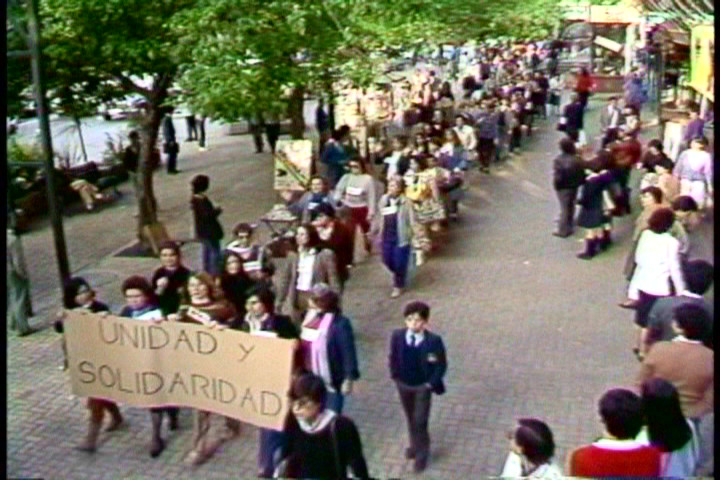
-
January 16, 18, 23 and 25, 2013 Sabatini Building, Auditorium
Block 2. Underspaces
The friction of bodies
This block reflects a series of collective experiences in semi-clandestine places, in certain "official" spaces and on the outskirts of large Latin American cities. New cultural manifestations linked to one another by the crudeness of their forms and by their total negation of official values. Later called the ‘subte’ scene (short for subterránea, underground), in this period creativity reached unknown heights, in contrast with the despondency and the brutality of the armed conflict in Peru, the military dictatorship in Chile and the processes of marginalisation in Colombia, Mexico and Brazil. Grouped around libertarian and anarchist discourses, and making use of music, the visual arts and poetry, these groups are characterized by their refusal to remain silent in the face of news about torture and disappearances, but also about the spread of the new market society. This independent scene choose to confront authoritarianism, repression and the social and cultural status quo, and it does so collectively through concerts, posters, scenographies, festivals and multidisciplinary encounters at universities, theatres and other places in the city.
Session 3
January 16, 7 p.m.
Punks
Sarah Yakhni and Alberto Gieco. Chile, 1984. Production format: U-Matic, 35 min. Exhibition copy in DVD. Original language: Portuguese, with Spanish subtitles. Distributed by Sarah Yakhni, Brazil.
Grito subterráneo (Underground Scream)
Julio Montero Solís. Peru, 1986. Production format: various, 120 min. Exhibition copy in DVD. Distributed by Julio Montero Solís, Peru.Session 4
January 18, 7 p.m.
Nadie es inocente (Nobody is innocent)
Sarah Minter. Mexico, 1987. Production format: U-Matic, 58 min. Exhibition copy in DVD. Distributed by Sarah Minter, Mexico.
Alma punk (Punk Soul)
Sarah Minter. Mexico, 1991. Production format: U-Matic, 56 min. Exhibition copy in DVD. Distributed by Sarah Minter, Mexico.Session 5
23 January, 7 p.m.
Rodrigo ‘D’. No futuro (Rodrigo 'D'. No future)
Víctor Gaviria. Colombia, 1990. Production format: 35 mm, 90 min. Exhibition copy in DVD.Session 6
25 January, 6 p.m.
Pank. Orígenes del punk en Chile (Pank. The origins of punk in Chile)
Martín Núñez. Chile, 2010. Production format: various, 80 min. Exhibition copy in DVD. Distributed by Martín Núñez, Chile.
Frenesí (Frenzy) - Liliana Maresca - 1984/1994
Adriana Miranda. Argentina, 1994.Production format: various, 35 min.Exhibition copy in DVD. Distributed by Adriana Miranda, Argentina.
Presentation by Miguel Conejeros
Miguel Conejeros is a musician. During his early career he was a member of the band Los Pinochet Boys (1984-1987), which pioneered a new way to conceive of rock/pop/electronic/experimental music in Chile and Latin America.
-
January 30 and February 1, 6, 8 and 13, 2013 Sabatini Building, Auditorium
Block 3. Sexual disobediences
The friction of bodies
In the 1980s various artistic experiences involving gender subversion and sexual disobedience put forward a critique of normative heterosexuality, and at the same time questioned the left-wing imaginary, by confronting the naturalized relationships of inequality, authoritarianism and subordination that support these discourses. This situation is addressed in Improper Behaviour, a film in which Cuban refugees are interviewed about the incarceration of homosexuals, political dissidents and Jehovah's Witnesses in labour camps, under the Cuban government's policy of Military Units to Aid Production (UMAP). Many of these art practices were also a response to the HIV/AIDS crisis, as mentioned in Dzi Croquettes, and to the continual stigmatisation of minorities. Through carnivalesque performative interventions, as in Pedro Lemebel: corazón en fuga (Pedro Lemebel: a fleeing heart), images of prosthetic alterations or encounters between non-normative sexualities, such as those seen in Batato's Movie, the artistic insubordination present in this block shatters heterosexuality as a political regime.
Session 7
30 January, 7 p.m.
La peli de Batato (Batato's Movie)
Goyo Anchou y Peter Pank . Argentina, 2011. Production format: various, 150 min. Exhibition copy in DVD. Distributed by Goyo Anchou, Argentina.Session 8
1 February, 7 p.m.
El homosexual o la dificultad de expresarse (The homosexual, or the difficulty of expressing oneself).
Teatro del Sol. Peru, 1990. Production format: VHS, 63 min. Exhibition copy in DVD. Distributed by Giuseppe Campuzano, Peru.
Pedro Lemebel: corazón en fuga (Pedro Lemebel: a fleeing heart)
Verónica Quense. Chile, 2009. Production format: Betacam, 53 min. Exhibition copy in Betacam. Distributed by Verónica Quense, Chile.Session 9
6 February, 7 p.m.
Conducta impropia (Improper Behaviour)
Néstor Almendros and Orlando Jiménez Leal. France, Cuba, 1984. Production format: 35 mm, 93 min. Exhibition copy in Betacam. Original language: Spanish and French, with Spanish subtitles. Distributed by Orlando Jiménez Leal, New York.
Presentation: Andrés Isaac Santana
Andrés Isaac Santana (Matanzas, Cuba, 1979) is an art critic, essayist, editor and exhibition curator. His publications include “Imágenes del desvío. La voz homoerótica en el arte cubano contemporáneo” (Ed. J.C, Sáez, Chile, 2004) and he edited the compilation of texts “Nosotros, los más infieles. Narraciones críticas sobre el arte cubano (1993-2005)”, (Ed. Cendeac, Murcia, 2007).Session 10
8 February, 7 p.m.
108 Cuchillo de palo (108 Wooden Knife)
Renate Costa. Spain, Paraguay, 2010. Production format: Super-8 and digital video, 93 min. Exhibition copy in Betacam. Distributed by: Estudi Playtime, Barcelona.
Reinas
Made by: Dea Pompa. Based on an original idea by: Lia Colombino. Paraguay, 2012. Production format: DV-Cam, 20 min. Exhibition copy in DVD. Distributed by Lia Colombino. Short film not previously released, made jointly with Museo Reina Sofía and the network Conceptualismos del Sur.Session 11
13 February, 7 p.m.
Dzi Croquettes
Tatiana Issa and Raphael Álvarez. Brazil, 2009. Production format: various, 110 min. Exhibition copy in Blu-Ray. Original language: Portuguese, with Spanish subtitles. Distributed by: Tatiana Issa and Raphael Álvarez, Brazil.
-
February 15, 2013 Sabatini Building, Auditorium
Block 4. Ongoing delirium and other experiments
The friction of bodies
The Bureau of Surrealist Enquiries, an institution invented by Antonin Artaud in 1924, was conceived as a place where anyone could go to explore madness in order to reinvent life through creative activity. Taking up the idea of this key institution once again, in the 1980s different groups in Argentina decided to refound the international surrealist movement. Among them was TIC - Taller de Investigaciones Cinematográficas, or the Cinematographic Investigation Workshop - which produced a series of videos now being shown for the first time.
Along with these videos by the TIC, other films recover the imaginary of the 1970s and 1980s and put forward poetic and experimental creations. Homem-ave gira deals with the poetic universe of the Brazilian singer Ney Matogrosso, who during the dictatorship of the 1970s broke sexual taboos with his behaviour on stage. Mi Co-Ra-Zón, by the Mexican Pola Weiss, explores the body, with its organs, guts and fluids, through montages linking the eye to the heart. The block ends with Melquíades Herrera, participant in the collective No-Grupo, who, in modifications of daily activities, takes imagination, provocation and collective creation to transform the “normal” conditions of existence.Session 12
February 15, 7 p.m.
Detrás del muro (Behind the wall)
Taller de Investigaciones Cinematográficas (TIC), Adrián Rivero (Adrián Fanjul). Argentina, 1980. Production format: Super-8, 5 min. Exhibition copy in DVD. Distributed by Roberto Barandalla, Argentina.
El Chulu
Taller de Investigaciones Cinematográficas (TIC), Sergio Bellotti. Argentina, 1980.
Production format: Super-8, 20 min. Exhibition copy in DVD. Distributed by Roberto Barandalla, Argentina.
El amor vence (Love wins)
Taller de Investigaciones Cinematográficas (TIC), Beto Sánchez (Roberto Barandalla).
Argentina, 1980. Production format: Super-8, 12 min. Exhibition copy in DVD. Distributed by Roberto Barandalla, Argentina.
El loco de la carretilla (The Madman with a Wheelbarrow)
Taller de Investigaciones Cinematográficas (TIC), Eduardo Nico "Magoo". Argentina, 1979.
Production format: Super-8, 7 min. Exhibition copy in DVD. Distributed by Roberto Barandalla, Argentina.
Homem-ave
Rafael Saar. Brazil, 2010. Production format: HD, 6 min. Exhibition copy in DVD. Original language: Portuguese, with Spanish subtitles. Distributed by Rafael Saar, Brazil.
Mi Co-Ra-Zón (My heart)
Pola Weiss. Mexico, 1986. Production format: U-Matic, 11 min. Exhibition copy in DVD. Distributed by: Documentary Archive of the MUAC, Universidad Nacional Autónoma de Mexico.
Venta de peines (Selling combs)
Jorge Prior and Melquíades Herrera. Mexico, 1993. Production format: Betacam, 2 min. Exhibition copy in Blu-Ray. Distributed by Producciones Volcán, Mexico.
Uno por 5, 3 por diez (One for 5, 3 for ten)
Jorge Prior and Melquíades Herrera. Mexico, 1992. Production format: Betacam, 11 min. Exhibition copy in Blu-Ray. Distributed by Producciones Volcán, Mexico.
Presentation: Jaime Vindel and Eduardo Nico “Magoo”.
Jaime Vindel is an art historian, a member of the curatorial team of Losing the Human Form and a participant in the network Conceptualismos del Sur.
Eduardo Nico “Magoo” is the co-founder, with Roberto Barandalla, of the Taller de Investigaciones Cinematográficas (Cinematographic Investigation Workshop) He has also published two books of poetry, "La Polaca" (1995) and "Puros por cruza" (2011).

Held on 09 Jan 2013
The expression the friction of bodies (el roce de los cuerpos) returns to the idea developed by the Argentine art historian Roberto Amigo about how the new forms of artistic activism in the 1980s in different places in Latin America took shape. If in the 1960s and 70s the linking of art and politics arose within traditional moulds related to the legacy of Marxism, in the 1980s that way of operating underwent a radical transformation. Encounters, festivities, the carnavalisation of protest and other forms of direct contact between bodies, whether in the private sphere or in a clandestine manner, would be the way to create a public counter-sphere in opposition to the devastating effects of violence.
Radical and libertarian attitudes thus appear, interweaving sexual dissidence, countercultural production, occupation of the streets, anarchism, social demands and civil disobedience or the demand that the victims of political disappearances come back to life, spaces and rituals that were previously invisible. This experimental wave brought a new way of thinking about and intervening in political happenings, using imaginaries of resistance and activism that favoured the building of new bodies and socialities, and the rebuilding of the emotional ties that had been broken by terror.
These film and video productions were made by documentary makers, artists, researchers, historians and people involved in these episodes. They include: amateur productions arising in underground spaces; works with the visual sophistication of a renewed cinematographic experimentalism; films of limited commercial circulation that draw connections between crisis periods by examining urban violence, music and drugs; and also new productions made especially for this exhibition. Using memory, narrative, recovered documents and images, and also musical production, this living archive of those events attempts to rethink the ways in which film and video have given a different visibility to a multitude of dissident bodies and behaviours.
Itinerary
Itinerary in collaboraction with AECID
Organised by
Conceptualismos del Sur Network and Museo Reina Sofía
Itinerancies
Museo Nacional Centro de Arte Reina Sofía, Madrid
9 January, 2013 - 15 February, 2013
Centro Cultural Juan de Salazar. Asunción, Paraguay
2 October, 2013 - 14 October, 2013
MALI. Lima, Perú
11 January, 2014 - 23 February, 2014
Centro Cultural de España en México, México D.F.
19 February, 2014 - 4 April, 2014
Centro Cultural de España en Tegucigalpa
5 March, 2014 - 20 March, 2014
Centro Cultural Parque de España, Rosario, Argentina
9 March, 2014 - 27 April, 2014
CCEBA (Centro Cultural de España) y UNTREF (Universidad Nacional de Tres de Febrero) Buenos Aires, Argentina
3 April, 2014 - 9 May, 2014
CCE (Centro Cultural de España), Montevideo
23 September, 2014 - 29 November, 2014
CCEG (Centro Cultural de España en Guatemala)
10 February, 2015 - 19 March, 2015
Centro Cultural de España, Santo Domingo, República Dominicana
5 May, 2015 - 30 May, 2015
Centro Cultural de España en Costa Rica
17 February, 2016 - 24 February, 2016
Más actividades
![Isabel Coixet, 100 Years and You Everywhere [100 años y tú en todos los sitios], 2026, película](https://recursos.museoreinasofia.es/styles/small_landscape/public/Actividades/2.diseminar-mundo.jpg.webp)
John Berger and Isabel Coixet. Continued Ways of Seeing
Thursday, 17 September 2026 at 7pm
Ways of Seeing (1972) is one of the most revolutionary television series on art history, the museum and contemporary critical culture. Across four episodes, an articulate, enthusiastic John Berger unpacks the relationships between classical art through the gaze and new technology, the nude and feminism, the oil painting and commodity fetichism, advertising and consumerism. In essence, a level of critical commitment only comparable to its capacity for dissemination. Unsurprisingly, the series, and the book that would distil it, continues to forge vocations. This session sees art historians Alberto López Cuenca and Modesta Di Paola carry out an analysis of Berger’s audiovisual work, placing the stress on episodes one and four of the series. In the first episode, Berger reflects on the connection between the act of seeing, looking and being in light of new technology, such as the film camera. At the same time, it analyses how the culture of reproduction is turning paintings into messages or fragments of communication while stressing the importance of silence when observing historical paintings. In the fourth and final episode, he introduces advertising as a new iconic-verbal language that shares certain principles with the message of oil painting as a luxury item.
The session opens with the premiere of a filmic letter from Isabel Coixet, one of Spain’s most internationally acclaimed directors, to John Berger, with whom she maintained a long friendship and deep admiration. The short film is testament to the ubiquitous and long-lasting presence of the author of Ways of Seeing, even after his death in 2017.
![Chantal Akerman, Woman Sitting after Killing [Mujer sentada después de matar], 2001, instalación. Museo Reina Sofía](https://recursos.museoreinasofia.es/styles/small_landscape/public/Actividades/chantal-akerman-mujer-sentada-despues-matar.jpg.webp)
On Your Screen: Art History and the Museum Facing the Audiovisual Challenge
18, 19 SEP 2026
The conference On Your Screen: Art History and the Museum Facing the Audiovisual Challenge sparks debate around the transformations of art history and museum space upon embracing the audiovisual format. Its starting point is John Berger’s emblematic television series Ways of Seeing (1972), a landmark in the democratisation of art-historical discourse. In the series, Berger illustrated how the transfer of a work such as Goya’s Los fusilamientos del 3 de mayo (The Third of May 1808 or the Executions) from museum gallery to home TV screen completely changed the viewer’s experience, allowing the image to travel to straight to the viewer.
In the twenty-first century, this screen-based ecosystem has expanded exponentially, with museums not only physically integrating screenings and devices into their galleries— following in the wake of many exhibitions on the moving image — but also deploying complex virtual strategies. Equally, numerous en vez de a multitudeof historians, students and creators use digital platforms to circulate their ideas and projects. This audiovisual shift opens access to ignored materials and democratises knowledge, as well as challenging traditional hierarchies and the interpretive authority of institutions. The conference, promoted by the research project ATLAS AV: The Audiovisualisation of Art History and the Museum, seeks to analyse this vast audiovisual material, its archives, and its capacity to transform the memory of art.
Godard and Miéville: Time and Ruin
Friday, 18 September 2026 - 7pm
Inside the framework of the conference On Your Screen: Art History and the Museum Facing the Audiovisual Challenge, this film series sets forth three critical visions of the museum via three sessions featuring the works of John Berger, Jean-Luc Godard and Anne-Marie Miéville, Ariella Azoulay, Alan Resnais and Chris Marker, Kwate Nee-Owoo, and the premiere of short films by Isabel Coixet and La Vulcanizadora (Maria Rojas Arias and Andrés Jurado). In classical theory, the museum gives the world meaning; it contains fragments of the past, granting them a history, a narrative that explains preterite time and the present. Today, there is an implicit assumption that this function hides and legitimises forms of power, yet what if the museum, instead of explaining the world, multiplied it through radical ideas, silenced periods and repressed subjects? Such is the approach of the film-makers and artists in this film season.
In 1972 the writer John Berger opened the landmark television series Ways of Seeing with an iconoclastic gesture: slicing Sandro Botticelli’s painting Venus and Mars (1485) in London’s National Gallery. A transgressive act that recalls contemporary attacks on the museum by dissident youth and with which Berger, after revealing it was a reproduction, sought to ignite debate around the idea of an original artwork and a copy. In this, the hundredth anniversary of his birth, the first session pays homage to one of the great art writers of the twentieth century. Starting with a review of Berger’s audiovisual work by art historians Alberto López Cuenca and Modesta Di Paola, the series begins with the premiere of 100 Years and You Everywhere (2026), an unreleased short film by Isabel Coixet composed as a beautifully crafted letter to Berger, and continues with an analysis of fragments of Ways of Seeing in relation to the museum and contemporary art.
The second session screens two medium-length films by Jean-Luc Godard and Anne-Marie Miéville on time, ruin and museum. In The Old Place. Small Notes Regarding the Arts at Fall of 20th Century (1999), both film-makers consider what remains of that “old place”, the museum, at the close of a century of wars and totalitarianism, and ask whether it should be more of a legend or desire than a place. This same driving principle leads Godard to build his own imaginary museum in Reportage amateur (maquette expo) (2006), a rickety toy museum which, paradoxically, contains the great film-maker’s full power of thought on history and images.
Finally, the third session explores one of the major challenges of recent years: the decolonisation of the museum, the recognition of its link to imperialist discourses of power and the need to situate a new silenced or repressed subject at the centre of the Western narration of history. Under the title Museums and Restitution, it includes the film Undocumented. Unlearning Imperial Plunder (2019), by theorist Ariella Azoulay, Statues Also Die, by Alan Resnais and Chris Marker (1953), Kwate Nee-Owoo’s You Hide Me (1970) and the first screening of the short film Quinto verso, parte de Tonada (Fifth Verse, Part of Tonada), by La Vulcanizadora (Maria Rojas Arias and Andrés Jurado), filmed at the Museo de América in Madrid.
![Ariella Azoulay, Un-documented. Unlearning Imperial Plunder [Indocumentados. Desaprendiendo el saqueo imperial], 2019, película](https://recursos.museoreinasofia.es/styles/small_landscape/public/Actividades/5.diseminar-mundo.jpg.webp)
Museums and Restitution
Saturday, 19 September 2026 - 7pm
Centuries of plundering, decades of amnesia, years of living with unmitigated extractivist power… Does a museum, as we know it, have a raison d'être in a postcolonial society?
This session expounds the operations of the museum as a colonial machine, while putting forward ideas, in narration, for a more just, equal and inclusive institution of the future via society’s marginalised and minority voices. The session begins with the international premiere of Quinto verso, parte de Tonada (Fifth Verse, Part of Tonada), which presents a vision of the Quimbaya Collection (fifth and sixth centuries CE) from the Museo de América in Madrid. It is constructed with the voices and chants of Wayúu mourners and guides, not only as a way of reinstating the role of these gold idols — anthropomorphic figures of men and women used as vessels in ritual practices — but also to imagine that what must be exhibited is not the gold itself. It is the ritual’s own chant. In the classic film You Hide Me (1970), Ghanaian film-maker Kwate Nee-Owoo accesses the British Museum’s collection of African art, located in the building’s basement, to question the meaning behind a museum plundering and nullifying. A fine exercise of first-person institutional critique screened for the first time in Spain. Almost seventy years since Resnais and Marker made Statues Also Die (1953), a reflection on the aura-bearing value of the museum opposite the identity-based and cultural belonging of African art, theorist Ariella Azoulay films the same statues again at the Musée du Trocadéro (today the Musée du Quai Branly), which survive and wait to be reunited with their people. Azoulay, whose wholly original undertaking is a lesson to the museum of the future, connects the forced migration of these sculptures with the mass transit of people crossing borders artificially imposed by the same system that has plundered their culture.
The School of Transformative Institutionalism and Local Organisation
From 21 to 24 September 2026
The School of Transformative Institutionalism and Local Organisation (S.T.I.L.O.) is a programme of joint learning and join strategy which sets in motion a process for the exchange of questions, methodologies and experiences between cultural organisations. The overall aim is to create, circulate and prototype tactics, tools and collective knowledge on institutional practices that open new channels for defending culture and advocating structural transformation in divergent geographical contexts.
The project is part of the Laboratorio de Institucionalidad Compartida (The Laboratory of Shared Institutionalism, LIC), a space for the Museo Reina Sofía’s research, work and advocacy centred on developing, experimenting with and systemising practices, protocols and tools which contribute to a fairer and more liveable cultural ecosystem.
For many years now, so-called infrastructural critique in museums questions material, legal and economic infrastructures, among others, as well as the forms of solidarity and practices required to sustain the cultural ecosystem. By approaching current debates, S.T.I.L.O. raises questions on the ways in which organisations define and interpret their practices, organise their relations and respond to the social contexts in which they operate.
The school gathers four cultural organisations that work via different institutional models – scale, contexts, conditions, different working models — with the goal of pooling common strategies and tools of organisation, advocacy and relationships with local communities.
The programme is conceived as a collaborative process with the participation of Arika, La Revuelta, BAK Basecamp and The Tentacular Museum (Museo Reina Sofía) and is structured around preparatory online sessions and an in-person seminar in Madrid.
S.T.I.L.O. is an activity framed inside the working strand of Situated Organisations from L'Internationale’s Museum of the Commons project, which reflects on the role of museums and art organisations as actors within complex social networks and ecosystems, with a view to exploring new ways to democratise institutions and make them more open, inclusive and useful.