-
Thursday, 10 February 2022 – 6pm / Second session: Thursday, 24 February 2022 – 6pm Sabatini Building, Auditorium
Kidlat Tahimik. Mababangong Bangungot (Perfumed Nightmare)
Philippines, 1977, colour, original version in English with Spanish subtitles, 16mm transferred to DA, 91’. Restored version
Tickets—With a presentation by Chema González, head of the Museo Reina Sofía’s Cultural and Audiovisual activities, in the first session, and by curator and film programmer Juan Guardiola in the second.
“I am Kidlat Tahimik and I choose my vehicle” are the words that introduce a young film-maker and the leading actor in this debut feature film, a cult classic, as he crosses a bridge — a metaphor for modernisation — pulling a toy car. Tahimik drives jeepneys, army jeeps converted into buses and customised with popular motifs and gaudy colours, which travel the route, the bridge, between the countryside and the big city. He is obsessed with Wernher von Braun, the aerospace engineer who built the rocket that took the United States to the moon, and dreams longingly of the West. After a summit of world leaders wearing safari suits in the Philippine jungle, the protagonist is invited to go to Paris, where he will see, first-hand, this yearned-for modernisation: “bridges, bridges everywhere!”. However, he also comes across its contradictions, or perfumed nightmares: cities obliterated by mega-structures, such as the Centre Pompidou under construction, filmed by Tahimik as if it were a large supermarket, and excessive ambition (“if small chimneys work, why the big ones? If small planes work, why the flying super machines?”). In short, this film is a vivid succession of gags that pass from being seduced by the West to relinquishing it.

-
Friday, 11 February 2022 – 6pm / Second session: Friday, 25 February 2022 – 6pm Sabatini Building, Auditorium
Kidlat Tahimik. Sinong Lumikha ng Yoyo? Sinong Lumikha ng Moon Buggy? (Who Invented the Yo-yo? Who Invented the Moon Buggy?)
Philippines, 1979, colour, original version in English with Spanish subtitles, 16mm transferred to DA, 95’. Restored version
Tickets—With a presentation by Sabrina Boutselis, a Filipino-North American art historian, in the first session.
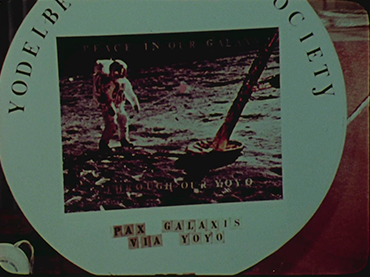
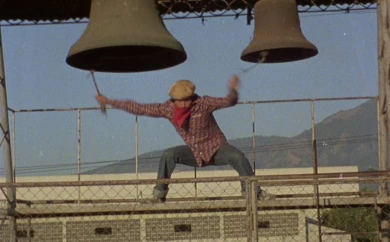
Few people have ever wondered what the yo-yo and moon buggy have in common: both are Filipino inventions. The first, a hunting tool invented by Malayan indigenous people in the sixteenth century; the second, a version of the jeepney Filipino engineer Eduardo San Juan put forward to NASA. Fewer still have wondered, as the protagonist does in this parody of the aerospace Cold War, if it’s possible to yo-yo on the moon. Will it go down, up, or stay still? With this target and the visionary help of a group of children, the protagonist founds the Philippine Official Moon Project (POMP), which will send an “underdeveloped” person to the moon for the first time. The rocket draws inspiration from the bell towers of colonial churches in the Philippines, with its energy source coming from boiling onion and its thrust from the first woman, not man, to walk on the moon: the Virgin Mary, as revealed in the iconography of the Immaculate Conception. The film, as the credits proclaim, “is a third-world space spectacle”.
-
Saturday, 12 February 2022 – 6pm / Second session: Saturday, 26 February 2022 – 6pm Sabatini Building, Auditorium
Werner Herzog. The Enigma Gaspar Hauser
Germany, 1974, colour, original version in German with Spanish subtitles, BR, 110’. Courtesy of the Werner Herzog Office
Tickets—With the presentation of Pablo Maqueda, filmmaker, author of Dear Werner. Walking on the cinema (2020), in the second session
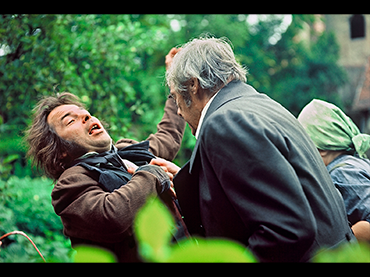
A historical drama by late-Romantic and irrationalist film-maker Werner Herzog, a close friend of Kidlat Tahimik’s and the person who encouraged him to take the leap into directing. The film is the nineteenth-century tale of a wild boy, a young adolescent held prisoner for years due to his controversial noble origins (according to speculation) and unable to speak, write and eat anything other than bread and water. A reflection on the extreme violence of social norms and the purest innocence of the misfit, Herzog’s film also sees Tahimik play a key role: an indigenous man paraded as an attraction in a human zoo — Kaspar Hauser’s equal in otherness and kidnapped over his exoticism, doomed to be repeated by conventional society. This performance would impel the examination of the Western colonial apparatus that runs through Kidlat Tahimik’s oeuvre.
-
Wednesday, 16 February 2022 – 6pm / Second session: Wednesday, 2 March 2022 – 6pm Sabatini Building, Auditorium
Kidlat Tahimik. Turumba
Philippines, 1981, colour, original version in Tagalog with Spanish subtitles, 16mm transferred to DA, 96’. Restored version
Tickets—With a presentation by Anna de Guia Eriksson, Philippine film-maker and programmer, in the first session, and a conversation between Kidlat Tahimik and Chema González in the second.
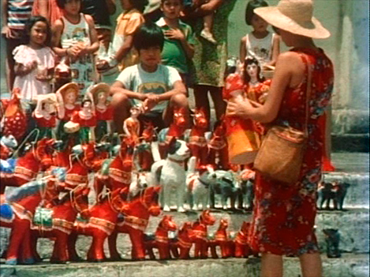
Half ethnographic documentary, half anti-capitalist fable, Turumba is the story of a village and how its traditional rituals transform through the appearance of a factory and standardised production. The village of Pakil (Philippines) holds the procession of the Lady of Sorrows as villagers dress in all their splendour for the occasion. A local sculptor and his son sell papier-mâché dogs in the street and a German tourist, associated with department stores in Munich, appears and buys them all up and commissions a large shipment. As a result, the family business becomes a large factory of child labour and, from one day to the next, the ritual time of procession is replaced by the accelerated and standardised rhythm of the factory. When a truck arrives to cart away the dogs, the child-workers wave unreservedly. The narrator’s voice concludes with the phrase: “we don’t know if the children are waving at the truck or at the devil because it’s finally leaving”.
-
Thursday, 17 February 2022 – 6pm / Second session: Thursday, 3 March 2022 – 6pm Sabatini Building, Auditorium
Kidlat Tahimik and Kidlat Gottlieb Kalayaan. Bakit Dilaw Ang Kulay ng Bahaghari? (Why Is Yellow at the Middle of the Rainbow?)
Philippines, 1981–1991, colour, original version in English and Tagalog with Spanish subtitles, 174’
Tickets—With a presentation by Kidlat Tahimik and Kidlat Gottlieb Kalayaan in the second session.
A wondrous film on contemporary Philippine history stretching across a vast compendium of ten years seen through the eyes of a child, Kidlat Gottlieb, the film-maker’s son, and an amusing and educational chat with his father. This film collage is key to understanding the Philippines today, and its influence radiates towards other decisive pictures in recent Philippine film, for instance Lav Diaz’s Evolution of a Filipino Family (2004). The film is articulated between the intimacy of the father-son relationship and the public relevance of the events it portrays, two aspects that bestow this historical epic with a personal and poetic quality. The film is split into three parts and an epilogue: I Am Frivolous Green, 1981–1983 narrates the journeys of an international film-maker through North American counterculture, with Dennis Hopper and Francis Ford Coppola, while it reflects on the third world, Ferdinand Marcos’s dictatorship and the assassination of Benigno Aquino; I Am Furious Yellow, 1983–1986 documents the yellow-coloured social tides against the dictatorship, up until the electoral triumph of Corey Aquino, reflecting on what it means to be Filipino; I Am Curious Pink, 1986–1989 revolves around the way of life of indigenous peoples in the Cordillera Administrative Region (RAC), nuclear disarmament, paramilitary groups and art movements rooted in a desire for peace; and, finally, We Are Disastrous Gray 1989–1991, which centres on the legacy of North American occupation and on efforts, real and symbolic, to rebuild the Philippines after an earthquake.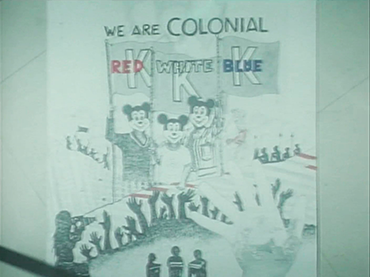
-
Friday, 18 February 2022 – 6pm / Second session: Friday, 4 March 2022 – 6pm Sabatini Building, Auditorium
Carte Blanche: José Rizal
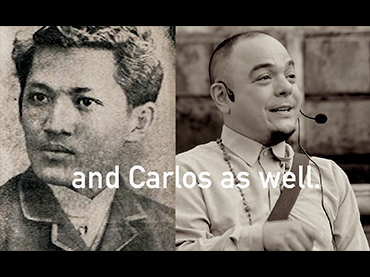
TicketsSally Gutiérrez. Camino RizalSpain, 2021, colour, original version in Spanish and English with Spanish subtitles, DA, 25’Marilou Diaz-Abaya. José RizalPhilippines, 1998, colour, original version in Tagalog with Spanish subtitles, DA, 165’—With a presentation by José Manuel Bueso Fernández, co-writer of Camino Rizal, and Kidlat Tahimik in the second.
Invited to programme a session in this film series, Kidlat Tahimik has selected two pieces on José Rizal (Philippines, 1861–1896), a man of letters, doctor and politician and author of the novels in Spanish Noli me tángere (1887) and El filibusterismo (1891). A leader of Philippine independence and educated in Madrid, he was executed at just 35 years of age in Manila by Spain’s colonial government. Camino Rizal is a documentary essay and a medium-length film that spotlights the tour by Philippine artist and performer Carlos Celdrán (1972–2019) in Madrid on the life of José Rizal and which, with the collaboration of artists and members of the Philippine community in Spain, brings the debates started by Rizal into the present. The second film is a Filipino fictional blockbuster which narrates the life of Rizal as a figure of vicissitudes, trapped between a yearning for modernisation and the need for emancipation from colonial power. As with Enrique de Malaca (1495–1521), the Philippine slave of Fernando de Magallanes, José Rizal is a source of fascination for Tahimik, his thought hovering over many of the film-maker’s reflections.
-
Saturday, 19 February 2022 – 6pm / Second session: Saturday, 5 March 2022 – 6pm Sabatini Building, Auditorium
Kidlat Tahimik. Balikbayan #1 Memories of Overdevelopment Redux VI
Philippines, 1979–2015, colour and b/w, original version in Tagalog and English with Spanish subtitles, DA, 159’
Tickets—With a presentation and performance by Kidlat Tahimik in the second session.
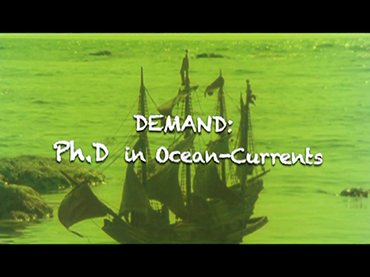
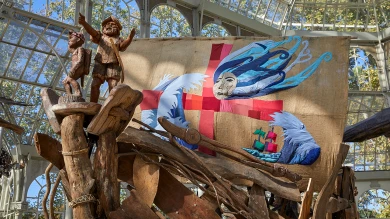
This is a film that has been re-edited repeatedly, a work in progress developed across different decades. It narrates the story of Enrique de Malaca (1495–1521), the Malayan slave and interpreter of Fernando de Magallanes who, according to different historical interpretations, could have been the first person to circumnavigate the globe, upon returning, in 1521, to the Philippine archipelago (his birthplace), before Juan Sebastián Elcano returned to Spain in 1522. Balikbayan is also a Tagalog term for foreign “guest worker”, a bureaucratic situation which has also affected Tahimik and makes him identify with the Filipino migrant community. Enrique de Malaca, therefore, constitutes the first balikbayan. The film-maker develops the idea that Enrique de Malaca, after being granted freedom by Magallanes, became a sculptor and made similar sculptures to the ones that populate Tahimik’s exhibition organised by the Museo Reina Sofía in the Palacio de Cristal. Ultimately, the film is an exploration of the epic Western narrations on “conquest” and “discovery” from the point of view of the other.
The Films of Kidlat Tahimik. Fables Against Developmentalism
![Kidlat Tahimik. Sinong Lumikha ng Yoyo? Sinong Lumikha ng Moon Buggy? [¿Quién inventó el yoyó? ¿Quién inventó el vehículo lunar?]. Película, 1978](https://recursos.museoreinasofia.es/styles/small_landscape/public/Actividades/1_snippet_0.png.webp)
Kidlat Tahimik. Sinong Lumikha ng Yoyo? Sinong Lumikha ng Moon Buggy? (Who Invented the Yo-yo? Who Invented the Moon Buggy?). Film, 1978
Held on 10 Feb 2022
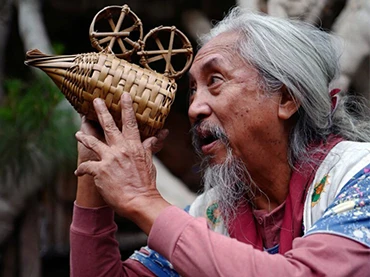
The Museo Reina Sofía organises a film series centred around Philippine film-maker Kidlat Tahimik (Baguio, Philippines, 1942) to coincide with the exhibition Kidlat Tahimik. Magellan, Marilyn, Mickey & Fr. Dámaso. 500 Years of Conquistador RockStars (Palacio de Cristal, 29 October 2021 – 6 March 2022). The programme includes five of Tahimik’s feature-length films and a “carte blanche” session for the director, as well as Werner Herzog’s film The Enigma of Kaspar Hauser (1974), Tahimik’s first appearance in film as an actor. Further, the series features debates and in-person conversations with the film-maker and his son, collaborator and leading actor, Kidlat de Guia.
Born Eric Oteyza de Guia, Kidlat Tahimik, which means “silent lightning” in Tagalog, is a linchpin of recent Philippine avant-garde film-making. Among Filipino directors of international distinction such as Khavn de la Cruz, Brillante Mendoza and Lav Diaz, he is regarded as an indisputable master of Philippine film, with his filmography also denoting the end of Third Cinema, the film movement from third-world countries that was prevalent in the 1960s and 1970s and championed “imperfect” film-making, as Cuban director Julio García Espinosa defined it, with scant resources and as a weapon of combat and emancipation from the first-world film industry and ideology. The themes of Third Cinema — inequality, the tyranny of progress and cultural and political imperialism — are also at the forefront of Tahimik’s work, yet rather than being treated in the black-and-white vein of exploited versus exploiter they are an intrinsic part of the third-world experience and life. Thus, Tahimik is one of the first film-makers to understand globalisation as a phenomenon in which these different worlds or states of development co-exist inside the same country, and to relate it to the desires and aspirations of subjects, just like the film-maker himself, who can move between the technological dream of a journey to the moon and the search for indigenous authenticity.
Kidlat Tahimik’s film-making decries forced growth and development and the cultural and social homogenisation this model implies, whilst innovatively steering clear of the social realism and factual documentary that prevailed around these issues during the 1970s, the period in which Tahimik produced his pivotal features. The film-maker overhauls the comedy genre by revamping the figure of the clown in cinema, from Charles Chaplin to Jacques Tati, a clown he plays and that experiences the contradictions of globalisation and continues to interrogate and investigate, with those accompanying him, other forms of living in the world. Because, when all is said and done, perhaps gullibility and absurdity are the best tools against developmentalism.
Curator
Chema González
Collaboration





Más actividades
Files of Tropical Revolutions
Sábado 20 y 27 de junio, 2026 - 19:00 H
The Reframing Banana Imagery series concludes with two works that condense the height and twilight of this period in history, epic sagas that cross borders and registers to embody experiences of armed struggle in the region. Cameras mix with firearms, borders between nations blur and patience reaches breaking point. This is where the tipping point lies, where the bloodshed weighs heavy and the murmurings of regional brotherhood are buried in the ground again.
Pan y dignidad (Carta abierta de Nicaragua) [Bread and Dignity (An Open Letter to Nicaragua)] recounts the historical records and process of national reconstruction in Nicaragua via the Sandinista popular uprising. Historias prohibidas de Pulgarcito (Forbidden Tales of Tom Thumb) places the camera at the heart of the El Salvador revolutionary struggle, interspersing testimonies of daily violence with the verses of the poet Roque Dalton.
Both works understand the armed revolution as an open file under construction. The insurgent brotherhood, although dissolved, still resounds in regional history.
Circling Over Exploited Bodies
Friday, 19 and 26 June 2026 - 7pm
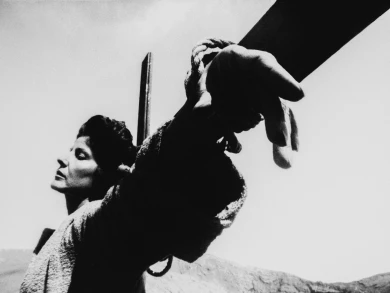
When forms of violence are inflicted on society, film responds from urgency. Images become abstract, sounds fade and the register of dissidence comes from the gut. La zona intertidal (The Intertidal Zone) is an essayistic and poetic approach to the repression of teachers in El Salvador in the 1970s — a teacher studies the biodiversity of the El Salvador coast as a boy finds a body on the same beach. A propósito de la mujer (About Women) interweaves testimonies of misery and rage towards patriarchal structures with fictional scenes of a symbolic procession through a harsh desert.
Both films understand the body as a target of violence and a territory of insurrection, a space where the blood shed by militancy and the patriarchal yoke turn pain into denouncement and existence outside the status quo into an act of political dissidence.
Central American Designation of Origin
Thursday, 18 and 25 June 2026 - 7pm
Fertile lands, farmers’ hands, rural faces. This first programme in the series Reframing Banana Imagery understands the foundations of the Central American experience from exploitation, extractivism and displacement, and from the organisation and resistance that emerged as a reaction. The four films within extend from a lyrical documentary on farmers’ solidarity to the playful subversion of the institutional format of the United Fruit Company.
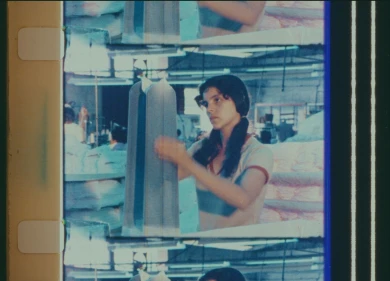
Bananeras (Banana Growers) is a combative portrait of the inhumane conditions of the American banana plantations located in Nicaragua through much of the twentieth century. Costa Rica Banana Republic is a perspicacious satire via an institutional documentary of banana production, spotlighting the extractive nature of this agro-exporting model in the 1970s. Organización Campesina (Farmers’ Organisation) frames rural resistance in Honduras from a direct depiction and lyrical documentary, while Dos veces mujer (Two Times a Woman) dissects the invisibility of the double-shift working day Central American women farmers endure: working in the countryside and working in the home. As a whole, the works here present the earth at once as a wounded body and a space of dignity.

Aesthetics of Peace and Desertion Tactics
8 October 2025 – 24 June 2026
The study group Aesthetics of Peace and Tactics of Desertion: Prefiguring New Pacifisms and Forms of Transitional Justice proposes a rethinking—through both a theoretical-critical and historical-artistic lens—of the intricate network of concepts and practices operating under the notion of pacifism. A term not without contestation and critical tension, pacifism gathers under its name a multiplicity of practices—from anti-militarism and anti-war movements to non-violence activism—while simultaneously opening urgent debates around violence, justice, reparation, and desertion. Here, pacifism is not conceived as a moral doctrine, but as an active form of ethical and political resistance capable of generating aesthetic languages and new positions of social imagination.
Through collective study, the group seeks to update critical debates surrounding the use of violence and non-violence, as well as to explore the conflict of their representation at the core of visual cultures. In a present marked by rearmament, war, genocide, and the collapse of the social contract, this group aims to equip itself with tools to, on one hand, map genealogies and aesthetics of peace—within and beyond the Spanish context—and, on the other, analyze strategies of pacification that have served to neutralize the critical power of peace struggles. Transitional and anti-punitive justice proposals will also be addressed, alongside their intersections with artistic, visual, and cinematic practices. This includes examining historical examples of tribunals and paralegal activisms initiated by artists, and projects where gestures, imaginaries, and vocabularies tied to justice, reparation, memory, and mourning are developed.
It is also crucial to note that the study programme is grounded in ongoing reflection around tactics and concepts drawn, among others, from contemporary and radical Black thought—such as flight, exodus, abolitionism, desertion, and refusal. In other words, strategies and ideas that articulate ways of withdrawing from the mandates of institutions or violent paradigms that must be abandoned or dismantled. From feminist, internationalist, and decolonial perspectives, these concepts have nourished cultural coalitions and positions whose recovery today is urgent in order to prefigure a new pacifism: generative, transformative, and radical.
Aesthetics of Peace and Tactics of Desertion, developed and led by the Museo Reina Sofía’s Studies Management, unfolds through biweekly sessions from October to June. These sessions alternate between theoretical discussions, screenings, work with artworks and archival materials from the Museo’s Collection, reading workshops, and public sessions. The group is structured around sustained methodologies of study, close reading, and collective discussion of thinkers such as Judith Butler, Elsa Dorlin, Juan Albarrán, Rita Segato, Sven Lütticken, Ruth Wilson Gilmore, and Franco “Bifo” Berardi; historical episodes such as the anti-nuclear and anti-arms race movement in Spain; and the work of artists and activists including Rojava Film Commune, Manuel Correa and the Oficina de Investigación Documental (Office for Documentary Investigation), and Jonas Staal, among other initial cases that will expand as the group progresses.

equipoMotor
Jueves alternos, 23 de octubre, 2025 - 11 de junio, 2026 - 17:30 h
El programa equipoMotor regresa en su edición 25-26 con un aire espectral y mutante para lanzar la pregunta: ¿y si el Museo fuera «un poco más Frankenstein»? Inspirándose en dicho monstruo y en todas aquellas criaturas que desafían la norma desde los márgenes, el proyecto de mediación cultural Galaxxia diseña y acompaña una edición incisiva, intergeneracional y descentralizadora, donde saberes invisibilizados, cuerpos raros y deseos molestos se entrelazan para generar nuevas formas de imaginación crítica y radical. En los sótanos y corredores del Museo —un particular laboratorio— las dudas no se esconden: son materia prima.
Así, para este curso el equipoMotor convoca a personas de todas las edades que hayan participado en ediciones anteriores de los distintos equipos del Área de Educación a recorrer el Museo como quien manipula un cuerpo abierto: descoyuntando algunas de sus categorías teóricas y artísticas —la necropolítica, lo crip-cuir, la lucha de clases, las políticas del malestar, la decolonialidad, la temporalidad cuir, la descentralización institucional o el feísmo— para articular un relato díscolo, remendado y palpitante.
El programa se estructura en bloques temáticos sobre lo freak como metodología, el trabajo cultural, la intergeneracionalidad y la diversidad territorial. Cada bloque a su vez se despliega en sesiones que combinan disparadores teóricos y estéticos, visitas a exposiciones y espacios liminales del Museo, talleres artísticos con artistas, ejercicios de curaduría audiovisual colectiva y de relatoría radiofónica, así como instancias de activación pública, mediante proyecciones de cine experimental y coloquios compartidos con el público, en complicidad con el archivo Hamaca y el Área de Cine y Nuevos Medios del Museo.
De este modo, la presente edición incorpora una particularidad: el grupo de participantes irá transformándose en un «colectivo curatorial audiovisual temporalmente autónomo», con capacidad de incidir en la programación del Museo y de abrir la conversación de equipoMotor al público general, cuestionando y expandiendo así los límites entre las cabezas que deciden, las manos que producen y los cuerpos y presencias que habitan la institución. Las personas seleccionadas en la modalidad oyente serán invitadas a las proyecciones públicas, así como a otras activaciones y momentos de apertura del equipoMotor.
Frente al relato de un museo homogéneo, pulcro y lineal, apostamos por un Museo disidente, contradictorio y lleno de vida residual. Un Museo que no tema hacerse preguntas incómodas ni mostrar sus cicatrices. equipoMotor. Un poco más Frankenstein no busca repensar el cuerpo de la institución, sino habitarlo en sus desgarros, tal como es: híbrido, inacabado, infecto, fantasmagórico… y cargado de esporas y chispas por venir.