David Lamelas

Held on 14 Jan 2005
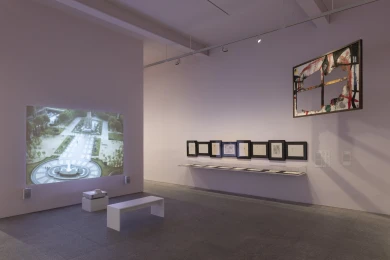
In his early works, the experience of displacement appears in his desire to represent cities in a neutral fashion, as the sum of spaces from which subjectivity seems to have been erased. A Study of Relationships between Inner and Outer Space (1969) and Time as Activity, Düsseldorf (1969) are based on an analytical approach to the urban space in which the city is seen as a set of knowledge systems, as the basis of geopolitical, economic and cultural data about which the artist is making an objective description. Later works, as different as The Invention of Dr. Morel (1999) and The Light at the Edge of a Nightmare (2002-2004), depict the artist’s emotional and creative return to Buenos Aires. In these works, space ceases to be the only protagonist; other characters emerge and the city no longer appears as a sum of spaces but as a landscape and a stage that is host to the dramatic action. While in the first works, the cities were only recognised by their titles, the abstract nature of the shots in his later works allows room for a portrait of places with emotional meaning for the artist.
Lamelas’ experience in Los Angeles at the end of the 1970s served as a moment of transition between his break with the city of his birth and his return there. In the pieces included in the third programme, made for television, the trust that his films placed in information gives way to truth understood as a game and the set as the perfect place to stage it.
At first glance, it may seem that there is no relationship between David Lamelas’ early structuralist films and his later narrative works which are imbued with a dramatic sense. However, his oeuvre as a whole constructs an architecture and set of common references that portray the artistic and living space where Lamelas contemplates his works.
Curatorship
Chus Martínez
Más actividades
International Museum Day 2026 with Radio 3
22 MAY 2026
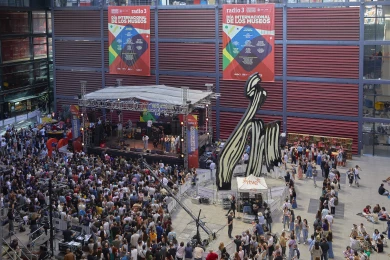
On Friday, 22 May 2026 the Museo Reina Sofía celebrates International Museum Day by way of a vibrant music programme conducted by Radio 3.
From 9am to 11pm, the Museo’s Nouvel Courtyard will host the live broadcast of Radio 3’s day-long programme —also available on a video streaming on the Radio3 website and app, on RTVEPlay and on the Museo’s social media accounts. The programme comprises more than twenty live acts, including artists such as Carlangas, Shego, Soleá Morente, Kokoshca, La Tania, La Pegatina, Pipiolas, Ángel Stanich, Triángulo de Amor Bizarro and Zahara, and many others.
With this programme the Museo Reina Sofía concludes its celebration of International Museum Day, which takes place on Monday, 18 May. Both on 18 May, from 10am to 9pm, and 22 May admission to the Museo will be free of charge.
Institutional Decentralisation
Thursday, 21 May 2026 – 5:30pm
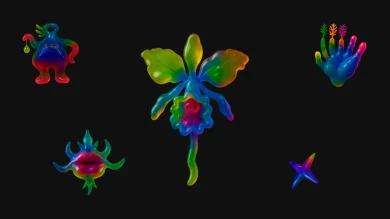
This series is organised by equipoMotor, a group of teenagers, young people and older people who have participated in the Museo Reina Sofía’s previous community education projects, and is structured around four themed blocks that pivot on the monstrous.
This fourth and final session centres on films that take the museum away from its axis and make it gaze from the edges. Pieces that work with that which is normally left out: peripheral territories, unpolished aesthetics, clumsy gestures full of intent. Instead of possessing an institutional lustre, here they are rough, precarious and strange in appearance, legitimate forms of making and showing culture. The idea is to think about what happens when central authority is displaced, when the ugly and the uncomfortable are not hidden, when they are recognised as part of the commons. Film that does not seek to be to one’s liking, but to open space and allow other ways of seeing and inhabiting the museum to enter stage.
Gerardo Mosquera: Island Thinker, Global Curator
19 MAY 2026
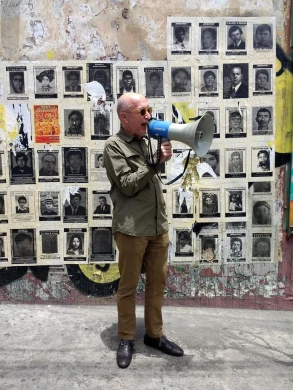
This encounter pays homage to Gerardo Mosquera (Havana, 1945), a pre-eminent curator, an essayist who has been part of key debates on decolonisation and the drifts of globalisation, a communicator and, primarily, an art critic who has managed to radically situate discourses and practices, while still taking on risks and perpetually upholding committed ethical positions.
Mosquera is one of the foremost curators internationally and was involved with the Havana Biennial from its foundation in 1984 to 1989, as well as curating pivotal shows in museums and art centres around the globe. Notable among his curatorial work is as adjunct curator at the New Museum in New York (1995–2009), the Liverpool Biennial (2006) and the exhibition It’s Not Just What You See. Perverting Minimalism (Museo Reina Sofía, 2000).
This round-table discussion, which features the participation of Gerardo Mosquerahimself and an ensemble of art critics, thinkers and artists, for instance Fernando Castro Flórez, Diana Cuéllar, Lillebit Fadraga and René Francisco Rodríguez, will approach the multifaceted and extremely fertile work of Mosquera as a renowned master curator.
Miguel Falomir, Director of the Museo Nacional del Prado, in Conversation with Museo Reina Sofía Director Manuel Segade
18 MAY 2026
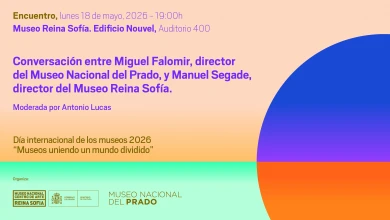
Museo del Prado and Museo Reina Sofía directors, Miguel Falomir and Manuel Segade, respectively,engage in conversation on Monday, 18 May in the Museo Reina Sofía’s Auditorium 400, in conjunction with International Museum Day 2026, the theme of which is “Museums Uniting a Dividing World”. The discussion, moderated by journalist and poet Antonio Lucas, will see the two heads of these major cultural institutions share their reflections on the role they play in today’s society.
In addition to addressing the management of art, the conversation seeks to explore in greater depth museums’ potential as meeting points to face today’s social tensions, thereby fulfilling the international mandate of this year’s edition.
The activity will be live-streamed and is available at this link.
Collection. Contemporary Art: 1975–Present
Miércoles 13 de mayo, 2026 - 19:00 h
In this lecture, Museo Reina Sofía director Manuel Segade outlines the key readings of the new presentation of the Collection on Floor 4 of the Sabatini Building. This new arrangement is framed inside an ambitious rehang that harnesses the uses of the Museo’s architecture, in a plan that will continue in 2027 with the opening of Floor 3 in the same building, culminating with Floor 2 in 2028.
The new rehang of the Collections, unveiled on 16 February 2026, sets forth a journey through contemporary art history over the past fifty years in Spain. Rather than an unambiguous narrative, the floor recounts the same period — from the Transition to democracy in Spain to the present — in three different ways, starting back at the 1970s time and again.
The exhibition route gets under way with a prologue that travels through the affections, material culture and institutionalism of the Spanish Transition, serving as a starting point for the three routes that follow. The first, A History of Affect in Contemporary Art, advances from affective systems in artmaking linked to the second wave of feminism, arriving at grief as a tool to interpret new realities. The second route, The Powers of Fiction: Sculpture, New Materialisms, and Relational Aesthetics, is conceived as a sculpture gallery in which the artworks engage with the public, focusing on the performance side of the discipline. This route shows, among other aspects, how Spanish sculpture has gained significant international visibility since the 1980s, with women artists playing a key role in this display. The third route, A New Framework. The Institution, the Market, and the Art that Transcends Both, zooms in on the origins of the Museo and its role in the process of art’s institutionalisation in Spain. In May 1986 the Centro de Arte Reina Sofía opened, occupying the first and second floors of the former hospital: the forty years that have elapsed since then enable a re-evaluation of the effects of the Museo on Spanish art and art on the institution.
This talk strengthens the goal of socially integrating the narratives produced by the Museo at a time when the Collections are under permanent review.