Held on 22, 29 Mar 2025
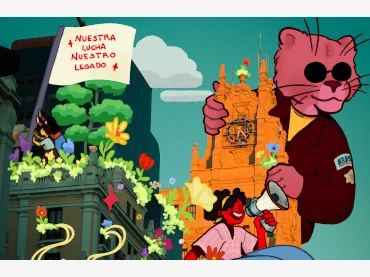
SOS Racismo Madrid and the Alliance for Solidarity, together with Museo Situado, present the fifth edition of the Festival of Anti-racist Culture, in conjunction with the International Day for the Elimination of Racial Discrimination. Through “artivism” and community creative processes, this encounter seeks to raise awareness of hate speech, call for anti-racist action and spotlight the agenda of racialised people. The festival, with the title Cooltura Futura, champions a change of paradigm in which diversity and anti-racism are its cornerstone. The encounter encompasses participatory spaces such as workshops, debates, ballroom and concerts, and features the participation of migrant, racialised and gender and sexual-affective dissidences. The activities that unfold embrace beauty, identity and community love and eschew the narrative of pain to build narratives of future, enjoyment and social transformation, demonstrating that art not only condemns inequalities but also opens pathways from pride, hope and collective strength.
The full programme is available here (in Spanish).
Collaboration
Madrid City Council and Teatro Accesible
Accessibility
Agenda
sábado 22 mar 2025 a las 12:00
Presentation of projects for the Artivism against Racism competition, by the Alliance for Solidarity
Locutorio Itinerante (Itinerant Phone Box) is an installation made by Cindy Paola Martínez-Acosta that draws inspiration from the phone boxes that were prevalent in the 1990s. Via a series of short stories simulating telephone calls from the daily lives of migrant people, the stress is placed on challenges and strong bonds of alliance.
Sonoridades y corpografías sagradas (Sacred Sounds and Corpographies) is a proposal by the Migrantes Transgresorxs collective and is based on a series of encounters and workshops conducted by young people. By way of podcasts, distant memories and histories of resistance interweave to create a combative counter-discourse to racist, xenophobic and LGBTI-phobic narratives.
¿Qué Mi(g)ras? Fanzine, by the ¿Qué Mi(g)ras? collective, which originates from the Artivism Laboratory, puts forward different artistic techniques to make the work of migrant and racialised artists visible. On this occasion they will present a fanzine.
Location: Nouvel Building, Protocol Room
Capacity: 150 people
sábado 22 mar 2025 a las 12:00
Get Ready with Peruvian transvestite Gad Yola
This session sees Gad Yola guide attendees so they can connect with the political history of drag and its relationship with the anti-racist struggle. Through examples and performances, it prompts a reflection on aesthetics and the drag/transvestite/transformist body. During her make-up, hairstyling and dressing process, she questions the Eurocentric and hegemonic canons of beauty, sharing her experience to foster an anti-racist drag culture in Spain while she offers beauty advice on their dismantling.
Accessible activity
The activity is wheelchair accessible and has accessible WCs.
The first row is reserved for people with hearing or visual disabilities.
Location: Nouvel Building, Protocol Room
Capacity: 150 people
sábado 22 mar 2025 a las 13:00
Encounter: Anybody Walking? Dissident Bodies that Inhabit the Ballroom
Perla Naomi, Cacao Díaz and Brad Scott in Conversation
Ballroom culture originated in the USA as a necessary radical act by the LGBTQIA+, Black and Latin community to respond to discrimination. Crystal LaBeija, a Black trans woman, created the first ballroom for Black and Latin people, creating a safe space for the community, in contrast to today, where ballroom culture opens its doors to all bodies, but without forgetting their origins. In this conversation, representatives from the ballroom community in Spain and part of the Kiki House of Laveaux speak about dissident bodies that inhabit it and their roles — those that perform, those that gaze and those that inhabit the ballroom beyond the dancefloor and categories.
Accessible activity
The activity is wheelchair accessible and has accessible WCs.
The first row is reserved for people with hearing or visual disabilities.
Teatro Accesible also supports the activity through the loan of hearing aid devices: personal magnetic induction loop systems and sound amplification with earphones.
Location: Nouvel Building, Protocol Room
Capacity: 150 people
sábado 22 mar 2025 a las 14:00
Community Lunch with Aires de Alondra
A collaborative, community-centred culinary experience conducted by Aires de Alondra. The initiative puts forward gastronomy and culture as a tool for dialogue and care.
Location: Nouvel Building, Protocol Room
Capacity: 150 people
sábado 22 mar 2025 a las 16:00
Queens at the Museum Kiki Ball
A ball is an event created within ballroom culture, with different categories of competition encompassing fields such as dance (voguing, dance-offs), fashion and the fashion show (runway, fashion killah, labels...), face and body (face, body realness) and others such as Black Hair Magic and Commentator vs Commentator. The aim is to create a space where anybody can express themselves on stage.
It sees in the spring as the Queens come together in the Museo Reina Sofía to celebrate another night of bodies that inhabit the ballroom. The space, replete with artworks, also demonstrates how you can break away from avant-gardes and stereotypes and how you can be the masterpiece that enraptures beholders.
Categories: Black Hair Magic, Fashion Killah, Washed Face, Trans Men Realness/FemmeQueen Realness with Posing, Commentator vs Commentator, OTA (Open to All) Runway, Walk for Your Sistah!, OTA (Open to All) Performance, Vogue for Your Sistah! and Dance-off.
Presented by: Perla Naomi, MC QueenBitch 007 and DJ Jourdan McDaniel Laveaux.
Jury: Godmother Koko Anunnaki, Cori Angels and Cacao Laveaux.
Accessible activity
The activity is wheelchair accessible and has accessible WCs on the third floor (access with lift).
Chairs are available for people who require them.
Location: Nouvel Building, Lobby
Capacity: 200 people
sábado 29 mar 2025 a las 11:30
Encounter: Creative Processes, with Noelia Cortés
Writer Noelia Cortés reflects on the power of the imagination, story and the word to transform common imaginaries, and how the Roma people have their own voice, despite the gaze of others constantly making them create from antagonism.
Accessible activity
The activity is wheelchair accessible and has accessible WCs.
The first row is reserved for people with hearing or visual disabilities.
Teatro Accesible also supports the activity through the loan of hearing aid devices: personal magnetic induction loop systems and sound amplification with earphones.
Location: Nouvel Building, Protocol Room
Capacity: 150 people
sábado 29 mar 2025 a las 12:00
Presentation of projects for the Artivism against Racism competition, by the Alliance for Solidarity
Locutorio Itinerante (Itinerant Phone Box) is an installation made by Cindy Paola Martínez-Acosta that draws inspiration from the phone boxes that were prevalent in the 1990s. Via a series of short stories simulating telephone calls from the daily lives of migrant people, the stress is placed on challenges and strong bonds of alliance.
Sonoridades y corpografías sagradas (Sacred Sounds and Corpographies) is a proposal by the Migrantes Transgresorxs collective and is based on a series of encounters and workshops conducted by young people. By way of podcasts, distant memories and histories of resistance interweave to create a combative counter-discourse to racist, xenophobic and LGBTI-phobic narratives.
¿Qué Mi(g)ras? Fanzine, by the ¿Qué Mi(g)ras? collective, which originates from the Artivism Laboratory, puts forward different artistic techniques to make the work of migrant and racialised artists visible. On this occasion they will present a fanzine.
Location: Nouvel Building, Protocol Room
Capacity: 150 people
sábado 29 mar 2025 a las 16:30
Situated Tours of the Collection
Tours of the Collection conducted by mediators from the Aissatou Ndiaye School of Situated Mediation.
The situated tours are life journeys through the Museo Reina Sofía Collection, whereby situated mediators seek to appeal to the desires and needs of migrant communities. Mediation is understood as a space of knowledge production and a vehicle for welcoming anti-racist and decolonial gazes that enrich museological narratives.
Accessible activity
Wheelchair loans and folding cane seats are available to the public
Location: Sabatini Building, rooms of the Collection. Meeting point: Sabatini Building, Main Entrance, Information Desk
Capacity: 40 people
sábado 29 mar 2025 a las 19:00
Conciertos de Pleneros del Exilio y Justicieros de la Cumbia
This session places music at the heart of a proclamation of Latin American and Caribbean culture: preserving its musical community roots and transmitting a cultural legacy of rhythm and dances.
Accessible activity
The activity is wheelchair accessible and has accessible WCs.
Seats are available for those who need them.
Accessible activity with vibrating backpacks provided by Teatro Accesible, with prior request by filling out a form from SOS Racismo Madrid.
Location: Sabatini Building, rooms of the Collection. Meeting point: Sabatini Building, Main Entrance, Information Desk
Capacity: 40 people
Participants
Aires de Alondra is a cultural association and family initiative that uses gastronomy and culture as tools for dialogue and care.
The ¿Qué mi(g)ras? collective came into being in 2024 from the Alliance for Solidarity’s Artivism Laboratory and puts forward different art techniques to grant visibility to the work of migrant and racialised artists.
Noelia Cortés is a poet and essayist. Her most recent publications include the poetry collection Del mar y la muerte (Editorial Cicely, 2024) and the essay La higuera de las gitanas (Ediciones en el mar, 2022), which analyses the deep-rooted anti-Romani sentiment in spaces such as feminism, culture, the media and language. Her latest work has been as a creative advisor on the documentary Farruquito, premiered in 2025.
Cacao Díaz is an artist of African descent whose practice spans different live-art and stage disciplines, constructing narratives and vibrations through the body that draw inspiration from experiences as a migrant and trans body. Díaz’s relationship with ballroom culture connects to affective communities of sexual dissidences and migrants, while the artist’s creative research focuses on recovering the stolen body, Afro-descendent rituals, transvestite fiction and performances of the body.
The Aissatou Ndiaye School of Situated Mediation is a project fostered by the Museo Situado assembly and the Museo Reina Sofía’s Tentacular Museum and Education Departments, in collaboration with intercultural mediator Hanan Dalouh Amghar. Its objective is for the Museo to be a more accessible space that is mindful of the demands of the community of which it is part, geographically and affectively, understanding mediation as a space of knowledge production and a vehicle for welcoming anti-racist and decolonial gazes which enrich the narratives of the Museo’s Collections. The Situated Mediators run visits to the Museo which appeal to the desires and needs of its communities and conduct them in Spanish and other languages such as Wolof, Bengali, Darija, Arabic and French.
Justicieros de la cumbia is a music band which plays a mix of cumbia, rock, reggae, funk, with a dash of madness, creating a stage-shaking musical experience.
Cindy Paola Martínez-Acosta is a political scientist and researcher.
Migrantes Transgresorxs formed in 2009 as a focal point of the LGBTI+ social movements of migrant, refugee and racialised people in Spain. The intersectional collective fights to preserve racialised lives and enhance the construction of migrant communities through encounters, workshops, actions and campaigns on human, social and cultural rights.
Perla Naomi is a trans-Indigenous-migrant artist. With a degree in Fine Arts from the Complutense University of Madrid, she works inside the framework of ballroom, opening new paths from an anti-racist, decolonial, trans and queer discourse. She has shown her work at Matadero Madrid, the Centro de Arte Dos de Mayo, La Parcería, the Centro de Cultura Contemporánea Condeduque, the Festival Ciudad Bailar, the SOS Racismo’s Anti-racist Festival in Puerta del Sol in 2019, the Boiler Room Festival, CoruFest, Noche Blanca Oviedo and Don’t Hit a la Negrx, among other art events.
Pleneros del exilio are a Madrid-based Puerto Rican band who come together to preserve idiosyncrasy. The rich musical rhythms that characterise Puerto Rico are the main vehicle they use to proclaim Latin American and Caribbean culture, taking it to stage and street.
Brad Scott was born in Venezuela and currently lives in Madrid. For the past four years, Scott has been actively involved in the ballroom community, most notably as the Princess in the House of Laveaux, as well as performing, during this period, in renowned spaces like La Casa Encendida, Matadero Madrid and Noche Blanca Oviedo.
Youssef Taki is an artist and researcher whose work encompasses, from different approaches, an understanding of migratory processes and colonial and post-colonial occurrences, analysing how they impact the present and daily life. Taki is part of the Al’Akhawat collective.
Teatro accesible is a pioneering project centred on integrating accessibility measures into theatre in Spain. It was set up in 2011 with the support of the Vodafone Foundation, the Centro de Rehabilitación Laboral Nueva Vida and the technology and accessibility company Aptent. Their approach centres on adapting plays by incorporating subtitling, audio description and sign language, as well as creating inclusive experiences such as touch tours and accessible talks for people with vision impairments.
Gad Yola is a multidisciplinary artist who, through the practice of drag, creates a critical discourse around heteronormativity and European whiteness. Born in Lima and raised in Madrid, she works to disrupt and rethink institutions, exhibition rooms and Spanish pop culture. She holds a degree in Audiovisual Communication from the Universidad Carlos III in Madrid and employs music and audiovisual production to express her opposition to racism and LGBTI phobia.


Más actividades
![Isabel Coixet, 100 Years and You Everywhere [100 años y tú en todos los sitios], 2026, película](https://recursos.museoreinasofia.es/styles/small_landscape/public/Actividades/2.diseminar-mundo.jpg.webp)
John Berger and Isabel Coixet. Continued Ways of Seeing
Thursday, 17 September 2026 at 7pm
Ways of Seeing (1972) is one of the most revolutionary television series on art history, the museum and contemporary critical culture. Across four episodes, an articulate, enthusiastic John Berger unpacks the relationships between classical art through the gaze and new technology, the nude and feminism, the oil painting and commodity fetichism, advertising and consumerism. In essence, a level of critical commitment only comparable to its capacity for dissemination. Unsurprisingly, the series, and the book that would distil it, continues to forge vocations. This session sees art historians Alberto López Cuenca and Modesta Di Paola carry out an analysis of Berger’s audiovisual work, placing the stress on episodes one and four of the series. In the first episode, Berger reflects on the connection between the act of seeing, looking and being in light of new technology, such as the film camera. At the same time, it analyses how the culture of reproduction is turning paintings into messages or fragments of communication while stressing the importance of silence when observing historical paintings. In the fourth and final episode, he introduces advertising as a new iconic-verbal language that shares certain principles with the message of oil painting as a luxury item.
The session opens with the premiere of a filmic letter from Isabel Coixet, one of Spain’s most internationally acclaimed directors, to John Berger, with whom she maintained a long friendship and deep admiration. The short film is testament to the ubiquitous and long-lasting presence of the author of Ways of Seeing, even after his death in 2017.
![Chantal Akerman, Woman Sitting after Killing [Mujer sentada después de matar], 2001, instalación. Museo Reina Sofía](https://recursos.museoreinasofia.es/styles/small_landscape/public/Actividades/chantal-akerman-mujer-sentada-despues-matar.jpg.webp)
On Your Screen: Art History and the Museum Facing the Audiovisual Challenge
18, 19 SEP 2026
The conference On Your Screen: Art History and the Museum Facing the Audiovisual Challenge sparks debate around the transformations of art history and museum space upon embracing the audiovisual format. Its starting point is John Berger’s emblematic television series Ways of Seeing (1972), a landmark in the democratisation of art-historical discourse. In the series, Berger illustrated how the transfer of a work such as Goya’s Los fusilamientos del 3 de mayo (The Third of May 1808 or the Executions) from museum gallery to home TV screen completely changed the viewer’s experience, allowing the image to travel to straight to the viewer.
In the twenty-first century, this screen-based ecosystem has expanded exponentially, with museums not only physically integrating screenings and devices into their galleries— following in the wake of many exhibitions on the moving image — but also deploying complex virtual strategies. Equally, numerous en vez de a multitudeof historians, students and creators use digital platforms to circulate their ideas and projects. This audiovisual shift opens access to ignored materials and democratises knowledge, as well as challenging traditional hierarchies and the interpretive authority of institutions. The conference, promoted by the research project ATLAS AV: The Audiovisualisation of Art History and the Museum, seeks to analyse this vast audiovisual material, its archives, and its capacity to transform the memory of art.
Godard and Miéville: Time and Ruin
Friday, 18 September 2026 - 7pm
Inside the framework of the conference On Your Screen: Art History and the Museum Facing the Audiovisual Challenge, this film series sets forth three critical visions of the museum via three sessions featuring the works of John Berger, Jean-Luc Godard and Anne-Marie Miéville, Ariella Azoulay, Alan Resnais and Chris Marker, Kwate Nee-Owoo, and the premiere of short films by Isabel Coixet and La Vulcanizadora (Maria Rojas Arias and Andrés Jurado). In classical theory, the museum gives the world meaning; it contains fragments of the past, granting them a history, a narrative that explains preterite time and the present. Today, there is an implicit assumption that this function hides and legitimises forms of power, yet what if the museum, instead of explaining the world, multiplied it through radical ideas, silenced periods and repressed subjects? Such is the approach of the film-makers and artists in this film season.
In 1972 the writer John Berger opened the landmark television series Ways of Seeing with an iconoclastic gesture: slicing Sandro Botticelli’s painting Venus and Mars (1485) in London’s National Gallery. A transgressive act that recalls contemporary attacks on the museum by dissident youth and with which Berger, after revealing it was a reproduction, sought to ignite debate around the idea of an original artwork and a copy. In this, the hundredth anniversary of his birth, the first session pays homage to one of the great art writers of the twentieth century. Starting with a review of Berger’s audiovisual work by art historians Alberto López Cuenca and Modesta Di Paola, the series begins with the premiere of 100 Years and You Everywhere (2026), an unreleased short film by Isabel Coixet composed as a beautifully crafted letter to Berger, and continues with an analysis of fragments of Ways of Seeing in relation to the museum and contemporary art.
The second session screens two medium-length films by Jean-Luc Godard and Anne-Marie Miéville on time, ruin and museum. In The Old Place. Small Notes Regarding the Arts at Fall of 20th Century (1999), both film-makers consider what remains of that “old place”, the museum, at the close of a century of wars and totalitarianism, and ask whether it should be more of a legend or desire than a place. This same driving principle leads Godard to build his own imaginary museum in Reportage amateur (maquette expo) (2006), a rickety toy museum which, paradoxically, contains the great film-maker’s full power of thought on history and images.
Finally, the third session explores one of the major challenges of recent years: the decolonisation of the museum, the recognition of its link to imperialist discourses of power and the need to situate a new silenced or repressed subject at the centre of the Western narration of history. Under the title Museums and Restitution, it includes the film Undocumented. Unlearning Imperial Plunder (2019), by theorist Ariella Azoulay, Statues Also Die, by Alan Resnais and Chris Marker (1953), Kwate Nee-Owoo’s You Hide Me (1970) and the first screening of the short film Quinto verso, parte de Tonada (Fifth Verse, Part of Tonada), by La Vulcanizadora (Maria Rojas Arias and Andrés Jurado), filmed at the Museo de América in Madrid.
![Ariella Azoulay, Un-documented. Unlearning Imperial Plunder [Indocumentados. Desaprendiendo el saqueo imperial], 2019, película](https://recursos.museoreinasofia.es/styles/small_landscape/public/Actividades/5.diseminar-mundo.jpg.webp)
Museums and Restitution
Saturday, 19 September 2026 - 7pm
Centuries of plundering, decades of amnesia, years of living with unmitigated extractivist power… Does a museum, as we know it, have a raison d'être in a postcolonial society?
This session expounds the operations of the museum as a colonial machine, while putting forward ideas, in narration, for a more just, equal and inclusive institution of the future via society’s marginalised and minority voices. The session begins with the international premiere of Quinto verso, parte de Tonada (Fifth Verse, Part of Tonada), which presents a vision of the Quimbaya Collection (fifth and sixth centuries CE) from the Museo de América in Madrid. It is constructed with the voices and chants of Wayúu mourners and guides, not only as a way of reinstating the role of these gold idols — anthropomorphic figures of men and women used as vessels in ritual practices — but also to imagine that what must be exhibited is not the gold itself. It is the ritual’s own chant. In the classic film You Hide Me (1970), Ghanaian film-maker Kwate Nee-Owoo accesses the British Museum’s collection of African art, located in the building’s basement, to question the meaning behind a museum plundering and nullifying. A fine exercise of first-person institutional critique screened for the first time in Spain. Almost seventy years since Resnais and Marker made Statues Also Die (1953), a reflection on the aura-bearing value of the museum opposite the identity-based and cultural belonging of African art, theorist Ariella Azoulay films the same statues again at the Musée du Trocadéro (today the Musée du Quai Branly), which survive and wait to be reunited with their people. Azoulay, whose wholly original undertaking is a lesson to the museum of the future, connects the forced migration of these sculptures with the mass transit of people crossing borders artificially imposed by the same system that has plundered their culture.
The School of Transformative Institutionalism and Local Organisation
From 21 to 24 September 2026
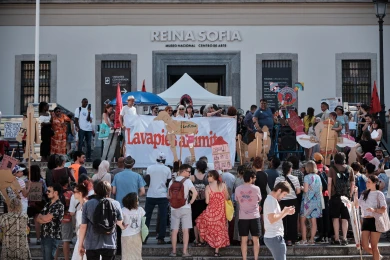
The School of Transformative Institutionalism and Local Organisation (S.T.I.L.O.) is a programme of joint learning and join strategy which sets in motion a process for the exchange of questions, methodologies and experiences between cultural organisations. The overall aim is to create, circulate and prototype tactics, tools and collective knowledge on institutional practices that open new channels for defending culture and advocating structural transformation in divergent geographical contexts.
The project is part of the Laboratorio de Institucionalidad Compartida (The Laboratory of Shared Institutionalism, LIC), a space for the Museo Reina Sofía’s research, work and advocacy centred on developing, experimenting with and systemising practices, protocols and tools which contribute to a fairer and more liveable cultural ecosystem.
For many years now, so-called infrastructural critique in museums questions material, legal and economic infrastructures, among others, as well as the forms of solidarity and practices required to sustain the cultural ecosystem. By approaching current debates, S.T.I.L.O. raises questions on the ways in which organisations define and interpret their practices, organise their relations and respond to the social contexts in which they operate.
The school gathers four cultural organisations that work via different institutional models – scale, contexts, conditions, different working models — with the goal of pooling common strategies and tools of organisation, advocacy and relationships with local communities.
The programme is conceived as a collaborative process with the participation of Arika, La Revuelta, BAK Basecamp and The Tentacular Museum (Museo Reina Sofía) and is structured around preparatory online sessions and an in-person seminar in Madrid.
S.T.I.L.O. is an activity framed inside the working strand of Situated Organisations from L'Internationale’s Museum of the Commons project, which reflects on the role of museums and art organisations as actors within complex social networks and ecosystems, with a view to exploring new ways to democratise institutions and make them more open, inclusive and useful.