Lucrecia Martel. Our Land
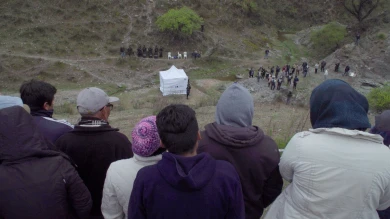
Lucrecia Martel, Nuestra tierra (Our Land), 2025, film
Held on 18 Apr 2026
Nuestra tierra (Our Land, 2025) is Argentinian film-maker Lucrecia Martel’s first documentary and her most recent work. The film focuses on the legal case surrounding the murder, in 2009, of Javier Chocobar, a member of the Los Chuschagasta Indigenous community, who was killed while resisting the forced displacement of ancestral land located in northern Argentina, territory hiscommunity has inhabited and farmed for centuries.
Drawning on fragments of the above-mentioned trial, which took place in 2019, as well as a meticulous reconstruction of the history of Los Chuschagasta since the seventeenth century, Martel decries how colonial violence, far from being a relic of the past, underlies current political and social structures and ends in the mistreatment and systematic invisibility of Indigenous peoples.
Lucrecia Martel is a director and screenwriter widely regarded asone of the most relevant film-makers in the twenty-first-centuryLatin American cinema. To date, she has directed four feature-length films: La ciénaga (The Swamp, 2001), Zama (2001), La niña santa (The Holy Girl, 2004) and La mujer rubia (The Blonde Woman, 2008), all of which have been awarded at film festivals, including recognitions in the Official Selection at Cannes. Accross her work Martel explores the complexities of an Argentina shaped by the political and social crisis of the 1990s and by the burden of a colonial past, which she translates into her own visual language of documentary, paradoxically offsetting it against fiction. As Martel asserts: “What I do is all lies, all artifice. I don’t believe in the truth and, if there is any effect of truth in my films, then it’s a miracle”.
These notions, the germinating material of her films, enable a reflection on how the tactics of fiction and imagination, materialized thought creativity, can function as powerful means of resisting the erasure of memory and as a tactic of reparative justice. This line of thought also underpins READ Madrid. The Festival of Books and Ideas, which frames the screening of this film.
READ Madrid is a space of encounter for critical and experimental voices in the sphere of literature and theory. The festival gathers a transatlantic framework of voices related to writing, art and publishing, whose practices challenge hegemonic frameworks of knowledge production and make room for performative and cinematic forms as expanded forms of research.
Inside the framework
Organised by
Museo Reina Sofía
Accessible activity
This activity has two spaces reserved for people with reduced mobility
Agenda
sábado 18 abr 2026 a las 16:30
Lucrecia Martel. Nuestra tierra (Our Land)
Argentina, USA, Mexico, France, the Netherlands and Denmark, 2025, DCP, colour, sound, original Spanish version with English subtitles, 122’
Más actividades
Exile and Alienation
Saturday 30 May and 6 Jun, 2026 - 18:00 H
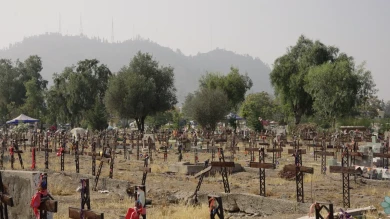
In the years of the Popular Unity Government in Chile, three young film-makers, Marilú Mallet, Valeria Sarmiento and Angelina Vázquez, went to the offices of Chile Films to present a film project. This session screens three films which convey the three directors’ experience of exile. In Dos años en Finlandia (Two Years in Finland), Angelina Vázquez depicts the social and working conditions of Chileans exiled in the Nordic country. The fictional work Lentement, directed by Marilú Mallet, follows a young Chilean exile around spaces of Montreal blighted by nostalgia and political rage. In Huellas (Fingerprints), Valeria Sarmiento returns to Chile to explore the memory of violence inflicted by Pinochet’s military dictatorship. The session culminates in a talk with the three directors, gathered here for the first time.
From North to South and South to North
Sunday 31 May and Friday 5 June, 2026
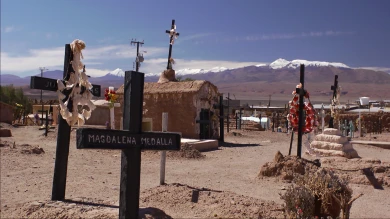
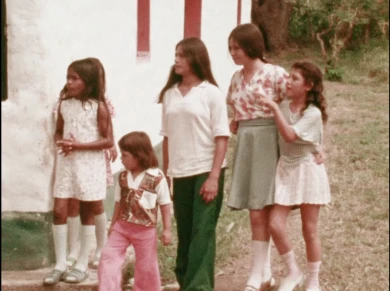
In a kind of road movie, Marilú Mallet travels across her native Chile after forty years of exile. The journey is an exploration of the dynamism of national identity, leading the film-maker to return to questions previously explored in her filmography and to search for new forms of filming the encounter between body and landscape.
Dear Americas
Friday 29 May and 5 June, 2026
In these films, Marilú Mallet travels to Solentiname, in Nicaragua, and Andahuaylillas, in Peru, to paint a portrait of communities which resist the severity of forced industrialisation. In Solentiname, the focus is on the poet and priest Ernesto Cardenal’s founding of a Christian, poetic and revolutionary utopia, while in Andahuaylillas, a town close to Cuzco, Mallet explores the multiple layers of Andean culture.
A Poetics of the Subject
Thursday 28 May and 4 June, 2026
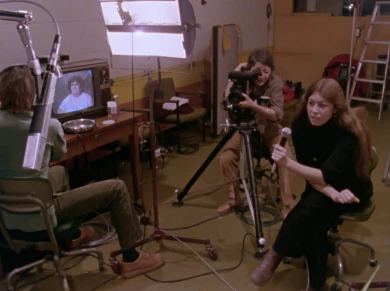
In the tension between documentary and fiction, between the rawness of a tragic political present and narrative escape, lies the truth of the exile’s condition. In Journal inachevé (Unfinished Diary, 1982) Marilú Mallet experiments with her own subjectivity, moving from affirmation to doubt. In Double Portrait (2000), María Luisa Señoret paints her daughter Marilú, who records the process. In this circular relationship, the film-maker constructs a poetics of the portrait as something perpetually unfinished, a process of exploration in which memory, identity and political history merge to become blurred.
Institutional Decentralisation
28 MAY 2026
This series is organised by equipoMotor, a group of teenagers, young people and older people who have participated in the Museo Reina Sofía’s previous community education projects, and is structured around four themed blocks that pivot on the monstrous.
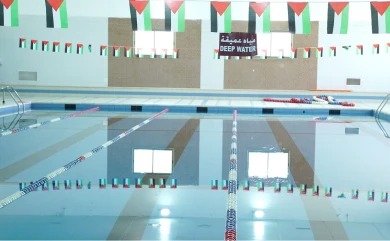
This fourth and final session centres on films that take the museum away from its axis and make it gaze from the edges. Pieces that work with that which is normally left out: peripheral territories, unpolished aesthetics, clumsy gestures full of intent. Instead of possessing an institutional lustre, here they are rough, precarious and strange in appearance, legitimate forms of making and showing culture. The idea is to think about what happens when central authority is displaced, when the ugly and the uncomfortable are not hidden, when they are recognised as part of the commons. Film that does not seek to be to one’s liking, but to open space and allow other ways of seeing and inhabiting the museum to enter stage.