Carta(s). Unfinished Timelines
Held on 01 Dec 2020
Carta(s) is a series of publications with which the Museo Reina Sofía seeks to broaden, through the publishing format, some of the debates that take place in the institution and beyond its walls, granting visibility to initiatives propelled or embraced by the Museo’s different lines of research and its artistic and critical productions.
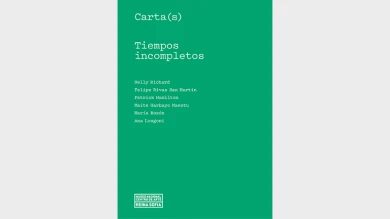
The fifth edition of the series, Unfinished Timelines, compiles some of the proposals and reflections framing the first edition of the Politics and Aesthetics of Memory Chair — a programme which sets out to revise the way in which the shadows of an unfinished past are cast on the living fabric of the present through art, theory, critique and politics.
The presentation of this new publication takes the form of an encounter between the authors of the texts (Maite Garbayo, Ana Longoni, Nelly Richard and María Rosón), sociologist and feminist archivist Javiera Manzi and artist and cultural critic Marcelo Expósito. A conversation on the echoes of feminist re-readings around the processes of transition in Spain and Latin America, placing the accent on the subjective footprints that shape identity, sexuality and gender, and the emergence (past and present) of women as collective subjects of political expression and social transformation, as vectors of commotion for new historical re-writings.
This edition includes texts by Nelly Richard, “Memories of Neoliberalism in Chile: Unfinished Pasts, Presents and Futures” and “Unfinished Timelines (Chile, First Neoliberal Laboratory”), also the title of the document-based show held in Space D of the Museo’s Library and Documentation Centre (2019), which exhibited a series of works by artists Felipe Rivas San Martín and Patrick Hamilton and with a photo reportage that is also part of the edition. Furthermore, there are texts by Maite Garbayo, “The Aesthetic Staging of Protest: Bodies, Alienations and Transmission”; María Rosón, “Mother Ghosts. A Feminist Approach to Recent Memory in Spain”; and by Ana Longoni, “Handkerchiefs: How the Mothers Became Feminists and Feminists Found the Mothers”.
Force line
Politics and Aesthetics of Memory
Organised by
Museo Reina Sofía
Participants
Marcelo Expósito is an artist, cultural critic, writer and teacher. He has lectured at academic institutions that include Universitat Pompeu Fabra, the University of Castilla-La Mancha, and the National University of La Plata, among others, and has published work as an author and editor — individually or in collaboration — of twenty books and monographs, for instance Producción cultural y prácticas instituyentes (Traficantes de Sueños, 2008), Walter Benjamin, productivista (consonni, 2013), Conversación con Manuel Borja-Villel (Turpial, 2015) and Discursos plebeyos. La toma de la palabra y de las instituciones por la gente común (Icaria editorial, 2019). The most recent exhibitions displaying his work in Spain and internationally most notably include: Playgrounds. Reinventing the Square (Museo Reina Sofía, Madrid, 2014), Hard Gelatin. Hidden Stories from the ‘80s (MACBA, Barcelona, 2017), Arte para pensar la nueva razón del mundo (BIENALSUR, Buenos Aires, 2017), Colonia apócrifa. Notas para un cine postcolonial (MUSAC, León, 2017), A World Where Many Worlds Fit (6th Taipei Biennial, 2018) and Tearing Up the Past (Tate Liverpool, 2019).
Maite Garbayo is a researcher and writer who holds a PhD in Art History from the University of the Basque Country and an MA in Art History from the National Autonomous University of Mexico (UNAM). A member of the Southern Conceptualisms Network, she studied her post-doctoral degree at UNAM’s Institute of Aesthetic Research with the project Intersubjetividad y transferencia: hacia una estética de lo incalculable (Intersubjectivity and Transfer: Towards an Aesthetic of the Incalculable). Her research focuses on the intersections between feminist theory and contemporary art and visual culture, with an emphasis on performance practices, the body and performativity. Her first book, Cuerpos que aparecen: performances y feminismos en el tardofranquismo, was published by consonni in 2016.
Ana Longoni is a writer and researcher who has propelled, since its foundation, the Southern Conceptualisms Network and is the current director of the Museo Reina Sofía’s Public Activities Area. With a PhD in the Arts from the University of Buenos Aires (UBA), she specialises in the relations between art and politics in Argentina and Latin America from the middle of the 20th century to the present day. Her books most notably include Del Di Tella a Tucumán Arde (Eudeba, 2000), Traiciones. La figura del traidor en los relatos acerca de los sobrevivientes de la represión (Norma, 2007) and Vanguardia y revolución. Arte e izquierda en la Argentina de los sesenta-setenta (Ariel, 2014). She has also overseen exhibitions such as: Roberto Jacoby. Desire Rises from Collapse (Museo Reina Sofía, Madrid, 2011), Losing the Human Form. A Seismic Image of the 1980s in Latin America (Museo Reina Sofía, 2012; Museo de Arte de Lima, 2013; Museo de la Universidad Nacional de Tres de Febrero, Buenos Aires, 2014), and Oscar Masotta. Theory As Action (MUAC, Mexico, 2017; MACBA, Barcelona, 2018; and Parque de la Memoria, Buenos Aires, 2018–2019). Since 2019, she is the director of Museo Reina Sofía’s Public Activities Area.
Javiera Manzi Araneda is a sociologist, archivist and militant feminist who is currently coordinator of the Southern Conceptualisms Network. She explores the crossroads between graphic art, social movements, feminisms and internationalist networks in Chile and Latin America, and was part of the curatorial team in Poner el Cuerpo. Llamamientos de arte y política en los años ochenta en América Latina (Museo de la Solidaridad Salvador Allende, Santiago de Chile, 2016) and ¡A la Calle Nuevamente! Gráfica y movilización estudiantil en Chile (Casa de las Américas, La Habana, 2018). Moreover, she is part of the 8M Feminist Coordination and Brigada Laura Rodig, two collectives from Santiago de Chile. She has also published work in different national and international journals and magazines and is co-author of the books Resistencia Gráfica. Dictadura en Chile: APJ y Tallersol (LOM, 2016). She has recently written about the present struggles in the feminist movement and the uprising in Chile in the books Por una constitución feminista (Libros del Pez Espiral, 2020), La Internacional Feminista (Tinta Limón / Traficantes de Sueños, 2020) and De la Marcha y el Asalto (Tiempo Robado, 2020).
Nelly Richard is a theorist and essayist. She founded and directed Revista de Crítica Cultural (The Magazine of Cultural Critique, 1990–2008), and was director of the MA in Cultural Studies from the University of Art and Social Sciences (ARCIS) from 2006 to 2013. She has written a broad number of national and international publications, for instance Margins and Institutions. Art in Chile Since 1973 (Metales pesados, 1986, re-printed in 2008); Masculine/Feminine. Practices of Difference(s) (Francisco Zegers Editor, 1993); The Insubordination of Signs. Political Change, Cultural Transformation, and Poetics of the Crisis (Cuarto propio, 1994); Cultural Residues. Chile in Transition (Cuarto propio, 1998); Fracturas de la memoria. Arte y pensamiento crítico (Siglo Veintiuno, 2007); Feminismo, género y diferencia(s) (Palinodia, 2008), Eruptions of Memory. The Critique of Memory in Chile, 1990–2015 (Universidad Diego Portales, 2010); Crítica y política (Palinodia, 2013); and Diálogos latinoamericanos en las fronteras del arte (Ediciones upd, 2014). Moreover, she curated the Chilean Pavilion at the 56th Venice Biennale in 2015 under the title Poetics of Dissent: Paz Errázuriz – Lotty Rosenfeld, and, since 2019, she has coordinated the force line Politics and Aesthetics of Memory and the Chair under the same title framed inside the Museo Reina Sofía’s Public Activities Area and Study Centre.
María Rosón holds a PhD in Art History from the Autonomous University of Madrid. She works as a post-doctoral researcher at the University of Valencia, in the research group REPERCRI (the Spanish acronym for the Contemporary Representations of Perpetrators of Mass Crimes), in which the feminist perspective intersects with the study of aggressors. Her lines of research are centred on material culture, specifically in twentieth-century Spain, at the crossroads with gender studies and studies of memory. In addition to articles and book chapters, she has published, with the publishing house Cátedra, Género, memoria y cultura visual en el primer franquismo (materiales cotidianos, más allá del arte). As co-editor, she has also worked on the following monographs: Poetry, Film, Humour. Narratives of Exception in the Years of Autarky (Museo Reina Sofía, 2017) and Queer Barbarisms and Other Proparoxytones (Bellaterra, 2017).
Más actividades
![Video-Nou/Servei de Vídeo Comunitari, Ocaña. Exposició a la Galería Mec-Mec [Ocaña. Exposición en la Galería Mec-Mec], 1977, película](https://recursos.museoreinasofia.es/styles/small_landscape/public/Actividades/coleccion-proyectada-7.png.webp)
Daily Matter
Thursday, 23 April and 14 May 2026 — 7pm
Time, light, vision. What is an image? How does an image make us see the world? First, hypnosis, a reset: Paulino Viota’s Duración (Duration, 1970), the portrait of a clock face over sixty seconds. Next, a window into a slightly altered reality: Javier Aguirre’s Objetivo 40º (40 Degree Lens, 1968–1970). A minimum intervention that inspires a session considered as successive immersions in blocks of time, as well as a journey that starts from the intimacy of a candle, the movement of a car around abandoned peripheries and the traces of anti-Franco protestors, with night falling to the emotive, profound and sharp voice of Ocaña. Now in 1990, the journey ends at other street protests, those articulated by the Agustín Parejo School collective owing to the housing problem in Málaga. As Javier Aguirre states: “It is not about achieving the objective. It is about demystifying it”.
Framed inside The Collection Screened is the programme Present Time: Insurgent Images, curated by Luis López Carrasco, a key film-maker with a distinguished international career. The works in the programme, selected from the Museo’s film and video collection, interlink projects that are conceptual, refined, systematic — as an X-ray of their time in history — with firebrand domestic and activist films, comprehending different political emergencies from the second half of the twentieth century in Europe and Latin America. These works are viewed in light of a genealogy of revolt which buries its roots in the nineteenth century.
Economy of Hate
18 ABR, 9 MAY 2026
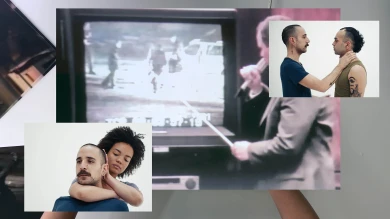
Economy of Hate features one sole work, Oído Odio (2021) by artist Diego del Pozo Barriuso. The piece combines television and media archive materials, recordings with performers with explicitly queer corporalities and 3D animations, combining in a strikingly fluid dialogue. The title alludes to a notion developed by the artist concerning the materiality with which hate circulates and the way it escalates. Setting out from the idea that hate is an affect which gains more value the more it circulates, the video shows the evolution from television to mobiles, expounding how the change of technological paradigm has made viral the fact of being in contact more than ever with explicitly violent images.
Inside the framework of The Collection Screened, a programme rooted in the institution’s film, video and moving image holdings, the Museo invites Laura Baigorri, one of the leading specialists in video art, to approach specific aspects related to identity, self-representation and the body within the Museo’s audiovisual collection since the 1990s.
![Dias & Riedweg, Casulo [Crisálida], 2019, película](https://recursos.museoreinasofia.es/styles/small_landscape/public/Actividades/desafios-cine-2.png.webp)
Other Voices in Us All
17 ABR, 8 MAY 2026
A session which starts from a subtle corporeal challenge that prompts a confrontation with reason from sensibility and emotion, both of which are linked to a difference in mental health or spiritualism. It opens with a beautiful and strange short film entitled A família do Capitao Gervásio (2013), by Tamar Guimarães and Kasper Akhøj, set in a small town in inland Brazil, where around half the inhabitants are psychic mediums whose work centres on community healing. The second piece, Dias & Riedweg’s Casulo, is the outcome of a participatory project with a group of patients from the Institute of Psychiatry at the Universidad Federal de Río de Janeiro. The video bears witness to the development of their routines after hospitalisation and captures their ideas and impressions about different aspects of life, revealing the division between territories of reason and madness in their daily existence.
Inside the framework of The Collection Screened, a programme rooted in the institution’s film, video and moving image holdings, the Museo invites Laura Baigorri, one of the leading specialists in video art, to approach specific aspects related to identity, self-representation and the body within the Museo’s audiovisual collection since the 1990s.
Mediations of the Archive: Art, Community, and Political Action
Tuesday 7, and Thursday 23, April, 2026 – 17:00 h
The online seminar Mediations of the Archive: Art, Community, and Political Action, curated by Sofía Villena Araya, examines the role of archival practices in caring for, dignifying, and activating memory in Central America. As part of the Cáder Institute for Central American Art’s first line of research, driven by the question “What Art Histories does Central America produce?”, this seminar proposes an approach to the archive as a mediator that articulates relationships between art, community, and political action, while engaging with the historiographical questions raised by their intersections.
Although the proposal is not limited to discussions of the Central American isthmus, it is framed by the particular conditions under which memory has been constructed in the region. Central America is a territory vulnerable to natural and geological disasters, marked by political violence exercised by authoritarian states and fragile institutions, a persistent colonial and imperial legacy, and the social fragmentation resulting from these factors. It is also a context in which the archive does not necessarily refer to a specific place —such as a building or documentary collection— nor does it primarily follow the protocols of a discipline such as archival science. Rather, the seminar explores how the archive operates, through art, as a dispositif that forges connections, generates forms of belonging, and opens spaces for political action.
The encounter unfolds across two sessions: the first focuses on archival practices addressing questions of memory, violence, and war; the second examines community-based practices surrounding queer and sex-dissident archives. In the face of the systematic destruction of memory, the archival practices discussed in these sessions demonstrate how the archive emerges in other spaces and according to different logics. Within this framework, the proposed space for exchange and research explores the role of art as a productive medium for constructing archives through images, affects, intimacy, performativity, the body, orality, and fiction, as well as through other materialities that challenge the centrality of the document and of writing.
Lucrecia Martel. Our Land
Saturday, 18 April 2026 – 4:30pm
Nuestra tierra (Our Land, 2025) is Argentinian film-maker Lucrecia Martel’s first documentary and her most recent work. The film focuses on the legal case surrounding the murder, in 2009, of Javier Chocobar, a member of the Los Chuschagasta Indigenous community, who was killed while resisting the forced displacement of ancestral land located in northern Argentina, territory hiscommunity has inhabited and farmed for centuries.
Drawning on fragments of the above-mentioned trial, which took place in 2019, as well as a meticulous reconstruction of the history of Los Chuschagasta since the seventeenth century, Martel decries how colonial violence, far from being a relic of the past, underlies current political and social structures and ends in the mistreatment and systematic invisibility of Indigenous peoples.
Lucrecia Martel is a director and screenwriter widely regarded asone of the most relevant film-makers in the twenty-first-centuryLatin American cinema. To date, she has directed four feature-length films: La ciénaga (The Swamp, 2001), Zama (2001), La niña santa (The Holy Girl, 2004) and La mujer rubia (The Blonde Woman, 2008), all of which have been awarded at film festivals, including recognitions in the Official Selection at Cannes. Accross her work Martel explores the complexities of an Argentina shaped by the political and social crisis of the 1990s and by the burden of a colonial past, which she translates into her own visual language of documentary, paradoxically offsetting it against fiction. As Martel asserts: “What I do is all lies, all artifice. I don’t believe in the truth and, if there is any effect of truth in my films, then it’s a miracle”.
These notions, the germinating material of her films, enable a reflection on how the tactics of fiction and imagination, materialized thought creativity, can function as powerful means of resisting the erasure of memory and as a tactic of reparative justice. This line of thought also underpins READ Madrid. The Festival of Books and Ideas, which frames the screening of this film.
READ Madrid is a space of encounter for critical and experimental voices in the sphere of literature and theory. The festival gathers a transatlantic framework of voices related to writing, art and publishing, whose practices challenge hegemonic frameworks of knowledge production and make room for performative and cinematic forms as expanded forms of research.