-
April 16, 23 and 30; May 14 and 28, June 4, 11, 18 and 25; July 2, 2015
Poetry
Friendship Generation: Zahra Ahmed Hasnaui and Bahia Mahmud Awah
April 16, 23 and 30; May 14 and 28, June 4. 7:00 p.m.
Legna. Round-table discussion with Bahia Mahmud Awah, Juan Carlos Gimeno and Juan Ignacio Robles
June 4. 8:00 p.m.
Ismael Diadié Haidara
June 11, 7:00 p.m.
Abdul Hadi Sadoun
June 18, 7:00 p.m.
Mahmud Sobh
June 25, 7:00 p.m.
Bahira Abdulatif
July 2, 7:00 p.m.The recitals, with the participation of Sahrawi, Mauritanian, Iraqi and Palestinian poets, explore the experience of diaspora and travel, where the relationship between cultures is a way of understanding and verbalising the world. The first six, conducted by two Sahrawi poets from the Friendship Generation, Zahra Ahmed Hasnaui and Bahia Mahmud Awah, conclude with a round-table discussion on Legna, the title shared by a documentary film and a book/anthology on historical and contemporary Sahrawi poetry. This poetry in Spanish and Hassaniya joins together a repertoire that stretches from Africa to Europe, passing though Latin America. In connection with this diversity, there are further contributions from Ismael Diadié Haidara, from Mauritania, Mahmud Sobh from Palestine and Bahira Abdulatif and Abdul Hadi Sadoun, both from Iraq.
-
May 2, 9 and 23; June 6, 2015
Music
Pilili Narbona. Resonating Bodhicitta
May 2, 7:00 p.m.Aziza Brahim Trio
Voice: Aziza Brahim
Guitar: Kailou Sangare
Bass: Guillem Aguilar
May 9, 7:00 p.m.DJ K-Sets. The Feminine Voice in the Arab Musicassette
May 16, 7:00 p.m.Luis Delgado. An Introduction to Andalusi Music
Conference-concert
May 23, 7:00 p.m.The concerts are approached through syncretism and movement without borders in a racially mixed and collective musical experience. Sahrawi-born Aziza Brahim, one of the most original and recognisable voices in West African music, performs a concert with guitar and percussion, where spoken anguish merges with contemporary jazz and flamenco. Luis Delgado, meanwhile, puts forward a journey through the musical history of Al-Andalus and its survival and transformation in North Africa. Pilili Narbona compiles and divulges the heritage of Sahrawi haul music, with Berber, Arabic and Sudanese influences that are only known orally. And to conclude, a session with DJ K-Sets, who explores the transformation of the uses of ethnographic music in metropolitan pop music, incorporating the tradition of scenes from contemporary musical sub-cultures to offer Pan-Arabic pop.
-
April 17; May 7 and 21; June 5 and 19; July 3 and 17; August 7 and 21, 2015
Tea ceremony
The music is also accompanied by other activities based around key aspects of Sahrawi culture, featuring the voice and presence of the actual community. One example is the tea ceremony, with participation from El Mohtar, Minan Mohamed, Beia Larosi, Cheja Abdalahe, Bushra Ahmed, Kefila Salama, Alia Sidati, Mailida Mohamed and Fatimetu Mohamed Embarec from the National Union of Sahrawi Women, who will all enter into dialogue with visitors in order to explain the most intimate sides of desert culture. Moreover, at 17:00 every day Pilar Millán’s audio piece Agua de té (Tea Water), recorded in the Mujeb Bedouin tent in the 27 de febrero Sahrawi refugee camp, will play.
-
May 8, 15, 22 and 29
Stories and songs under the Bedouin tent
Elsewhere, Liman Boicha and Gabriel Flores, a Sahrawi poet and Mexican musician with ties to the culture, will conduct a family activity based on oral tradition: a theatre conversation between a musician looking for his lost camel and a poet preparing a tea ceremony in his Bedouin tent, revealing the most relevant aspects of Sahrawi culture in an event where music, poetry and comedy inhabit this unique space.
-
April 28; May 6, 13, 20 and 27; June 3, 10, 17 and 24, 2015
Conferences
Boaventura de Sousa Santos and María Paula Meneses. Epistemologies of the South: The Colonial Library and the Challenges of Post-Colonial Studies
April 28, 7:00 p.m.
Isaías Barreñada and Laura Langa. Minorities and Nomadism in Diaspora
May 6, 7:00 p.m.
Jose Antonio Rodríguez Esteban. The Invention of Territory. Spanish Cartography in Africa
May 13, 7:00 p.m.
Rocío Medina. Sahrawi Women: Power, Territory and Body from Decolonial Feminism
May 20, 7:00 p.m.
Eloy Martín Corrales. Images of Exoticism. Visual Culture and Maghrebi Identity in Spain
June 3, 7:00 p.m.
Juan Carlos Gimeno. Lessons from Epistemic Decolonisation in Latin America
June 10, 7:00 p.m.
Ildefonso Barrera Martínez. Sahara: its Plants and its People. Sahrawi Ethnobotany
June 17, 7:00 p.m.
Bernabé López García. The Vitality of Social Movements to the North and South of the Mediterranean
June 24, 7:00 p.m.The conferences are devised as a series of dialogues from renowned historians, anthropologists and theorists seeking new ways of constructing decolonial knowledge, from epistemological calls from the south, dissolving dominator-dominated logics, to considering another globalisation, where relationships and diversity replace a unique concept of the world. They bring together diverse schools of thought, such as epistemologies of the south by Boaventura de Sousa Santos and Maria Paula Meneses, or the decolonial shift grouped around Duke thinkers, such as Ramón Grosfoguel; from Spanish Arabism, with Bernabé López García, to the examination of visual culture and its ideology via Eloy Martín Corrales. These conferences endeavour to provide a response to the question: Can we imagine a post-capitalist future? Perhaps this idea, facing the collapse of a hegemonic world system, has to look outside of Europe – perhaps this post-capitalist outlook is specifically post-Western and post-Europe.
-
April 16 - June 4, 2015
Film
Carlos Velo y Enrique Domínguez Rodiño. Romancero marroquí
1939, 35 mm, b/w, 85’. Courtesy of Filmoteca Española
Ricardo Franco. El desastre de Annual
1970, 16 mm, b/w, 82’. Courtesy of Films 59
Antoni Muntadas. On Translation. Miedo/Jauf
2007, video, colour, 52’. Courtesy of the artist and HAMACA
Escuela de Formación Audiovisual Abidin Kaid Saleh. Patria dividida
2013, video, colour, 63’. Courtesy of FiSahara
Escuela de Formación Audiovisual Abidin Kaid Saleh. El-Aarifa
2014, video, colour, 22’. Courtesy of FiSahara
Pilar Monsell. África 815
2014, HD video, colour, 66’. Courtesy of the artistAn archive of a series of films that look to reflect the different aspects of the historical relationship between Spain and North Africa: from the formation of stereotypes to a review of the colonial experience in recent video, including critical reflections and experiences of autonomy by Sahrawi culture itself. Noteworthy films among the selection include Romancero marroquí (1939) – produced without recognition by the renowned avant-garde film-maker Carlos Velo, who participated in the Spanish Pavilion in Paris, alongside Guernica – about the dawn of Spanish Fascism in North Africa; El desastre de Annual (1970) by Ricardo Franco, evoking the tragic episode of the Moroccan War, which serves as a parable for disenchantment in the final stages of the Franco Regime; Antoni Muntadas’s On Translation. Miedo-Jauf (2007), a documentary essay on the perception of migration to both sides of the Strait; and the recent África 815 (2014) by Pilar Monsell, a documentary exploration of homosexuality in the Spanish Legion displaced to Africa and sexual exploitation in North Africa.
A continuous session during opening hours
Activities in the Tuiza
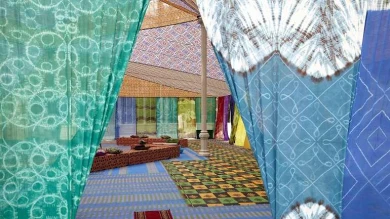
Held on 16, 17, 28 Apr, 02, 08, 09, 15, 16, 22, 23, 29 May, 05, 19 Jun, 03, 17 Jul, 07, 21 Aug 2015
This programme of activities, which relates Sahrawi culture to a broader social and cultural framework, aims to become tuiza, a space that reimagines an alternative possible geography, where its centres are not metropolises of financial power, but narrations and accounts of a periphery that lives on in expressions of identity and cultural contamination. The Palacio de Cristal architecture was originally designed to house an exhibition of exotic plants brought in for the General Exhibition on the Philippine Islands in 1887. The plants were brought from the same country, still a Spanish colony at that time, displaying an image where the ideals of industrial modernity manifested the command and control of the world from Europe. Tuiza, which is the name of this Sahrawi tent, but also means “collective work” in Hassaniya, on the other hand, attempts to decolonise the imagination and articulate knowledge and sensibilities that circulate from south to south, without stopping at the homogenisation of the centre or the Western narrative; Tuiza formulates an epistemology of possible souths, understanding, and paraphrasing Boaventura de Sousa Santos, these “souths” as new processes of production, knowledge and relationships that originate from those places and peoples that have suffered discrimination under an unequal, racist and sexist order.
The Palacio de Cristal, transmuted into a refuge against the designs of an inefficient and unfair system-world, becomes a new space of relations, bringing a horizon of change and learning to life and, giving a leading role to oral and immaterial culture through words, music and image: poetry recitals, education events and concerts multiply these narratives and introduce other forms of community living; conferences call upon a broad academic community to deal with the decolonisation of territory, bodies and knowledge, as well as the survival of the imagery of exoticism and its current confrontations; and finally, it becomes a living archive through film, spanning from the clichéd and stereotypical image in historical Spanish colonial film to recent critical reviews.
Participants
Zahra Ahmed Hasnaui
A poet, and member and founder of the Sahrawi writers’ group Friendship Generation. She studied at the Faculty of Philology at the Complutense University of Madrid and has participated in contemporary Sahrawi poetry anthologies Aaiún, gritando lo que se siente (Aaiún. Shouting what you Feel, Universidad Autónoma de Madrid, 2006) and Um Draiga (Diputación de Zaragoza, 2007).
Isaías Barreñada
A political scientist specialised in the Arab world and Spanish foreign policy. He is also a professor of International Relations at the Complutense University of Madrid and was coordinator of the Education Programmes and Publications in the Casa Árabe-International Institute of Arab and Muslim World Studies. He is co-author and coordinator of books such as Conflictos en el ámbito internacional: aportaciones para una cultura de paz (Conflicts in the International Sphere: Contributions for a Culture of Peace CIDEAL, 2008) and Redes sociales en Marruecos. La emergencia de la sociedad marroquí (Social Media in Morocco. The Emergence of Moroccan Society, Icaria, 2004).
Ildefonso Barrera Martínez
A botanist and professor in the Department of Plant Biology at the Complutense University of Madrid. He is co-author of the book Sahara Occidental: plantas y usos (The Western Sahara: Plants and Uses, Monografías de Botánica Ibérica nº4, 2007), which is set up as an ethnobotanical study of the Western Sahara, analysing the uses and customs of the Sahrawi people in relation to their plant resources.
Bahira Abdulatif
A Baghdad-born Iraqi writer and translator, she is the founder of El Aleph 2000, a publishing house for the dissemination of Arab culture. She was a professor in the Spanish department of the University of Baghdad and Associate Professor in the Department of Arab and Islamic Studies at the Autonomous University of Madrid. She has published in Arabic (poetry, prose and essays) and translated works by Rafael Alberti (Best Translated Book of the Year in Iraq), Jorge Luis Borges, José Carlos Mainer and José Antonio Maravall, among others, into the same language.
Limam Boicha
A poet and member of the Friendship Generation group. His verses have been published in the books Los versos de madera (The Wooden Verses, Puentepalo, 2004) and Ritos de jaima (Rites of the Bedouin Tent, Bubisher, 2012) and included in the anthologies Bubisher (Puentepalo, 2003), Añoranza (Amigues del Poble Sahrauí de les Illes Balears, 2003) and Treinta y Uno — Thirty One (Sombrerete, Sandblast, 2007).
Aziza Brahim
A Sahrawi-born singer, her music stems from traditional Sahrawi sounds and West African percussion and features flamenco, jazz and blues rhythms. In 2000 she settled in Spain, where she formed the Gulili Mankoo band, recording two self-produced records: the EP Mi Canto (2008) and the album Mabruk (2012). Her latest production is entitled Soutak (Glitterbeat, 2014).
Luis Delgado
A musician, composer and music producer who researches early and traditional music. He has worked with eclectic groups, predominated by the search for the Eastern roots of Western music, such as Ibn Baya, dedicated to Andalusi music, Finis Africae, to ethnic fusion, and Babia, which fuses rhythms from the East and West. He has released over thirty records as a solo artist and has participated in more than one hundred and fifty recordings as a musician and producer. Moreover, he has composed the music for theatre productions and film scores.
Ismail Diadié Haidara
A historian and writer who is responsible for the conservation of Fondo Kati, the most important collection of Andalusi documentary heritage outside of Spain, made up of over 3,000 manuscripts his family took to Timbuktu (Mali) after being expelled from Toledo in 1468. Due to the recent events of 2012, he was exiled to Spain, his current country of residence.
Enrique Domínguez Rodiño
A journalist, writer and film producer. In 1933 he was named the administrative director and managing director of the film production company CEA (Cinematografía Española Americana), acting as vice chairman from 1935 to 1965. In 1939 took charge of finishing off the production of the documentary Romancero marroquí, shot by Carlos Velo, in which he appeared credited as “Production manager. Plot, screenplay and dialogue”.
DJ K-Sets (Manuel Sánchez Laliga)
Manuel Sánchez Laliga, who works under the name DJ K-Sets, develops an archive project that reviews different types of contemporary Arab music – the recollection and classification of diverse underground and at the same time traditional phenomena in popular urban music. Among other centres and festivals, he has performed at La Mar De Músicas (Cartagena), Recyclart (Brussels), together with Awesome Tapes From Africa, and the Sala Apolo (Barcelona).
The Abidin Kaid Saleh Audiovisual School
An education project promoted since 2010 by the Sahara International Film Festival. It came into being after the initiative “Film for the Sahrawi People” and aims to bring the study of film and video closer to young people in Sahrawi refugee camps.
Gabriel Flores
A Mexican-born artist linked to Sahrawi culture, he is the external director of Enamus, a Sahrawi music school in the 27 de febrero refugee camp. He also participated in the recording of Mariem Hassan’s record El Aaiun Egdat (2012), playing flute, saxophone and percussion.
Ricardo Franco
A director, screenwriter, actor and film producer who belonged to the renowned “School of Argüelles”, together with Luis Revenga and Antonio Drove, among others. El desastre de Annual (The Annual Disaster, 1970), his first feature-length film, came up against strong censorship and was withdrawn after appearing at the Benalmádena Festival in 1971. He directed, among other films, Pascual Duarte (1976), Después de tantos años (After So Many Years, 1994) and La buena estrella (The Lucky Star, 1997).
Juan Carlos Gimeno
A Doctor of Philosophy and Head Professor of Anthropology at the Autonomous University of Madrid, where he was in charge of the Department of Social Anthropology and Spanish Philosophical Thought. Currently, he is head researcher of the RDI project Consolidación y declive del orden colonial español en el Sahara Occidental (The Consolidation and Decline of the Spanish Colonial Order in Western Sahara, Ifni-Tarfalla-Sahara: 1956-1976). Among his distinguished publications is Transformaciones socioculturales de un proyecto revolucionario: la lucha del pueblo Saharaui por la liberación (Socio-cultural Transformations of a Revolutionary Project: The Sahrawi People’s Struggle for Liberation Colección Monografías, nº 43, 2007).
Abdul Hadi Sadoun
A writer, hispanicist and editor as well as an essayist and contributor in numerous Spanish and Arab cultural journals. He has also written a number of publications, in both Arabic and Spanish, for instance: Siempre todavía (Always Still, Ed. Olifante, 2010), Campos del extraño (Fields of the Stranger, Alhulia, 2011) and the anthology of modern Iraqi poetry in the Spanish language La Maldición de Gilgamesh (The Curse of Gilgamesh, Tempestad, 2003). He has also translated Jorge Luis Borges, Antonio Machado, Octavio Paz, Rafael Alberti, Vicente Aleixandre, Federico García Lorca, and other writers, into Arabic.
Laura Langa
An anthropologist specialised in cooperation, development and humanitarian action. She is a researcher at the University Institute of Women’s Studies at the Autonomous University of Madrid and the Institute for the Study of Conflicts and Humanitarian Action. She has also taught in the International Development Cooperation Master’s Degree, specialising in the analysis of the concept of resilience in development cooperation and humanitarian action.
Bernabé López García
A lecturer on the History of Contemporary Islam in the Department of Arab and Islamic Studies at the Autonomous University of Madrid and director, at the same institution, of the Workshop of International Mediterranean Studies. He has also published, among other titles, Historia y memoria de las relaciones hispano-marroquíes (The History and Memory of Hispano-Moroccan Relations), with Miguel Hernando de Larramendi (Ed. del Oriente y del Mediterráneo, 2009), and El mundo arabo-islámico contemporáneo. Una historia política (The Contemporary Arab-Islamic World. A Political History, Síntesis, 1997).
Bahia Mahmud Awah
A founding member of the group of Sahrawi writers in Spanish, the Friendship Generation. He is also Honorary Professor of Social Anthropology at the Autonomous University of Madrid. He has published various books of poetry and essays, including Literatura Del Sahara Occidental. Breve Estudio (Literature of the Western Sahara. A Brief Study, Bubok, 2008) and the book of poems Versos refugiados (Refugee Verses, Universidad de Alcalá de Henares, 2007) and El sueño de volver (The Dream of Returning, CantArabia, 2012).
Eloy Martín Corrales
A historian and professor at the Pompeu Fabra University (Barcelona). The outcome of his interest in the study of Spanish colonialism in North Africa and Hispano-Muslim relations in the period between the 16th and 20th centuries can be found in: Marruecos y el colonialismo español (1859-1912). De la guerra de África a la penetración pacífica (Morocco and Spanish Colonialism (1859–1912). From the African War to Pacific Penetration, Bellaterra, 2002) and La imagen del magrebí en España. Una perspectiva histórica, siglos XVI-XX (The Maghrebi Image in Spain. A Historical Perspective from the 16th Century to the 20th Century, Bellaterra, 2002).
Rocío Medina
A Professor in the field of Philosophy of Law at the Pablo de Olavide University (Seville). She is the author and coordinator of, among others, Activismo académico en la causa saharaui. Nuevas perspectivas críticas en Derecho, Política y Arte (Academic Activism in the Sahrawi Cause. New Critical Perspectives on Law, Politics and Art), together with Ramón Luis Soriano (Aconcagua Libros, 2014) and the article “Mujeres Saharauis, Colonialidad del Género y Nacionalismos: un acercamiento a partir de los feminismos decoloniales” (“Sahrawi Women, Gender Coloniality and Nationalism: An Approach from Decolonial Feminism”, Relaciones internacionales: Revista académica, 2014).
María Paula Meneses
A professor and researcher in the Centre of Social Studies at the University of Coimbra (Portugal) and Doctor of Anthropology at Rutgers University (New Jersey, USA). She is also the author of numerous articles and essays, including the noteworthy As Guerras de Libertação e os Sonhos Coloniais, together with Bruno Sena Martins (Almedina, 2013) and Epistemologies of the South, with Boaventura de Sousa Santos (Akal, 2014).
Pilar Monsell
A film-maker. Her first production was entitled Distancias (Distances, 2008), followed by the short films Pan, trabajo y libertad (Bread, Work and Freedom 2012) and Vualcão (Volcano, 2013). África 815 (2014) is her first feature-length film, and received critical acclaim at major independent film festivals. Besides her work as a director she is also an editor and a teacher in documentary film.
Antoni Muntadas
An artist considered one of the pioneers of media art and conceptual art in Spain. Between 1990 and 2014 he was professor of the MIT Program in Art, Culture and Technology (ACT) in Cambridge, Massachusetts. He has exhibited internationally at museums such as New York’s MoMA, Museo de Arte Moderno in Buenos Aires and Museu de Arte Moderna, Rio de Janeiro, as well as participating in Documenta X in Kassel and other exhibitions. Between 2011 and 2012 the Museo Reina Sofía held Entre/Between, a retrospective devoted to his work.
Pililli Narbona
A teacher, producer, singer, guitarist and composer. She combines her study of philosophy with her training in song, guitar, percussion and dance and is a member of the Seville group Moakara. She is in charge of the creation of the music laboratory África no se vende, in a continuous process of gestation, which features different African musicians such as Sirifo Kouyate, Luali Said and Malick Diaw. She presented this project at the World Social Forum in 2011 and has presented it in the last three editions of the Festival ARTifariti in Western Sahara.
Juan Ignacio Robles
An anthropologist and Professor in the Department of Social Anthropology at the Autonomous University of Madrid. He also works in the Grupo de Antropología Audiovisual del Instituto Madrileño de Antropología and is a researcher in the Grupo de Estudios Coloniales: Sáhara Occidental. He is co-author of the documentary Legna: Habla el verso saharaui (Legna: the Sahrawi Verse Speaks, Antropología en Acción ONGD and Ministerio de Cultura RASD, 2014), winner of the first Fisáhara Award in 2014.
Jose Antonio Rodríguez Esteban
A Professor of Geography at the Autonomous University of Madrid and part of the research group Estudios poscoloniales: Sahara Occidental-EPSO, from the same institution. He is author of numerous publications, which include the books España en África. La ciencia española en el Sáhara Occidental, 1884-1976 (Spain in Africa. Spanish Science in Western Sahara, 1884–1976, Ediciones Calamar, 2011) and Geografía y colonialismo (Geography and Colonialism, UAM, 1996).
Mahmud Sobh
A poet and lecturer of Arab and Islamic Studies at the Complutense University of Madrid. Born in Safad (Palestine), in 1965 he settled in Spain to write his doctoral thesis on classical Andalusi poetry. He has participated in numerous poetry recitals and has written, among numerous other titles, Historia de la literatura árabe clásica (The History of Arab Classical Literature, Anaya, 2002), El diván de la poesía árabe oriental y andalusí (The Divan of Eastern and Andalusi Arab Poetry, Visor, 2012) and the book of poetry Mar Blanco (White Sea, La Discreta, 2007).
Boaventura de Sousa Santos
A philosopher, professor, Doctor of Sociology of Law at Yale University (USA) and lecturer of Sociology at the University of Coimbra (Portugal), where he is also director of the Centre of Social Studies and the 25 de Abril Documentation Centre. He is the author of key studies such as Epistemologies of the South (Akal, 2014), together with María Paula Meneses, and Conocer desde el Sur: Para una cultura política emancipatoria (Knowing from the South: For an Emancipatory Political Culture, Plural, 2008).
Carlos Velo
A Spanish director, producer and screenwriter exiled to Mexico as a result of the Spanish Civil War. As a producer he was not credited with the feature-length documentary Romancero marroquí (1938-39) – after shooting the film he decided to take up exile, which meant it was finished by Enrique Domínguez Rodiño. In Spain he had previously directed important documentaries such as Almadrabas (1934), La ciudad y el campo (City and Country, 1934) and Felipe II y El Escorial (1935). Among other films, he directed Torero (Bullfighter, 1956) and Pedro Páramo (1969) in Mexico and also produced Nazarín (1958) with Luis Buñuel.

Más actividades
![Blake Edwards, The Party [El guateque], 1968, película](https://recursos.museoreinasofia.es/styles/small_landscape/public/Actividades/ciclocine-piscinas-14.jpg.webp)
Blake Edwards. The Party
Thursday, 20 August 2026
In The Party, actor Hrundi V. Bakshi (Peter Sellers) is mistakenly invited to a glamorous dinner party in Hollywood. His curiosity and two left feet lead to one funny mishap after the other. During the soiree he consoles Michèle, a young actress who has been fired by her producer, and the chaos gathers momentum when Bakshi accidentally opens a retractable floor, making the guests fall into a swimming pool. A small hippie-style elephant gatecrashes the party, brought by a group of young people, and Bakshi asks the guests to wash the elephant as it is a sacred animal in his country. The house fills with soap suds, culminating in a wackily chaotic party.
When Stanley Kubrick was once asked who Peter Sellers was, he replied: “There is no such person as Peter Sellers”. The Party is one of the most widely recognised comedies in the history of film, its director Blake Edwards and the English actor making an entertaining critique of a fading conservative society. The cultural revolutions of the 1960s fit into the container of a choppy swimming pool: people from high society, an elephant, a Russian ballet, waiters, beatnik youth… similar to Sellers’s own identity: an empty vessel that can be refilled. In the film, Edwards tapped into the ingenious actor’s innate improvisation and the swimming pool as a container for revolutionary intent.
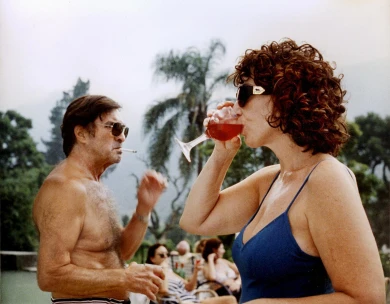
Lucrecia Martel. La ciénaga (The Swamp)
Viernes 21 de agosto, 2026
A couple of families spend the summer in a country cottage. The relationship between them exposes a crisis. The alcoholism of Mecha (Graciela Borges) and Gregorio (Martín Adjemián) becomes clear, leading to a drift in the education of their children and impacting relationships of respect and affect. Weariness expresses the lackadaisical environment.
In La ciénaga Lucrecia Martel approaches the decadence of a middle-class Argentinian family. The pool of dirty, stagnant water reflects the economic and social collapse of a whole country, yet reflects more than economic crisis as it becomes a murky well feeding off the pain of those living in the house. An erstwhile space of joy, the swimming pool becomes a reflection of adult depression, resulting in apathy. And the children, especially the girls, seem to be the only people awake in this drift. Barring a flicker of unawareness, the young people immerse themselves in rainwater or the water from the river, in water that flows, but are cautious of getting too close to the swimming pool.
![Yorgos Lanthimos, Kynodontas [Canino], 2009, película](https://recursos.museoreinasofia.es/styles/small_landscape/public/Actividades/ciclocine-piscinas-16_00.jpg.webp)
Yorgos Lanthimos. Dogtooth
Saturday, 22 August 2026
A couple with three adult children live in a modern country cottage. A large swimming pool takes centre stage in a sizeable garden. The property is skirted by a large fence that blocks a view of the outside. Here, the father has educated his children without outside contact, maintaining their belief in a false world: aeroplanes fall in the garden like toys and they must act like dogs to defend themselves from the ferocious cats that surround the house. The promise of going out into the world when they lose their dogtooth is proof of their maturity.
Lanthimos builds a world that is surreal, comical and terrible. The swimming pool is the house’s central element, a limited, controlled space assimilated like the sea, yet under the father’s supervision. A space of imagination, but with sinister intentions: the children are indoctrinated under the water as they believe in a better world. Far from reality. The swimming pool’s limits are the limits of their freedom, a false state of well-being expressed in the weightless bodies in the water. The liquid element is an analgesic magma with the power to educate offspring under the latent fear of a shark bite.
![Binka Zhelyazkova, Baseynat [La piscina], 1977, película](https://recursos.museoreinasofia.es/styles/small_landscape/public/Actividades/ciclocine-piscinas-17_00.png.webp)
Binka Zhelyazkova. The Swimming Pool
Viernes 28 de agosto, 2026
The young, bright Bella (Yanina Kasheva), after unforeseen heartbreak at her graduation party, meets Apostol (Kosta Tsonev), a reserved architect, and Boyan (Kliment Denchev), a comedy actor who is cynical about his country. The three characters climb up to a diving board in a municipal swimming pool, where they begin a strange relationship of friendship, love and despair which reflects a generational clash.
Binka Zhelyazkova, the great enfant terrible of Eastern European cinema, critic of the communist system and widely acclaimed film-maker beyond Bulgarian borders, made in The Swimming Pool a masterly metaphor for a country in decline. The public pool symbolises a closed, immovable enclosure where society is festering. From the height of a diving board she sees, in a panoptic view, the different generations living underneath a limited space. On one side, older people attempt to preserve the old revolutionary spirit with constant collective swimming exercises while, on the other, young people don’t hide the desire for freedom that remains unrealised. The result is an ideological clash in how to act and move in the enclosure, unearthing vast hypocrisy in the lost ideals of socialism, reflected in the total apathy of youth. The Swimming Pool for Zhelyazkova is a reflection of the disillusionment and existential void of a whole country and system.
![Jacques Deray, La piscine [La piscina], 1969, película](https://recursos.museoreinasofia.es/styles/small_landscape/public/Actividades/ciclocine-piscinas-18.jpg.webp)
Jacques Deray. The Swimming Pool
Saturday, 29 August 2026
The characters played by Alain Delon (Jean-Paul) and Romy Schneider (Marianne) experience their love in apparent splendour. A sun-drenched house, a blissful swimming pool, beautiful bodies, sexuality in abundance. The visit of Harry (Maurice Ronet), a successful musician, friend of Jean-Paul and ex-lover of Marianne, accompanied by his young and beautiful daughter Penélope (Jane Birkin), rocks their relationship, bringing to light the jealousy and insecurities of each one in a dark game of possession and male rivalry.
If there was a definition of the glistening blue pool in this sexual thriller, it would be the paradise of Adam and Eve, represented by the shots of happiness of Romy Schneider and Alain Delon in this swimming pool on France’s Côte d’Azur. The appearance of these two beautiful creatures kissing semi-naked by the water is one of film’s resonant images. The paradise cannot be fractured, not even by death. As in the crossing of the Tigris and Euphrates rivers, where humanity’s first lovers bathed naked in the water, innocent to their imminent end, the reflection of the crystalline water of The Swimming Pool shows this game, and the deep traumas which, under this mantle, are hidden in the amorous relationships and limits that only love is capable of breaking to solve.
In this session both endings to the film are screened: the original version, open and symbolic, and the Spanish version, marked by censorship during Francoism, and its sequence for a Spanish premiere — a stereotypical and reductive vision reflecting the sociological condition of the country.