22nd Contemporary Art Conservation Conference
Held on 16 Mar 2021
Access to the microsite 22nd Contemporary Art Conservation Conference
The 22nd Contemporary Art Conservation Conference, organised by the Museo Reina Sofía’s Department of Conservation and Restoration and supported by the MAPFRE Foundation, will be held on 16 and 17 March 2021. As an international encounter it sets out to share and debate experiences and research, open new channels of study and reflect upon the institutional management of conservation and the professional practice of restoration.
This new edition is held for the first time in a virtual format via 15-minute contributions from speakers, followed by a five-minute Q&A session live with the audience. It features participation from universities, museums, art centres, and restorers’ associations, among others. Attendance certificates will not be issued in this particular edition.
Those that have already signed up will receive an email with instructions and a link to the Museo’s online platform enabling them to follow and participate in the event. The activity will also be streamed live.
Programme
Tuesday, 16 March 2021 - Central European Time (CET)
3:30pm Opening session
4pm Presentation
Mabel Tapia (deputy director of Museo Reina Sofía), Jorge García Gómez-Tejedor (head of the Museo Reina Sofía’s Department of Conservation and Restoration), Mayte Ortega (coordinator of the 22nd Contemporary Art Conservation Conference), and Leyre Bozal (curator of collections from the Culture Area of the MAPFRE Foundation).
4:15pm TetraArt: A System of Conservation and Existence in Digital Art Linked to Programming Code
Juan Alonso López Iniesta (Rey Juan Carlos University) and José Ramón Alcalá Mellado (University of Castilla-La Mancha).
4:40pm 3D Digitalisation Applied to the Study of the Artwork on Paper. Assessing the Use of Photogrammetry and Laser Scan Arms in Two-dimensional Heritage Conservation
M. Carme Balliu (Centre de Restauració de Béns Mobles de Catalunya) and Aleix Barberà Giné (independent conservator and restorer).
5:05pm Conservation Objectives for a LUGÁN sound work: Emulating to Exhibit, Restoring to Retrieve
Arianne Vanrell Vellosillo (Museo Reina Sofía).
5:30pm Georgia O'Keeffe Through Works from the Thyssen-Bornemisza Collections
Marta Palao González-Aller and Susana Pérez Pérez (Thyssen-Bornemisza National Museum)
Co-author: Andrés Sánchez Ledesma (Thyssen-Bornemisza National Museum).
5:55pm A Practical Assessment for a Video Installation Intervention Comprising CRT TVs: 6 TV Dé-Coll/age by Wolf Vostell
Regina Rivas Tornés (Museo Reina Sofía) and Elena Morales García (independent professional)
Co-author: Diego Mellado Martínez (independent professional).
6:20pm Performance Art in Portugal: Archive and Conservation
Ana Cancela (Centro de Investigação Transdisciplinar “Cultura, Espaço e Memória” from Universidade do Porto).
6:45pm Presentation of the Work Group Present-day and 20TH-CENTURY ART, by GE-IIC
Rita Amor García and Carlota Santabárbara (group coordinators)
6:55pm End
Wednesday, 17 March 2021 - Central European Time (CET)
4pm Opening session
4:15pm Dismantle, Divide, Destroy: Ethical Considerations During the Preservation of Enamel on Steel Painting in Architecture by Stefan Knapp (1921–1996) (in English)
Catia Wesolowska (Museo Nacional de Gdańsk).
4:40pm PVAc, its Application in Artistic Production and its Properties Opposite Aqueous Cleaning Treatments
Manuel Bochaca Arizaga (Universitat Politècnica de València)
Co-authors: Laura Osete Cortina and María Teresa Doménech Carbó (Universitat Politècnica de València).
5:05pm Beyond Phthalates: the Emission of Modern Plasticizers from Polymers and an Evaluation of the Degradation of Soft-PVC Objects in Museum Collections (in English)
Patricia Schossler (independent researcher).
5:30pm The Discovery and Restoration of an Oscar Domínguez Surrealist Object
Reyes Jiménez de Garnica (Museu Picasso de Barcelona)
Co-author: Humberto Durán (Museo Reina Sofía).
5:55pm Going Green in the Conservation of Contemporary Art and Design Objects: an Evaluation of Surface Cleaning with Biodegradable Agents (in English)
Elli Kampasakali (Aristotle University of Thessaloniki)
Co-authors: Theodora Fardi, Eleni Pavlidou and Dimitrios Christofilos (Aristotle University of Thessaloniki).
6:20pm Footprints of Historical Events in Artworks: the Museo de la Solidaridad Collection
Clara Barber Llatas (independent restorer)
Co-authors: José Antonio Madrid García (Universitat Politècnica de València) and Luis Montes Rojas (University of Chile).
6:45pm End
Coordinated by
Mayte Ortega, Department of Conservation-Restoration of the Museo Reina Sofía
Organised by
Museo Reina Sofía
Sponsorship
The Mapfre FoundationMás actividades
![Mike Nichols, The Graduate [El graduado], 1967, película](https://recursos.museoreinasofia.es/styles/small_landscape/public/Actividades/ciclocine-piscinas-9_0.jpg.webp)
Mike Nichols. The Graduate
Friday, 31 July 2026
Benjamin Braddock (Dustin Hoffman) is a young graduate from a wealthy California family. After returning home he meets Mrs Robinson (Anne Bancroft), who seduces him in successive encounters and shows him things that can’t be read in books. Mrs Robinson’s daughter, Elaine (Katharine Ross), enters his life to turn his feelings upside down.
Anne Bancroft’s remarkable performance shows the need to feel alive in a world gone stale, and the weapons sex possesses opposite romantic love. This is the learning curve young Ben experiences, and it is the time he spends drifting in the swimming pool that takes him from bewilderment to lucidity. He goes from a fool in a wetsuit lost at the bottom of the pool, to letting himself sway on the waters of pleasure or to see the mantle of the pool covered in fallen leaves with the arrival of love. The swimming pool is the place that initiates a change of state: an awakening of life forces.
Sol Iglesias. The Swimmers
Saturday, 1 August 2026
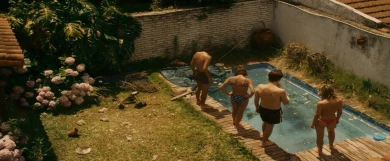
The end of the world, caused by climate change, is here and a group of friends wander from swimming pool to swimming pool at the height of a long, hot summer in Buenos Aires. From pool to pool, they cross the city, drifting leisurely and agreeably. In this transit they encounter different survivors searching desperately for water until their journey ends.
In echoing Frank Perry and Sydney Pollack’s film The Swimmer, Sol Iglesias’s The Swimmers is, equally, a path towards first light. The swimming pools symbolise, on this sunburnt stage, a metaphor at once for shelter and death by asphyxiation. It is the extreme heat that turns it into a fresh and pleasurable ending. The swimming pool, moreover, represents the lethargy of a youth tired of fighting against something they see as “inevitable”. As the young people trespass on a neighbourhood’s private property — rather than in public space — the pool is a stronghold of intimacy that must be seized: the false paradise of a collapsed society. The film brings the viewer closer to another film to feature in this series, La ciénaga (The Swamp, 2001) by Lucrecia Martel, in which bodies search for recesses of stagnant water.
Jack Hazan. A Bigger Splash
Friday, 7 August 2026
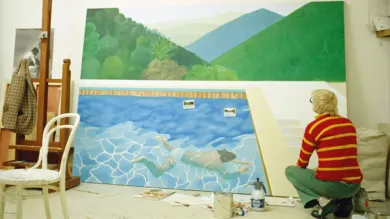
Painting endows a fleeting and unique moment with permanence and stability. This was the vision of the late David Hockney when, brushstroke by brushstroke, he returned to the swimming pool in A Bigger Splash: the great dive into a Californian pool which freezes a sense of happiness. A splash made by Peter Schlesinger, the painter’s partner from whom he has just separated.
In the film A Bigger Splash, Jack Hazan portrays the world of a successful artist, art-market and art-dealer pressure, the tension between the ego and personal frailty, and the obligation to continue with a style and iconography which, despite its instantly recognisable artistic imprint, creates doubts for the painter. In a grey, rainy London, a glum Hockney, the victim of soured love, keeps returning to the Californian swimming pool that holds the promise of happiness, in the form of a homosexual Arcadia in which the painter lives with his young partner and a group of equally glowing and attractive friends. Ultimately, the pool, as Jack Hazan recalls in this pioneering artist’s documentary, is a simile for the same painting in its original intention: hang onto fleetingness to lend it a permanence for the beholder, despite it not existing. Hockney, as one of the last great painters, knew his medium remained largely unchanged across hundreds of years of history.
Six Swimming Pools. A Dive into Experimental Film
Saturday, 8 August 2026
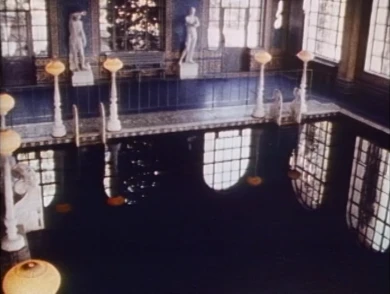
For the first time, the Museo’s summer cinema programme includes an experimental film section, centred on the experience and feeling of bodies under water. This session glides between the ostentatious aquatic architecture of Barbara Hammer and Barbara Klutinis and Jakobois’s fantasies, fleeting contact and wet, sexualised bodies. Six completely different swimming pools — private, public, transparent, bottomless, indoor, outdoor — all designed for leisure, competition and desire, nonetheless. A journey ranging from the monumentality of architecture to the intimacy of wet bodies.
Pools, by Barbara Hammer and Barbara Klutinis, turns swimming pools designed by pioneering architect Julia Morgan for the castle of tycoon William Randolph Hearst — the inspiration for Citizen Kane — into a space of play, bodily exploration and queer appropriation, an excuse to dive into a scene reserved for privilege. In An Algorithm, Bette Gordon fragments a series of headfirst dives and turns the sporting gesture into a visual score of repetitions, variations and rhythms. Tony Hill’s Water Work seduces with perspective, reflections and depth — the swimming pool as optical illusion, as an unstable surface which distorts and multiplies the gaze. Cheap Imitation “They Walk and I Walk”, by Rickard Eklund, submerges the camera to capture a choreography of synchronized bodies, a dance suspended under water. Naked bodies that dodge, twist and embrace in a space seemingly with no gravity combine in Gunilla Leander’s All Under. Passage du désir, by Jakobois, closes the programme with a montage in which water is no longer an environment, becoming instead a territory of desire.
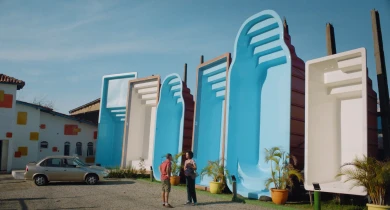
Dominga Sotomayor. Debajo and Thais Fujinaga. A Felicidade das Coisas
Friday 14 August 2026
Two gems, from two new voices in Latin American cinema, which swing between families, swimming pools, reencounters and status. In Debajo, a short film on youth by Chilean director Dominga Sotomayor, an abstract yet powerful bird’s-eye view of a swimming pool co-exists with the relationships of a crisis-stricken family, gathered to see an eclipse. Sotomayor’s distinctive film-making of care and affects shares a similar space to the daily naturalism of Thais Fujinaga’s A Felicidade das Coisas. In the director’s first feature film, the swimming pool is not a horizontal basin for swimmers’ immersion; rather it is a huge vertical monolith, a kind of an anti-monument, anchored in the garden of a middle-class family. The film conveys the efforts and challenges of a mother of two children to build a swimming pool in their modest summer house, a mother who, alone, comes up against a hypermasculine world. Equally, the film speaks of family love, and the search for status, with the swimming pool a languishing totem of the Brazilian middle class during the years of Bolsonarism.