Held on 23 Jan 2021
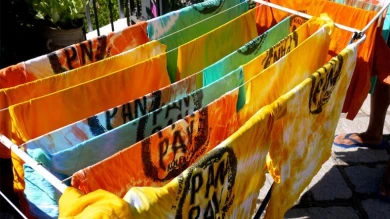
Pan-Pan Kolektiva was formed in March 2020 as a listening-centred research group, with PAN PAN a standard urgency signal standing for Pay Attention Now, but not as urgent as MAYDAY. After the global health and social emergency caused by COVID-19 society is not necessarily at an endpoint, yet it does require our attention. The crisis has been compounded by uncertainty stemming from already unstable employment and personal situations and we have witnessed the rise of individualism, solitude and isolation, which could lead to psychological imbalances.
Over these months, Pan-Pan Kolektiva has focused its interests on analysing, through listening, the effects of these crises, observing how the social fragmentation mentioned above has triggered the simultaneous and oddly related rise of totalitarian ideologies with the ascent of New Age or anti-mask movements that harbour conspiracy theories — generally speaking, what has been termed “conspiritualism”.
Pan-Pan Kolektiva sets out from the hypothesis that the current situation is giving rise to collective trauma and from the following question: Do we have the necessary tools to listen to each other or do we need to create new ones?
Pan-Pan Kolektiva takes this question to form the basis of its work around the concept of “post-traumatic listening”, a mode of listening that is yet to be defined or settled upon, and that relegates our position as an individual subject to collectivise malaise and experiences of mourning. Therefore, the collective has contacted a series of artists, thinkers and cultural agents and asked them to produce a series of tools they will present publicly at this event.
Moreover, the encounter features different listening exercises conducted by Víctor Aguado Machuca, Elisa Arteta, José Begega, José Luis Espejo, the Grupal Crew Collective (GCC), Susana Jiménez Carmona, Mattin, Violeta Mayoral, Agnès Pe, Miguel Prado and Arnau Sala.
Additional Material
Pan Pan Kolektiva. Post-traumatic Listening. Disclaimer, 2020
Participants
Víctor Aguado Machuca is an artist, architect, musician and curator. He is president of the Electroacoustic Music Association of Spain (AMEE) and a researcher in Philosophy and Language Sciences at the Autonomous University of Madrid. He has curated exhibitions in institutions such as the Ibero-American Institute of Finland (Madrid), Medialab-Prado (Madrid), the Cervantes Institute in Berlin and New York, The Graduate Center, CUNY (New York) and Oolite Arts (Miami).
Elisa Arteta is a dancer and choreographer with an MA in Contemporary Technological and Performance Art from University of the Basque Country and an MA in Performing Arts and Visual Culture from University of Castilla-La Mancha and Museo Reina Sofía. She combines her art projects in the field of choreography with her management work through co-directing Centro Huarte. Her work, performed in myriad art spaces in Spain and internationally, explores proprioception and the relationship between mind and body.
Jose Begega is a visual artist with a degree in Fine Arts from the Polytechnic University of Valencia and an MA in Artistic Production and Research from the University of Barcelona, and a porn actor and sex worker. Through his own body, life experience and environment he investigates the spectator as an active subject in the artistic process, pornography, the construction of identities and fictions, the internet, interviews and audiovisual mediums to question the notion of reality.
José Luis Espejo is a teacher, researcher and exhibition and concert curator. After studying Art History, he bases his research on the relationships between the art and culture of listening, participating in self-managed projects such as Mediateletipos, Ursonate Fanzine and the Listening Observatory. He is an advisor on the live arts (music-sound) programme in the Museo Reina Sofía’s Public Activities Department and is a contributor to and founding member of RRS, the Museo’s online radio station. Moreover, he coordinates the module on Theory and History on the MA in the Music Industry and Sound Studies at Carlos III University in Madrid.
Grupal Crew Collective (GCC) is an open, mutating and interdisciplinary platform of diverse origins based in Madrid. Its efforts are concentrated into investigating the potential of music and partying as instruments of cultural agitation and social aggregation. GCC draws inspiration from collective creation that is inherent in ludic-music practices of all kinds from communities and sub-cultures, vindicating their habitually disparaged value in the spheres of Art, Culture and Politics (the capitals are not free).
Susana Jiménez Carmona holds a PhD in Humanities and Culture from the University of Girona and is a graduate from the Guitar degree course at the Professional Music Conservatory of Córdoba. She is a lecturer on the MA in Sound Art at the University of Barcelona. Her work flows between music, sound art and philosophy, encompassing research, teaching and artistic practice, particularly its collaborative side. She has collaborated with different stage art companies, artists and collectives, giving an array of lectures and talks and publishing pieces in different international magazines on music and sound art.
Mattin is a sound artist and theorist. His work focuses on the conceptual investigation of noise and improvisation, exploring strands that include the role of listening in relation to the immeasurable accumulation of digital information and at a time of mounting polarisation and social fragmentation; or the potential non-verbal communication can activate between bodies participating in a reflexive encounter. Moreover, he has co-edited, with Anthony Iles, Ruido y capitalismo (Noise and Capitalism, 2011) and participated in documenta14 (2017) with the “durational” concert Disonancia social (Social Dissonance).
Violeta Mayoral is a multidisciplinary artist and experimental dramaturgist who holds a degree in Communication and Cultural Industries from the University of Barcelona, with a specialisation in Semiotics and Image Theory from the National Autonomous University of Mexico. She carries out her work with the unswerving conviction that everything can be signified, exploring, from the mise en scène of the everyday, hermeneutic questions that always flow out into a reflection around the existence of the individual and their semiotic condition.
Agnès Pe is a music researcher and sound producer with an interest in pedagogy. Her sound productions transcend limitations of music genre, navigating the detritus generated through MIDI archives and fictionalised narratives. She currently coordinates the radio programme Mitt Paté (Radio On Berlin), exploring the plunderphonics generated and distributed inside the internet framework.
Miguel Prado is an artist and researcher in the Philosophy Department at the University of the West of England, Bristol. He has written extensively about the theory of information and cybernetics in relation to the notion of noise and produces variegated music and audio pieces, working with different sound artists and theorists such as Mattin, with whom he recently produced the podcast Social Discipline. He is currently part of the band Harrga with Dali de Saint Paul.
Arnau Sala Sáez is a musician and visual artist. His different-format works feed into one another, with sound translating into visual structures whose form is condensed into sound compositions. By way of this habitat, Arnau builds a system with elements related to one sole consciousness. Under the name Ex Continent the artist presents installations in which sound, light and image coexist formally and conceptually.

Más actividades
Files of Tropical Revolutions
Sábado 20 y 27 de junio, 2026 - 19:00 H
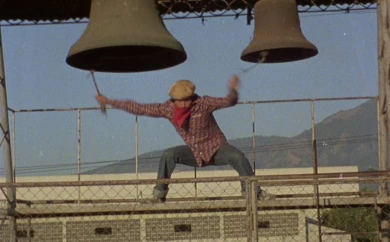
The Reframing Banana Imagery series concludes with two works that condense the height and twilight of this period in history, epic sagas that cross borders and registers to embody experiences of armed struggle in the region. Cameras mix with firearms, borders between nations blur and patience reaches breaking point. This is where the tipping point lies, where the bloodshed weighs heavy and the murmurings of regional brotherhood are buried in the ground again.
Pan y dignidad (Carta abierta de Nicaragua) [Bread and Dignity (An Open Letter to Nicaragua)] recounts the historical records and process of national reconstruction in Nicaragua via the Sandinista popular uprising. Historias prohibidas de Pulgarcito (Forbidden Tales of Tom Thumb) places the camera at the heart of the El Salvador revolutionary struggle, interspersing testimonies of daily violence with the verses of the poet Roque Dalton.
Both works understand the armed revolution as an open file under construction. The insurgent brotherhood, although dissolved, still resounds in regional history.
Circling Over Exploited Bodies
Friday, 19 and 26 June 2026 - 7pm
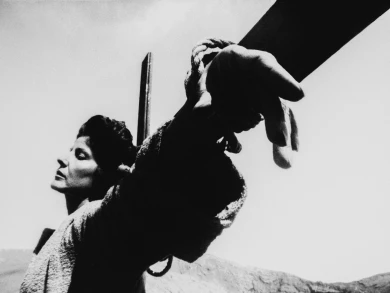
When forms of violence are inflicted on society, film responds from urgency. Images become abstract, sounds fade and the register of dissidence comes from the gut. La zona intertidal (The Intertidal Zone) is an essayistic and poetic approach to the repression of teachers in El Salvador in the 1970s — a teacher studies the biodiversity of the El Salvador coast as a boy finds a body on the same beach. A propósito de la mujer (About Women) interweaves testimonies of misery and rage towards patriarchal structures with fictional scenes of a symbolic procession through a harsh desert.
Both films understand the body as a target of violence and a territory of insurrection, a space where the blood shed by militancy and the patriarchal yoke turn pain into denouncement and existence outside the status quo into an act of political dissidence.
Central American Designation of Origin
Thursday, 18 and 25 June 2026 - 7pm
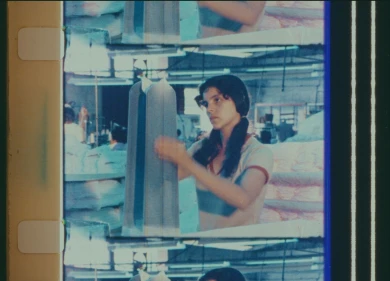
Fertile lands, farmers’ hands, rural faces. This first programme in the series Reframing Banana Imagery understands the foundations of the Central American experience from exploitation, extractivism and displacement, and from the organisation and resistance that emerged as a reaction. The four films within extend from a lyrical documentary on farmers’ solidarity to the playful subversion of the institutional format of the United Fruit Company.
Bananeras (Banana Growers) is a combative portrait of the inhumane conditions of the American banana plantations located in Nicaragua through much of the twentieth century. Costa Rica Banana Republic is a perspicacious satire via an institutional documentary of banana production, spotlighting the extractive nature of this agro-exporting model in the 1970s. Organización Campesina (Farmers’ Organisation) frames rural resistance in Honduras from a direct depiction and lyrical documentary, while Dos veces mujer (Two Times a Woman) dissects the invisibility of the double-shift working day Central American women farmers endure: working in the countryside and working in the home. As a whole, the works here present the earth at once as a wounded body and a space of dignity.

Cinema, for the First Time
7 and 14 June 2026 – 12:00 pm
The final session in this Moon Projector season contemplates the feeling around the first experience of cinema — cinema as revelation, magic, fantasy and mystery from the first gaze, from the first contact with the medium, and imagery etched on the retina of childhood. The programme shows Émile Cohl’s landmark Fantasmagorie (1908), the first ever hand-drawn animation, and Ignacio Agüero’s Cien niños esperando un tren (One Hundred Children Waiting for a Train, 1988), a feature-length film on play and the origins of cinema.
Fantasmagorie (1908)by Émile Cohl (Paris, 1857– Villejuif, 1938) is the first expression in the history of animated drawing. Émile Cohl was an illustrator who belonged to the Parisian art group Arts incohérents (1882–1895), who was bestowed with an absurdist and pre-Surrealist talent. Whereas the Lumière brothers were able get audiences out of their seats as they witnessed a train moving towards them in 1895, Fantasmagorie is a supernatural experience, akin to an apparition yet also innocuous and entertaining — the inanimate comes to life out of nothing and figures seemingly move with little sense. From the outset, animation was related to caricature, fabulation and the comical, a sweet spot for the dreams of the youngest audience.
From the discovery of new imagery arising from the animated line to knowledge of the world through a screen, Cien niños esperando un tren (1988), by Chilean director Ignacio Agüero (Santiago, 1952), narrates a group of young people’s discovery of cinema in a workshop on the origins of the medium in a poverty-stricken town on the outskirts of Santiago de Chile. Play, fun and learning combine with a fascination with images, as viewing Émile Cohl’s Fantasmagorie (1908) in the workshop becomes an act of freedom.
Elisa González and Leah Pattem. Soy Tribulete 7
13 JUN 2026
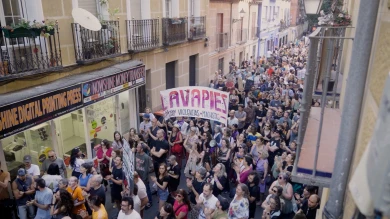
Framed inside this year’s Neighbourhood Picnic is the screening, in the Museo’s Cinema, of a film related to the life and protests of the Lavapiés neighbourhood, addressing issues of gentrification and the right to housing: Soy Tribulete 7 (I Am Tribulete 7, 2026), directed by Elisa González and Leah Pattem.
As the Spanish housing crisis takes hold in Lavapiés, this story begins in February 2024, when the residents of Calle Tribulete, 7, a block of apartments on a street in this Madrid barrio, receive a letter informing them that their building has been sold to a vulture fund. The news spreads quickly around the neighbourhood and, when it comes to the attention of González and Pattem, they grab their cameras and head straight for the building, where they encounter one hundred or so residents still in shock. The film Soy Tribulete 7 flows into the building and the daily lives of a community united, whose looming eviction occasions the fight of their lives. Ultimately, a path of resistance that will turn the community into a symbol of struggle for the right to housing.
Both film-makers worked closely with a group of tenants — Cris, Nani, Blanca, José, María Jesús and Antonia — to tell the story of how the building became the most creative stage of resistance ever witnessed in the area. The work presents the daily life of these residents in Madrid’s now-iconic “building fighting eviction”, depicting their collective struggle and the violent disruption to their lives. Through personal interviews, observational footage, archive material, music and a narration by eighty-year-old actress Ana Martín García, the film casts light on the human stories behind a community struggle.
The Neighbourhood Picnic is an annual gathering of festivities organised by Museo Situado, a network made up of associations, activists and residents from Lavapiés, a racially diverse, working-class neighbourhood where the Museo Reina Sofía is located.