-
Wednesday, 13 December 2023 Sabatini Building, Floor 1, Room 102
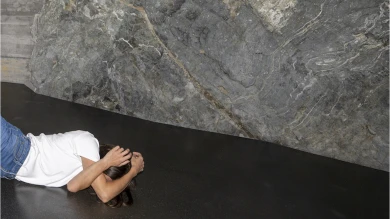
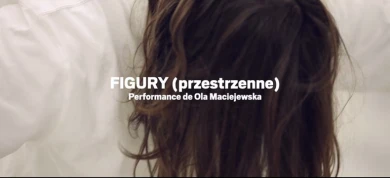
FIGURY (przestrzenne). Ola Maciejewska
Choreographer Ola Maciejewska has conducted in-depth research into Loie Fuller (Illinois, 1862 — Paris, 1928), one of the most innovative and recognised women dance artists in modernism. Maciejewska’s piece Loie Fuller: Research (2011), was performed in the Museo Reina Sofía in the spring of 2018 and involved a succession of physical exercises which used the “dancer’s dress” invented by Fuller in a piece which tautened and related the sculptural with the figure that sculps and dances the fabric. And thus the idea of physical strength and endurance (necessary to hold the weight of large fabrics) revealed a unique concept of dance and the figure of the dancer: that of a body always related to other bodies and living or lifeless bodies.
FIGURY (przestrzenne) [FIGURE (SPATIAL)] broadens and gives continuity to these investigations, comprising a dance solo that enquires about the body’s relationship with its environment, which tries to incorporate, via gestures and movements, a series of porous sculptures or figures that come into direct contact with space or which, going further, are built by it. Corporeal work is activated around the sense of the deceleration of time and the idea of physical resilience; the search entails inhabiting, adapting, listening and producing new relationships between the body and that which surrounds it to reveal not only spaces but also co-existent temporalities. The interest in the sculptural in this piece is not only related to the artistic discipline but also the question around the commitment a body acquires to its more immediate — spatial, architectural, institutional, affective, physical, sensitive — environment. Maciejewska thus stresses the idea that all elements of the space in which the piece unfolds “develop verbs” that participate in the action and modify its state: a wall, an artwork, a cold marble floor, a dog, a tree, a spectator.
The word “przestrzenne” means spatial figure in Polish and, consequently, FIGURY (przestrzenne) alludes to the way in which the body is always dependent on something that extends beyond it, much in the same way that plants depend on light. This dependence is based on a double concealment: something we intuit as different from the human but actually exists within it.
Credits:
Concept and performance: Ola Maciejewska
Production: Caroline Redy. So We Might As Well Dance
Co-production: CND Pantin, Cndc Angers
Residencies: Pact Zollverein, Muzeum Susch (Acziun Programme)
Project carried out with funding from the Direction régionale des Affaires culturelles (DRAC) Bretagne – Support for choreography projects.
-
Thursday, 14 December 2023 Sabatini Building, Garden
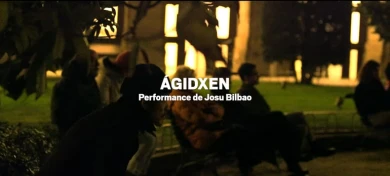
ágidxen. Josu Bilbao
ágidxen is a phonetic transcription of a dialectical variation of the adverb agerian, which in Basque is a derivative of the verb ageri, an important element in the Basque language and epistemology. Possible translations of the verb ageri are: visibly, revealingly, either in public or openly, yet it is a term which, in this instance, refers to the learning acquired by the artist in the environment of the home to refer to the specific circumstance in which a member of the family becomes uncovered at night.
This fact (to become uncovered) prompts a simple form of care in that another person covers them, whether in the middle of the night or in the morning. It is a circumstance that is named — and is comprehended without any need for explanation — through the word ágidxen, which when pronounced creates a specific sound. It is a form of speech which transmits a particular state and makes the word and the tongue a shared place between bodies and voices.
A body is uncovered, unprotected, like a call to be assisted by others. The tongue, as a muscular organ of the mouth, is also exposed at the time of pronouncing words. To speak, say and name is to put the tongue (anatomical and linguistic) in contact with the air. To leave the tongue exposed, openly. ágidxen throws into relief phonation to observe how each sound is developed in the body, understanding that the voice is body and matter and here, in the Museo’s Garden, it is also foliage and half-light. Equally, it looks to be conscious of the time of emission and the semantic landscapes, at times abstract, that this invokes.
The act of creating sound through the voice, as a physical occurrence, also stirs an awareness of other forms of presence. Firstly, orality which, as a collective practice, notices and makes us notice what we are, producing memory and developing history. And secondly, because the space of action and pronunciation are shaped with the vibration of musical composition, in this instance produced by Estanis Comella. The different morphologies of voice and sound are envisaged, remaining in the air or covering themselves in an action of listening and mutual care. Phonemes, words, phrases, ambient sound, air, birds and whispers open mental, imaginary and physical spaces. They make reality.
Credits:
Performance: Josu Bilbao and Estanis Comella
Supported by the Department of Culture and Linguistic Policy of the Basque Government, ágidxen had a first stage, askiè altu, held in the auditorium of the University of the Basque Country/Euskal Herriko Unibertsitatea, in Bilbao, within the framework of the Urak dakar encounters, curated by Bulegoa z/b.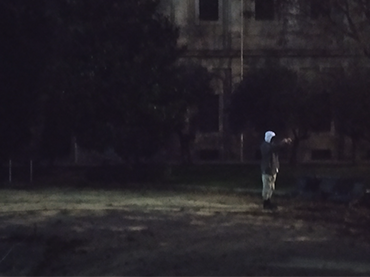
-
Thursday, 14 December 2023 Sabatini Building, Floor 1, Room 102
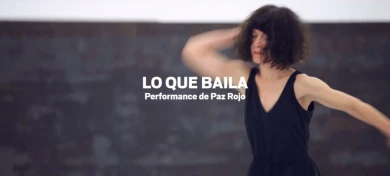
Lo que baila (What Dances). Paz Rojo
“The coherence and persistence of Paz’s work has brought about vast and fruitful constellations crossed with questions on what dance does and the affective, political and aesthetic framework of choreography and its relationship to the forces and impulses of the capitalist system, with a view to delving into the possibility of a mode of subjectivation extracted from its regime of value production”.
Andrea RodrigoLo que baila (What Dances) seeks, through a modus operandi rooted in dance, to make something present that is not there, since it has already been there and because, in not being, it is kept latently as an event to come, and can re-appear at any time and in many forms. This form, Paz Rojo tells us, is a found form, “a print or residue that can be enjoyed selflessly”.
This piece gathers and mobilises findings, also making them appear and disappear, and stays in continuous movement, akin to the movement of consciousness, which goes from one thought and observation to the next, without staying with any of them, letting them circulate in disregard, sliding in the direct sense of physical dance. It opens feelings and meanings that are dissociated from the aspiration of a characteristic subjectivity. To dance de-subjectivation to exhaustion. Letting, by doing so, the vibrating contours to be perceived of a body that does not end where the skin ends.
Credits:
Concept, dance and sound space design: Paz Rojo
Sound editing: Paz Rojo and Emilio Tomé
With the support of the Festival Domingo-La Casa Encendida (Madrid, 2021) and programmes of stage creation residencies at the Centro de Cultura Contemporánea Condeduque (Madrid) and Köttinspektionen Dans (Uppsala, Sweden).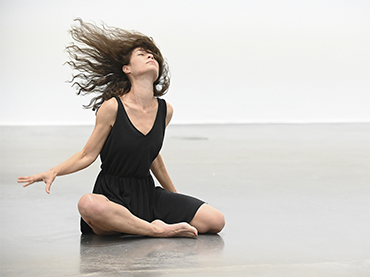
Held on 13, 14 Dec 2023
The Museo Reina Sofía presents the fifth edition of ESTUDIO, an annual programme which brings together work in a range of formats and is the outcome of research conducted by a series of artists and researchers whose practices are tied, either directly or dialogically, to the sphere of choreography and performance. From the specific nature of curation and gazing through an experimental prism, ESTUDIO sets out to perceive artistic work as a learning process of what is as yet unknown, incorporating meaning around space — the studio as a place of work and experimentation — and essay — a commitment to opening the uncertain from its alliance with language and its functioning as proof of all that we assume we know.
Under the title In the Recess, Occurrence, this edition turns its attentions towards cavities, both mental and physical, that open in our bodies after the passing-through of other bodies. As porous beings we live in constant relations and exchange with others, not only because we are social, or because we inhabit the planet — filled with other living beings — but because we are the planet. And its history. As part of this planet-being, the proposals in this edition of ESTUDIO take on a poetic responsibility, with Ola Maciejewska, Josu Bilbao and Paz Rojo assaying material forms that are poetic, physical and anatomical, and which entail passing through knowledge knowing that results are not guaranteed.
That which surrounds us — space, people, living beings, a tongue, a language, a form of speech, its sound — produces a sensitive print in our muscles, glands, organs and all that defines us as human animals. Yet our bodies, drawing from Daisy Hildyard’s The Second Body (2017), do not end where our skin ends. The skin has long been that “inviolable frontier” which invites and pushes, where “you are encouraged to be yourself and to express yourself — to be whole, to be one”. In her book, Hildyard suggests that all living beings in fact have two bodies: the animal body demarcated by its skin and a “second body” formed by neuronal, sensitive and affective connections which we maintain with a broad network of ecosystems that involve us in the global development of the planet.
Yet what remains of everything that has left its impression on us, that has left a physical impression on our bodies? The recesses endure, those spaces where the living memory of events and the relations that surround us is encapsulated. Remaining connected to these cavities means to exercise some resistance, not understood as the action of opposing something but rather the capacity of a body to hold the weight — physical, psychological, emotional — of that which it wants to last. It is to walk with such weight, to speak with it, with the force of that desire.
What can be shared of that which remains affixed, that which one carries? To whom does it belong? The different proposals contained within this fifth edition bring to light how an awareness of the connection of the body with life, understood as an occurrence that exceeds biography (and also contains it), prompts thought around the hollows we can open via our gestures, between movements and the displacements of extremities, and also in the movement of the tongue, that organ which, in the act of speaking, comes into contact with the air. The cavity of the mouth, that recess which allows for its sound and transmission. Whoever listens perceives its sense in relation to the ear and the mind, recording, in unsuspected ways, its affective effects, the affection of how to say something in a given moment, and, when it was said previously to the person who now transmits it, a sense that can only be understood in certain contexts.
The movement of bodies progressively opens spaces along the way, accommodating hitherto unperceived forms and temperatures. It is in the recess where the possibility of other forms of presence — physical or psychological, present, past or future and undoubtedly material — occur. And it is in the occurrence of direct action where other modes of temporality are also made possible, temporalities that are hard to restrain, qualities and textures that tilt back and forth between the internal and the external, or where these notions of inside/outside are no longer opposed. In view of the above, this edition encourages participation in a shared experience to live in, for an afternoon/evening, the cavities — gestural, dance-related, linguistic — to observe how time unfolds durée réelle (real duration), a concept vitalist philosopher Henri Bergson defined as a succession of qualitative changes that penetrate without a precise contour.
ESTUDIO V. In the Recess, Occurrence, therefore, continues along the line of previous editions: Estudio I (2019), Half Said, Unsaid (2020), Go Out to Encounter. Speak to Place (2021) and Second Skin. Subcutaneous (2022). In each of these editions, the practical research of guest artists served as conceptual triggers to trace a non-linear path around the voice as materiality; the blurring of subjectivity; the willingness for dialogue with landscape, the environment, places and other living beings; and awareness of a subcutaneous historical memory or the capacity to withstand sensitive impressions. Therefore, the presentations unfurled by Maciejewska, Bilbao and Rojo will take place across two consecutive afternoons/evenings inside the spaces of the Sabatini Garden and Room 102 in the Museo, constituting an invitation to observe, think and feel together, to witness the world from the minimal and proximate gestures it contains.
Curator
Isabel de Naverán (ARTEA)
Organised by
Museo Reina Sofía
Participants
Josu Bilbao sets out from the persistent orality in certain languages that are dying out to expand his work towards sculpture as a practice which produces physical and sensorial spatiality. He has carried out exhibitions and collaborations in spaces and institutions such as Bulegoa z/b (Bilbao), Halfhouse (Barcelona), etHALL (Barcelona), Carreras Múgica (Bilbao), Centro Párraga (Murcia), Centro Botín (Santander), CentroCentro (Madrid), Museo de Bellas Artes (Bilbao) and Tabakalera (San Sebastián).
Estanis Comella currently develops work in which writing and musical production converge, along with other disciplines, using live performance as a medium to create an ephemeral architectural atmosphere in spaces. He has shown and performed his work, among other spaces, in Azkuna Zentroa (Bilbao), Tabakalera (San Sebastián), Bulegoa z/b (Bilbao), CentroCentro (Madrid), Bombon Projects (Barcelona), etHALL (Barcelona), La Panera (Lleida), Carreras Múgica (Bilbao) and Azala (Lasierra).
Ola Maciejewska is a choreographer and researcher who was born in Poland and lives in Paris. In 2012, she gained an MA in Contemporary Theatre and Dance from the University of Utrecht. In addition to a number of academic explorations, Maciejewska has performed the pieces Loie Fuller: Research (2011), Bombyx Mory (2015) and Dance Concert (2018), which have been presented in contemporary dance and art contexts in Canada, Spain, France, the Netherlands, Poland, Portugal, Switzerland and Taiwan. From 2016 to 2018, she was an associate artist at the centre chorégraphique national de Caen en Normandie (France).
Paz Rojo is a choreographer, dancer and researcher whose interests revolve around dance and its potential to create alternative ecologies that include debates on the ontology of dance in late capitalism and the aesthetics of dance after the end of the future. She attained a PhD in Performance Practices, specialising in Choreography, from the Stockholm University of the Arts with the research thesis The Decline of Choreography and Its Movement: a Body's (path)Way (2019). As part of this research, she published the book To Dance in the Age of No-Future (Circadian, 2020).
Más actividades
![Isabel Coixet, 100 Years and You Everywhere [100 años y tú en todos los sitios], 2026, película](https://recursos.museoreinasofia.es/styles/small_landscape/public/Actividades/2.diseminar-mundo.jpg.webp)
John Berger and Isabel Coixet. Continued Ways of Seeing
Thursday, 17 September 2026 at 7pm
Ways of Seeing (1972) is one of the most revolutionary television series on art history, the museum and contemporary critical culture. Across four episodes, an articulate, enthusiastic John Berger unpacks the relationships between classical art through the gaze and new technology, the nude and feminism, the oil painting and commodity fetichism, advertising and consumerism. In essence, a level of critical commitment only comparable to its capacity for dissemination. Unsurprisingly, the series, and the book that would distil it, continues to forge vocations. This session sees art historians Alberto López Cuenca and Modesta Di Paola carry out an analysis of Berger’s audiovisual work, placing the stress on episodes one and four of the series. In the first episode, Berger reflects on the connection between the act of seeing, looking and being in light of new technology, such as the film camera. At the same time, it analyses how the culture of reproduction is turning paintings into messages or fragments of communication while stressing the importance of silence when observing historical paintings. In the fourth and final episode, he introduces advertising as a new iconic-verbal language that shares certain principles with the message of oil painting as a luxury item.
The session opens with the premiere of a filmic letter from Isabel Coixet, one of Spain’s most internationally acclaimed directors, to John Berger, with whom she maintained a long friendship and deep admiration. The short film is testament to the ubiquitous and long-lasting presence of the author of Ways of Seeing, even after his death in 2017.
![Chantal Akerman, Woman Sitting after Killing [Mujer sentada después de matar], 2001, instalación. Museo Reina Sofía](https://recursos.museoreinasofia.es/styles/small_landscape/public/Actividades/chantal-akerman-mujer-sentada-despues-matar.jpg.webp)
On Your Screen: Art History and the Museum Facing the Audiovisual Challenge
18, 19 SEP 2026
The conference On Your Screen: Art History and the Museum Facing the Audiovisual Challenge sparks debate around the transformations of art history and museum space upon embracing the audiovisual format. Its starting point is John Berger’s emblematic television series Ways of Seeing (1972), a landmark in the democratisation of art-historical discourse. In the series, Berger illustrated how the transfer of a work such as Goya’s Los fusilamientos del 3 de mayo (The Third of May 1808 or the Executions) from museum gallery to home TV screen completely changed the viewer’s experience, allowing the image to travel to straight to the viewer.
In the twenty-first century, this screen-based ecosystem has expanded exponentially, with museums not only physically integrating screenings and devices into their galleries— following in the wake of many exhibitions on the moving image — but also deploying complex virtual strategies. Equally, numerous en vez de a multitudeof historians, students and creators use digital platforms to circulate their ideas and projects. This audiovisual shift opens access to ignored materials and democratises knowledge, as well as challenging traditional hierarchies and the interpretive authority of institutions. The conference, promoted by the research project ATLAS AV: The Audiovisualisation of Art History and the Museum, seeks to analyse this vast audiovisual material, its archives, and its capacity to transform the memory of art.
Godard and Miéville: Time and Ruin
Friday, 18 September 2026 - 7pm
Inside the framework of the conference On Your Screen: Art History and the Museum Facing the Audiovisual Challenge, this film series sets forth three critical visions of the museum via three sessions featuring the works of John Berger, Jean-Luc Godard and Anne-Marie Miéville, Ariella Azoulay, Alan Resnais and Chris Marker, Kwate Nee-Owoo, and the premiere of short films by Isabel Coixet and La Vulcanizadora (Maria Rojas Arias and Andrés Jurado). In classical theory, the museum gives the world meaning; it contains fragments of the past, granting them a history, a narrative that explains preterite time and the present. Today, there is an implicit assumption that this function hides and legitimises forms of power, yet what if the museum, instead of explaining the world, multiplied it through radical ideas, silenced periods and repressed subjects? Such is the approach of the film-makers and artists in this film season.
In 1972 the writer John Berger opened the landmark television series Ways of Seeing with an iconoclastic gesture: slicing Sandro Botticelli’s painting Venus and Mars (1485) in London’s National Gallery. A transgressive act that recalls contemporary attacks on the museum by dissident youth and with which Berger, after revealing it was a reproduction, sought to ignite debate around the idea of an original artwork and a copy. In this, the hundredth anniversary of his birth, the first session pays homage to one of the great art writers of the twentieth century. Starting with a review of Berger’s audiovisual work by art historians Alberto López Cuenca and Modesta Di Paola, the series begins with the premiere of 100 Years and You Everywhere (2026), an unreleased short film by Isabel Coixet composed as a beautifully crafted letter to Berger, and continues with an analysis of fragments of Ways of Seeing in relation to the museum and contemporary art.
The second session screens two medium-length films by Jean-Luc Godard and Anne-Marie Miéville on time, ruin and museum. In The Old Place. Small Notes Regarding the Arts at Fall of 20th Century (1999), both film-makers consider what remains of that “old place”, the museum, at the close of a century of wars and totalitarianism, and ask whether it should be more of a legend or desire than a place. This same driving principle leads Godard to build his own imaginary museum in Reportage amateur (maquette expo) (2006), a rickety toy museum which, paradoxically, contains the great film-maker’s full power of thought on history and images.
Finally, the third session explores one of the major challenges of recent years: the decolonisation of the museum, the recognition of its link to imperialist discourses of power and the need to situate a new silenced or repressed subject at the centre of the Western narration of history. Under the title Museums and Restitution, it includes the film Undocumented. Unlearning Imperial Plunder (2019), by theorist Ariella Azoulay, Statues Also Die, by Alan Resnais and Chris Marker (1953), Kwate Nee-Owoo’s You Hide Me (1970) and the first screening of the short film Quinto verso, parte de Tonada (Fifth Verse, Part of Tonada), by La Vulcanizadora (Maria Rojas Arias and Andrés Jurado), filmed at the Museo de América in Madrid.
![Ariella Azoulay, Un-documented. Unlearning Imperial Plunder [Indocumentados. Desaprendiendo el saqueo imperial], 2019, película](https://recursos.museoreinasofia.es/styles/small_landscape/public/Actividades/5.diseminar-mundo.jpg.webp)
Museums and Restitution
Saturday, 19 September 2026 - 7pm
Centuries of plundering, decades of amnesia, years of living with unmitigated extractivist power… Does a museum, as we know it, have a raison d'être in a postcolonial society?
This session expounds the operations of the museum as a colonial machine, while putting forward ideas, in narration, for a more just, equal and inclusive institution of the future via society’s marginalised and minority voices. The session begins with the international premiere of Quinto verso, parte de Tonada (Fifth Verse, Part of Tonada), which presents a vision of the Quimbaya Collection (fifth and sixth centuries CE) from the Museo de América in Madrid. It is constructed with the voices and chants of Wayúu mourners and guides, not only as a way of reinstating the role of these gold idols — anthropomorphic figures of men and women used as vessels in ritual practices — but also to imagine that what must be exhibited is not the gold itself. It is the ritual’s own chant. In the classic film You Hide Me (1970), Ghanaian film-maker Kwate Nee-Owoo accesses the British Museum’s collection of African art, located in the building’s basement, to question the meaning behind a museum plundering and nullifying. A fine exercise of first-person institutional critique screened for the first time in Spain. Almost seventy years since Resnais and Marker made Statues Also Die (1953), a reflection on the aura-bearing value of the museum opposite the identity-based and cultural belonging of African art, theorist Ariella Azoulay films the same statues again at the Musée du Trocadéro (today the Musée du Quai Branly), which survive and wait to be reunited with their people. Azoulay, whose wholly original undertaking is a lesson to the museum of the future, connects the forced migration of these sculptures with the mass transit of people crossing borders artificially imposed by the same system that has plundered their culture.
The School of Transformative Institutionalism and Local Organisation
From 21 to 24 September 2026
The School of Transformative Institutionalism and Local Organisation (S.T.I.L.O.) is a programme of joint learning and join strategy which sets in motion a process for the exchange of questions, methodologies and experiences between cultural organisations. The overall aim is to create, circulate and prototype tactics, tools and collective knowledge on institutional practices that open new channels for defending culture and advocating structural transformation in divergent geographical contexts.
The project is part of the Laboratorio de Institucionalidad Compartida (The Laboratory of Shared Institutionalism, LIC), a space for the Museo Reina Sofía’s research, work and advocacy centred on developing, experimenting with and systemising practices, protocols and tools which contribute to a fairer and more liveable cultural ecosystem.
For many years now, so-called infrastructural critique in museums questions material, legal and economic infrastructures, among others, as well as the forms of solidarity and practices required to sustain the cultural ecosystem. By approaching current debates, S.T.I.L.O. raises questions on the ways in which organisations define and interpret their practices, organise their relations and respond to the social contexts in which they operate.
The school gathers four cultural organisations that work via different institutional models – scale, contexts, conditions, different working models — with the goal of pooling common strategies and tools of organisation, advocacy and relationships with local communities.
The programme is conceived as a collaborative process with the participation of Arika, La Revuelta, BAK Basecamp and The Tentacular Museum (Museo Reina Sofía) and is structured around preparatory online sessions and an in-person seminar in Madrid.
S.T.I.L.O. is an activity framed inside the working strand of Situated Organisations from L'Internationale’s Museum of the Commons project, which reflects on the role of museums and art organisations as actors within complex social networks and ecosystems, with a view to exploring new ways to democratise institutions and make them more open, inclusive and useful.