-
Wednesday, 4 October 2023 Sabatini Building, Floor 1
First guided tour around the exhibition
—Conducted by the show's curator, Laura Katzman
-
Thursday, 23 November 2023 Sabatini Building, Floor 1
Second guided tour around the exhibition
—Conducted by the show's curator, Laura Katzman
-
Wednesday, 10 January 2024 Sabatini Building, Floor 1
Third guided tour around the exhibition
—Conducted by the show's curator, Laura Katzman
-
Monday, 19 February 2024 Sabatini Building, Floor 1
Fourth guided tour around the exhibition
—Conducted by the show's curator, Laura Katzman
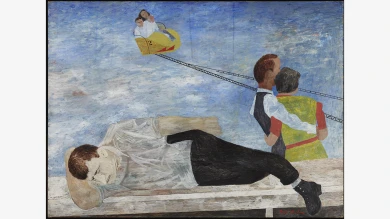
![Ben Shahn, The Passion of Sacco and Vanzetti [La pasión de Sacco y Vanzetti], 1958. Colección Michael Berg © Estate of Ben Shahn / VEGAP, Madrid, 2023](https://recursos.museoreinasofia.es/styles/small_landscape/public/Actividades/encuentro_ben_shahn.jpg.webp)
Ben Shahn, The Passion of Sacco and Vanzetti, 1958. Colección Michael Berg © Estate of Ben Shahn / VEGAP, Madrid, 2023
Date and time
Held on 04 Oct, 23 Nov 2023; 10 Jan, 19 Feb 2024
The exhibition Ben Shahn. On Nonconformity surveys the work of artist Ben Shahn (Kaunas, Lithuania, 1898 – New York, 1969), a pivotal figure in American social realism. Laura Katzman, the show’s curator, explores the main themes in his work, accompanied by a dramatized reading by Alberto Chessa of a selection of Shahn’s essays and lectures, in which he discussed his conception of the creative process and the purposes of art, and texts that influenced his life and work.
Born into a working class, immigrant family from Eastern Europe, Shahn was one of the most prolific and committed American artists in the period stretching from the 1930s to the 1960s. His work explored important issues within the USA’s social context and global history, from the New Deal to the Vietnam War. Advocating the conviction of “nonconformity”, Shahn also challenged the predominance of Abstract Expressionism and other variants of avant-garde art in the 1950s. This retrospective, the first organised in Spain, spotlights the artist’s commitment to social justice, from contemporary diversity and equity perspectives —Shahn was an advocate for workers’ and migrants’ rights and openly criticised the abuses committed by the upper and ruling classes.
This curatorial encounter punctuates the key aspects of the exhibition, for instance the economic and environmental crises of the Great Depression, the rise of fascism, the atrocities of the Second World War, the anti-communist crusades of the Cold War, the threat of annihilation in the atomic era, struggles for labour and civil rights and the defence of human rights, as well as Shahn’s interest in spiritual themes and bible stories in his later years.
Organised by
Museo Reina Sofía
Collaboration
Programme
Encounters
Inside the framework of
TIZ 11. Utopia Memorial
Participants
Alberto Chessa is a writer, translator and voice actor. He is the author of six poetry books that have been awarded with different distinctions — the latest, entitled Palabras para luego, will be published soon by Huerga & Fierro. He has also overseen an essay volume on the film-maker Theo Angelopoulos (Círculo de Bellas Artes, 2015) and a book of aphorisms. As a translator, his most recent publication is a version of Elizabeth Barrett Browning’s Twelve Sonnets from the Portuguese (Balduque, 2022), while his voice has featured on numerous advertising creations, documentaries and information devices such as the audio-guide for the Alhambra in Granada and the online courses of the Telefónica Foundation for the Museo del Prado and Museo Reina Sofía in Madrid.
Laura Katzman holds a PhD in Art History from Yale University. She is a professor of Art History at James Madison University (Virginia, USA) and specialises in American art from the New Deal era and documentary photography from the USA and Puerto Rico. Katzman is the co-author, with Deborah Martin Kao and Jenna Webster, of Ben Shahn’s New York: The Photography of Modern Times (Yale University Press, 2000) and main author of Re-viewing Documentary: The Photographic Life of Louise Rosskam (Penn State University Press, 2014), and the editor of The Museum of the Old Colony: An Art Installation by Pablo Delano (UVA Press, 2023). She has also been a visiting curator at the Harvard University Art Museums and the American University Museum, and has been the recipient of grants from the Fulbright Foundation, the Smithsonian Institution and the Center for Advanced Study in the Visual Arts at the National Gallery of Art, Washington.
Más actividades
Dear Americas
Friday 29 May and 5 June, 2026
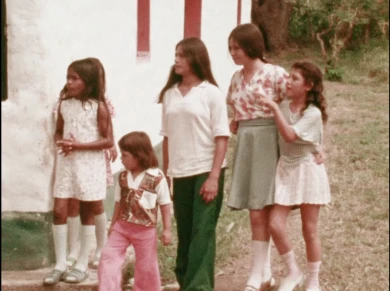
In these films, Marilú Mallet travels to Solentiname, in Nicaragua, and Andahuaylillas, in Peru, to paint a portrait of communities which resist the severity of forced industrialisation. In Solentiname, the focus is on the poet and priest Ernesto Cardenal’s founding of a Christian, poetic and revolutionary utopia, while in Andahuaylillas, a town close to Cuzco, Mallet explores the multiple layers of Andean culture.
A Poetics of the Subject
Thursday 28 May and 4 June, 2026
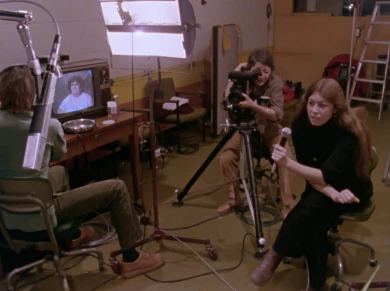
In the tension between documentary and fiction, between the rawness of a tragic political present and narrative escape, lies the truth of the exile’s condition. In Journal inachevé (Unfinished Diary, 1982) Marilú Mallet experiments with her own subjectivity, moving from affirmation to doubt. In Double Portrait (2000), María Luisa Señoret paints her daughter Marilú, who records the process. In this circular relationship, the film-maker constructs a poetics of the portrait as something perpetually unfinished, a process of exploration in which memory, identity and political history merge to become blurred.
Institutional Decentralisation
28 MAY 2026
This series is organised by equipoMotor, a group of teenagers, young people and older people who have participated in the Museo Reina Sofía’s previous community education projects, and is structured around four themed blocks that pivot on the monstrous.
This fourth and final session centres on films that take the museum away from its axis and make it gaze from the edges. Pieces that work with that which is normally left out: peripheral territories, unpolished aesthetics, clumsy gestures full of intent. Instead of possessing an institutional lustre, here they are rough, precarious and strange in appearance, legitimate forms of making and showing culture. The idea is to think about what happens when central authority is displaced, when the ugly and the uncomfortable are not hidden, when they are recognised as part of the commons. Film that does not seek to be to one’s liking, but to open space and allow other ways of seeing and inhabiting the museum to enter stage.
Ordinary, Common and Public. Common Fixes for Ordinary Communities
Tuesday, 26, and Wednesday, 27 May 2026 – Check programme
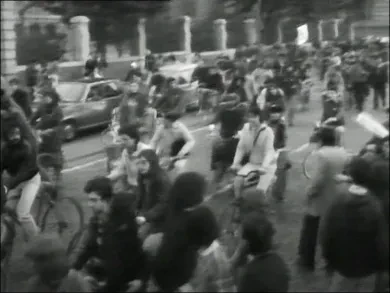
Ordinary, Common and Public. Common Fixes for Ordinary Communities is the title of the fourteenth encounter run by Sociología Ordinaria, a transdisciplinary research group that explores daily knowledge deemed ordinary, superficial or frivolous from a traditional academic and intellectual viewpoint.
This latest edition seeks to approach and map connections between concepts of the commons and the public realm — remembering that the ordinary is also the commons — and to ensure affects and moods of discontent are mobilised towards hope.
By way of its multiple declinations — community, community-based practices, the commons, the communal — the encounter seeks to reflect on different ways of creating, (re)configuring, maintaining, fixing, arranging, caring for and defending the public realm and the commons. Furthermore, it explores forms of invocation and experimentation as tools opposite the helplessness of an uncertain present, in addition to resistance against attempts of expropriation, distortion, privatisation and touristification.
Felix Gonzalez-Torres. Sweet Revenge
26 MAY 2026
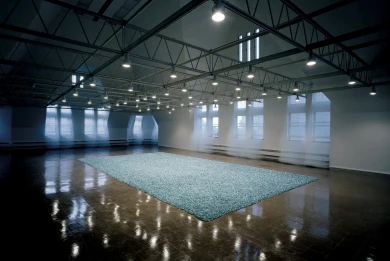
Nancy Spector and Alejandro Cesarco, curators of the exhibition Felix Gonzalez-Torres. Sweet Revenge, will speak with Manuel Segade, director of the Museo Reina Sofía, in a session dedicated to exploring the interpretive frameworks of this first large-scalepresentation in Madrid of the work of Felix Gonzalez-Torres (1957–1996), whose practice continues to resonate in the present.
The conversation begins with the exhibition’s title itself, Sweet Revenge, understood as a paradoxical notion that articulates much of the artist’s thinking. From there, the tensions running through his work are explored: the coexistence of opposing registers, ambiguity as a method, and the simultaneously affective and political charge of his works.
The dialogue also touches on some of the themes that run through his body of work, such as thenotions of identity, citizenship, and authority, alongside experiences linked to the AIDS crisis, and emotions such as love, loss, grief, and optimism. Special attention is given to the way in which Gonzalez-Torres shifts languages associated with Arte Povera, conceptualism, and minimalism towards open, participatory, and deeply personal structures.
The session also includes a reflection on the research process that shaped the exhibition, providing context for the curatorial decisions and criteria that structure it. In this context, Gonzalez-Torres’s work emerges as a device that actively engages those who activate orinterpret it, distributing responsibility for the production of meaning—a process that is alwaysunstable and constantly under negotiation.
These inaugural conversations, part of the main working strands of the Museo’s Public Programmes Area, aim to explore in greater depth the exhibition narratives of the shows organised by the Museo from the perspective of artists, curators and specialists.