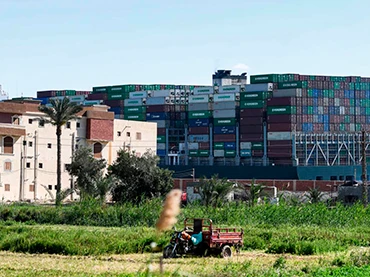
A trailer by the Ever Given jammed on the Suez Canal, Middle East Eye, 29 March 2021
Held on 18 Jun 2022
For the sixth year running, the Archipelago concert series invites the public to delve into the complex nature of the contemporary world through listening, this time setting out from one of the most remarkable images of 2021: the container ship Ever Given stranded on the Suez Canal. In the image, one of the world’s biggest ships is the backdrop to a trailer harvesting crops. The picture, taken in Egypt, demonstrates the lavish scale of global consumption, bringing two means of transport separated by a supposed technological evolution face to face. Conversely, however, the trailer is not that old and the ship has been following a well-travelled route for thousands of years. It is through this image that the 2022 edition of Archipelago recaps learnings around the common history of tradition and experimentation, adding to this narrative accounts of forced migration, the transportation of raw materials and goods, the importance of ports, colonial routes and ocean currents.
The construction of the Persian Royal Road in the fifth century BC set off a kind of proto-globalisation that radically ground to a halt when the Ottoman Empire took Constantinople in 1453. Given the monopoly of that empire and Venice over materials travelling from China, India and Persia, Europe began its overseas expansion, establishing alternative trade routes. It was at that time that a seafarer, possibly Genoese, rode trade winds through sheer luck and ended up in what is today known as Antilles. Once established in the Caribbean, the Spanish Empire opened a route from the Viceroyalty of New Granada (Cartagena de Indias today) to Seville, but not before passing through Cuba, and, making use of the Gulf Stream in the Atlantic Ocean, its boats travelled to the European continent.
[dropdown]
In 1565, following the Kuroshio Current in the Pacific Ocean, a route known as the Manila Galleon was established, joining Acapulco and the Philippines via Hawai. The power of a communications network and the sea shipping of materials laid the foundations for modern imperial control, and with it, in parallel, unexpected musical mutations. The trade winds and the Gulf Stream and Kuroshio and Humboldt Currents were and continue to be decisive for health, identity, supplies and shortages.
It is no coincidence that the interoceanic submarine cables that create the internet’s infrastructure coincide with the mapping of British, Spanish and Portuguese imperial routes. Taking advantage of the situation caused by the COVID-19 global pandemic, “platform capitalism” has sought to regulate streaming, promising to “rejuvenate” the music industry as a form of leisure and communication. Yet this “new” data flow transmitted by submarine cables is one further chapter in an ongoing material history of the expansion of imperialist power which, via maritime routes, exploits life, extracts minerals and projects the routes of people’s voluntary and forced migration.
This new edition of Archipelago, therefore, retrieves the image of the Ever Given stuck on the Suez Canal, verifying how modes of current listening are always conditioned by a profound history of currents, routes and musical mutations.
[/dropdown]
6pm / Sabatini Building, Auditorium
Presentation
—Conducted by Rubén Coll and José Luis Espejo
For the first time, the Archipelago curators will present the framework of texts, concepts and documentation they use to structure the festival’s programme by looking at the theoretical reference points from the past five editions of the festival — Habib Hassan Touma, Jean-Claude Éloy, Eugenia Fraga, Ngũgĩ wa Thiong'o and Édouard Glissant, among others — along with the recent addition of approaches by Michael Denning and his “archipelago of colonial ports” in Noise Uprising: The Audiopolitics of a World Musical Revolution (2020); Jussi Parikka with A Geology of Media (2021); Nick Srnicek’s Platform Capitalism (2018); and Kyle Devine’s view on the material cost of music in Decomposed: The Political Ecology of Music (2019).
6:20pm / Sabatini Building, Auditorium
Erkizia + Cantizano: O’Gemer, live quadraphonic performance
Xabier Erkizia works from the Basque Country, drawn by a curiosity to any form of communication or creation involving listening and sound. He has co-directed the ERTZ Festival and is a member of the Audiolab Association. Erkizia is a scholar of soundscapes and coordinator of the Soinumapa sound map, and a record label, audiovisual and radio producer. O’Gemer is an experimental film directed by Erkizia and centres on the tuning of the noise made by the axles of ox carts: an ancestral sound and possibly the oldest known sound design in a means of transport; the groan Atahualpa Yupanqui alluded to in one of his Milongas and never wanted to oil. O’Gemer is also a testimony of the journey made by these carts between Europe and Brazil, most likely following the shipping route established by Pedro Álvares Cabral in 1500 and which, since 2021, has connected Latin America and Europe via the company EllaLink’s fibre optic cables. The event will feature a live spatial version accompanied by Raul Cantizano’s electroacoustic hurdy-gurdy. Raúl Cantizano, for his part, is a guitarist from Seville. On his albums Guitar Surprise. Mito y geología del Canti (2017) and Zona Acordonada (2021) he explores the limits of flamenco, experimentation and improvisation. Moreover, his guitar has served as an accompaniment for Llorenç Barber, Niño de Elche, Juan Carlos Lérida, Belén Maya, Andrés Marín and Rocío Márquez, but for this performance he will draw from an amplified hurdy-gurdy, its hypnotic sound bearing a relation to the sound of ox carts in O’Gemer.
7:30pm / Sabatini Building, Garden
Mohammad Reza Mortazavi
Mohammad Reza Mortazavi was born in Isfahan two months after the start of the Iranian Revolution. He has lived in Germany for the past two decades, where he has shaped his career as a musician and composer. His approach to the tombak and the daf instruments, after a childhood fascination, transcends traditional playing techniques — the influence of both stretches from Central Asia to the northwest corner of Africa. This longitudinal expansion was connected for thousands of years by the Silk Road, which was paved with the construction of the Persian Royal Road, at the centre of which was today’s Iran. Mortazavi’s focus on music seeks to detach the constrictions inherent in the tombak and daf, as well as national narrative cultures. His approach on albums such as Ritme Jaavdanegi (Latency, 2019) was lauded by the English-speaking music press and in experimental circles, leading him to take part in the thirtieth anniversary of Tresor, Berlin’s legendary techno nightclub and label, as well as participating in festivals such as Berlin Atonal and Rewire. Mohammad Reza Mortazavi’s performance in Archipelago is also a chance to encounter the sounds from his most recent album Prisma (Flowfish, 2022).
8:15pm / Sabatini Building, Garden
Pujllay Masis
The first journeys between the Iberian Peninsula and today’s Americas were made by following trade winds. At sea level, these winds blow regularly from east to west, but at an altitude of 6,000 metres there is a trade wind inversion. These winds are at once a meteorological force that rocked the boats of looters and slave traders and the stream that allows planes to travel from the Americas to Europe on the route used by Latin American diaspora. The Pujllay Masis cultural association is a Madrid-based brotherhood of Bolivian origins whose objectives include disseminating Pujllay (which means “game” in Quechua), a set of dance rituals linked to Yampara culture; dances carried out in the rainy season to honour Pachamama, the Andean goddess of fertility, crops and harvest. Equally, they remember an indigenous victory that occurred in 1816 during independence from the Spanish colonies. In 2014, UNESCO declared Pujllay Intangible Cultural Heritage.
8:40pm / Sabatini Building, Garden
Edna Martinez
Edna Martinez is an artist, DJ and curator from Cartagena de Indias who lives in Berlin. Throughout her career, she has focused on spotlighting Caribbean picó, leading her to delve into the roots of popular Colombian music, African rhythms, tropical sounds and even Arabic folklore. These sounds are often the result of the industrialisation of maritime shipping and the framework of contemporary ports and canals, most notably the Suez and Panama Canals, the Strait of Malacca and the Honolulu fuel supply port. For centuries, these have been intersections of geopolitics and global trade. Martinez creates and organises an array of initiatives: Prende la Vela, a celebration of Afro-Latin culture; El Volcán - El Orgullo de Berlín, a night devoted to Colombian soundsystems; and LatinArab, a musical journey from Alexandria to Cartagena de Indias. She also works in radio on Radio Alhara and Worldwide FM.
10:30pm / Sabatini Building, Garden
Mazaher
In 1998, Ahmed El Maghraby formed Mazaher in an attempt to keep the tradition of the Egyptian Zar alive and prevent it from dying out. The Zar originally spread from Ethiopia to the Red Sea and the Persian Gulf, through the nineteenth-century slave trade, incorporating Sufism elements in Egypt. Ceremonies, officiated by women, initiate the devout by cleaning their spirit through song, dance and polyrhythmic percussion, inducing a trance and driving evil out. The participants inherit the practice of Zar from their mothers and grandmothers. Mazaher sees out the sixth edition of Archipelago, which gets under way with maritime shipping through the Suez Canal, inaugurated in 1869 during the British colonial occupation of Egypt, and ends with the same canal blocked by the Ever Given — the starting point of this programme — in 2021, and also the same canal through which submarine cables pass, following the sea trade routes joining China and Europe for thousands of years, and which stop in each major city in North Africa to enable a data flow listened to as music and, formerly, to transport materials from which instruments and their sounds are made.
Curators
Rubén Coll y José Luis Espejo
Organised by
Museo Reina Sofía
Collaboration
Sponsor
Inside the framework of
Sponsor




Más actividades
![Tracey Rose, The Black Sun Black Star and Moon [La luna estrella negro y negro sol], 2014.](https://recursos.museoreinasofia.es/styles/small_landscape/public/Obra/AD07091_2.jpg.webp)
On Black Study: Towards a Black Poethics of Contamination
Monday 27, Tuesday 28 and Wednesday 29 of April, 2026 – 16:00 h
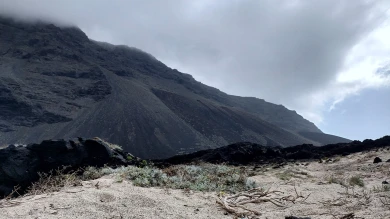
The seminar On Black Study: Towards a Black Poethics of Contamination proposes Black Study as a critical and methodological practice that has emerged in and against racial capitalism, colonial modernity and institutional capture. Framed through what the invited researcher and practitioner Ishy Pryce-Parchment terms a Black poethics of contamination, the seminar considers what it might mean to think Blackness (and therefore Black Study) as contagious, diffuse and spreadable matter. To do so, it enacts a constellation of diasporic methodologies and black aesthetic practices that harbor “contamination” -ideas that travel through texts, geographies, bodies and histories- as a method and as a condition.
If Blackness enters Western modernity from the position of the Middle Passage and its afterlives, it also names a condition from which alternative modes of being, knowing and relating are continually forged. From within this errant boundarylessness, Black creative-intellectual practice unfolds as what might be called a history of touches: transmissions, residues and socialities that unsettle the fantasy of pure or self-contained knowledge.
Situated within Black radical aesthetics, Black feminist theory and diasporic poetics, the seminar traces a genealogy of Black Study not as an object of analysis but as methodological propositions that continue to shape contemporary aesthetic and political life. Against mastery as the horizon of study, the group shifts attention from what we know to how we know. It foregrounds creative Black methodological practices—fahima ife’s anindex (via Fred Moten), Katherine McKittrick’s expansive use of the footnote, citation as relational and loving labour, the aesthetics of Black miscellanea, and Christina Sharpe’s practices of annotation—as procedures that disorganise dominant regimes of knowledge. In this sense, Black Study is approached not as a discrete academic field but as a feel for knowing and knowledge: a constellation of insurgent practices—reading, gathering, listening, annotating, refusing, world-making—that operate both within and beyond the university.
The study sessions propose to experiment with form in order to embrace how ‘black people have always used interdisciplinary methodologies to explain, explore, and story the world.’ Through engagements with thinkers and practitioners such as Katherine McKittrick, C.L.R. James, Sylvia Wynter, Christina Sharpe, Fred Moten, Tina Campt, Hilton Als, John Akomfrah, fahima ife and Dionne Brand, we ask: What might it mean to study together, incompletely and without recourse to individuation? How might aesthetic practice function as a poethical intervention in the ongoing work of what Sylvia Wynter calls the practice of doing humanness?
Intergenerationality
Thursday, 9 April 2026 – 5:30pm
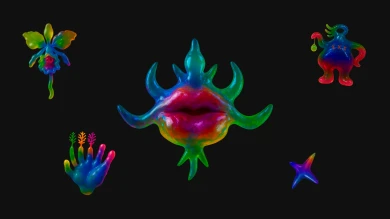
This series is organised by equipoMotor, a group of teenagers, young people and older people who have participated in the Museo Reina Sofía’s previous community education projects, and is structured around four themed blocks that pivot on the monstrous.
The third session gazes at film as a place from which to dismantle the idea of one sole history and one sole time. From a decolonial and queer perspective, it explores films which break the straight line of past-present-future, which mix memories, slow progress and leave space for rhythms which customarily make no room for official accounts. Here the images open cracks through which bodies, voices and affects appear, disrupting archive and questioning who narrates, and from where and for whom. The proposal is at once simple and ambitious: use film to imagine other modes of remembering, belonging and projecting futures we have not yet been able to live.
Thinking with African Guernica by Dumile Feni
Wednesday 25th March, 2026 – 7.00pm
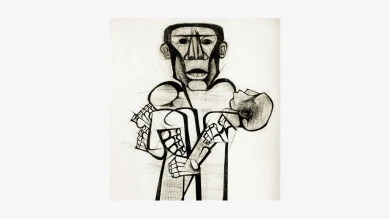
Curator Tamar Garb brings together a panel of specialists from different disciplines, ranging from Art and Social Anthropology to African Studies and the History of violence, on the occasion of the first edition of the series History Doesn’t Repeat Itself, but It Does Rhyme, starring African Guernica (1967) by Dumile Feni (Worcester, South Africa, 1942 – New York, 1991). The aim of this meeting is to collectively reflect on the points of convergence between the works of both Pablo Picasso and the South African artist.
African Guernica is the monumental drawing created by Dumile Feni in the 1960s. The piece is being shown for the first time outside South Africa, in dialogue with Picasso’s Guernica (1937). This provocative physical encounter invites us to consider both artworks as anti-war and anti-totalitarian manifestos, albeit relating to different places and moments.
For this panel, Siyabonga Njica presents the artistic and cultural context of 1960’s Johannesburg, contemporary to Feni’s work. Pumla Gobodo-Madikizela addresses the trauma of apartheid from both aesthetic and oneiric perspectives. Thozama April analyses the artist’s corpus in relation to archival practices and conservation. Finally, Elvira Dyangani Ose offers a reading of African Guernica through the lens of Pan-African modernity and the collapse of the centre-periphery duality.
These events, which form part of the core strands of the Public Programmes department, aim to provide deeper insight into and broaden public engagement with the Museum’s Collections and temporary exhibitions.
History Doesn’t Repeat Itself, but It Does Rhyme. Dumile Feni: African Guernica
Tuesday 24th March, 2026 – 6.30pm
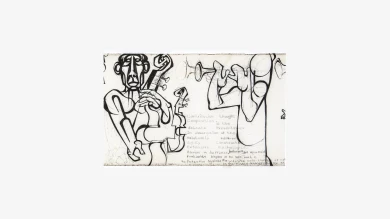
On the occasion of the exhibition History Doesn’t Repeat Itself, but It Does Rhyme. Dumile Feni: African Guernica, its curator Tamar Garb, introduced by Manuel Segade, Director of the Museo Reina Sofía, highlights the opportunities for reflection offered by the presentation at the Museum of African Guernica (1967), the African sibling to Pablo Picasso’s emblematic painting. The event concludes with the live premiere of a musical composition created especially for this event by the South African artists Philip Miller and Tshegofatso Moeng.
African Guernica, the monumental drawing produced by the South African artist Dumile Feni (Worcester, South Africa, 1942 – New York, 1991) in the 1960s, is presented for the first time outside South Africa in dialogue with Picassos’s Guernica (1937). Feni’s work is deeply connected to its place of origin, emerging from the context of state violence and institutionalised racial oppression under apartheid. Viewing both artworks side by side makes it possible to consider their shared references and strategies, their similarities and synergies, as well as the formal and figurative differences that largely result from their geographical and temporal separation.
The musical composition by Philip Miller and Tshegofatso Moeng intends to establish a parallel dialogue between traditional South African sounds and the classical repertoire for strings, voice and wind instruments. A full ensemble of performers from South Africa and Spain has been brought together for this purpose.
These inaugural conversations, which form part of the core strands of the Public Programmes Department, aim to explore in depth the content of the exhibitions organised by the Museum from the perspective of artists, curators and specialists.
Remedios Zafra
Thursday March 19, 2026 - 19:00 h
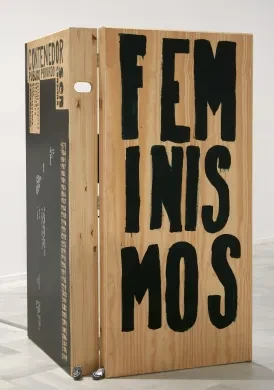
The José Luis Brea Chair, dedicated to reflecting on the image and the epistemology of visuality in contemporary culture, opens its program with an inaugural lecture by essayist and thinker Remedios Zafra.
“That the contemporary antifeminist upsurge is constructed as an anti-intellectual drive is no coincidence; the two feed into one another. To advance a reactionary discourse that defends inequality, it is necessary to challenge gender studies and gender-equality policies, but also to devalue the very foundations of knowledge in which these have been most intensely developed over recent decades—while also undermining their institutional support: universities, art and research centers, and academic culture.
Feminism has been deeply linked to the affirmation of the most committed humanist thought. Periods of enlightenment and moments of transition toward more just social forms—sustained by education—have been when feminist demands have emerged most strongly. Awareness and achievements in equality increase when education plays a leading social role; thus, devaluing intellectual work also contributes to harming feminism, and vice versa, insofar as the bond between knowledge and feminism is not only conceptual and historical, but also intimate and political.
Today, antifeminism is used globally as the symbolic adhesive of far-right movements, in parallel with the devaluation of forms of knowledge emerging from the university and from science—mistreated by hoaxes and disinformation on social networks and through the spectacularization of life mediated by screens. These are consequences bound up with the primacy of a scopic value that for some time has been denigrating thought and positioning what is most seen as what is most valuable within the normalized mediation of technology. This inertia coexists with techno-libertarian proclamations that reactivate a patriarchy that uses the resentment of many men as a seductive and cohesive force to preserve and inflame privileges in the new world as techno-scenario.
This lecture will address this epochal context, delving into the synchronicity of these upsurges through an additional parallel between forms of patriarchal domination and techno-labor domination. A parallel in which feminism and intellectual work are both being harmed, while also sending signals that in both lie emancipatory responses to today’s reactionary turns and the neutralization of critique. This consonance would also speak to how the perverse patriarchal basis that turns women into sustainers of their own subordination finds its equivalent in the encouraged self-exploitation of cultural workers; in the legitimation of affective capital and symbolic capital as sufficient forms of payment; in the blurring of boundaries between life and work and in domestic isolation; or in the pressure to please and comply as an extended patriarchal form—today linked to the feigned enthusiasm of precarious workers, but also to technological adulation. In response to possible resistance and intellectual action, patriarchy has associated feminists with a future foretold as unhappy for them, equating “thought and consciousness” with unhappiness—where these have in fact been (and continue to be) levers of autonomy and emancipation.”
— Remedios Zafra