Held on 20 May 2022
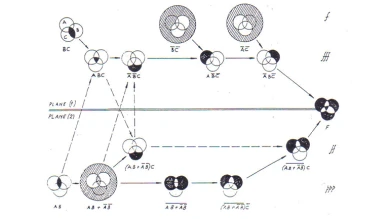
Algorithms is an evening of music based on a set of mathematical instructions describing the homonym concept. On this occasion, the Museo Reina Sofía offers a session of guided listening with two pieces for piano by Iannis Xenakis: Herma (1961) and Evryali (1973), performed by Magdalena Cerezo Falces. To make Xenakis’s method of mathematical composition legible, the performer is joined by musicologist and educator Marina Hervás and artist Marta Verdem, whose visuals are designed specifically for the event. This will be followed by Xenakis’s piece La légende d’eer (1977-1978) performed by musician Sergio Luque, with the collaboration of Juan Carlos Blancas. Musician and architect Iannis Xenakis was born in 1922 at the heart of the Greek community of Brăila, in Romania, his compositions doing justice to Greek mathematical, harmonic and architectural tradition. Xenakis, one of the foremost figures of twentieth-century music, is known for his definition of stochastic music, his forays into algorithmic music and his model of architectural-musical composition via Polytopes.
The aim of the evening is to critically contextualise the figure of this musician in relation to other models of non-European mathematical music and to analyse the implications in the current use of computer algorithms by music streaming platforms.
Juan Carlos Blancas is a sound designer, musician and teacher. He has broad experience in creating sound spaces for audiovisual, literary and stage art projects and specialises in producing field recordings, in addition to the digital transformation and processing of this material via programming environments. Under the alias Coeval he has made music since the 1990s that has been released and disseminated in different experimental audio formats and contexts, mainly in Spain and Europe. He is a founding member of the CRC Cultural Association of Digital Art and is a contributor to different training programmes in the Katarina Gurska Advanced School of Music in Madrid and the Community of Madrid’s ECAM School of Cinematography and Audiovisuals.
Magdalena Cerezo is a pianist and performer specialised in contemporary music. She is the founder of the ensembles LAB51 and f:t, and an honorary member of the Junge Deutsche Philharmonie and a pianist in the Arxis Ensemble. Across her career, she has played in spaces that include Madrid’s National Auditorium, Kölner Philharmonie in Cologne, Berliner Philharmonie, Staatsoper Stuttgart and the Centre Pompidou in Paris, and has performed at festivals such as Darmstädter Ferienkurse and Donaueschinger Musiktage in Germany, ManiFeste in France, and RESIS in Spain. Moreover, she has worked with composers like Beat Furrer, Helmut Lachenmann, Bernhard Lang and Rebecca Saunders and has premiered the works of Ablinger, Sara Glojnarić and Fabián Panisello.
Marina Hervás holds a PhD in philosophy from the Autonomous University of Barcelona, a degree in Philosophy and an MA in Art Theory and Cultural Management from the La Laguna University, and a degree in Music History and Science from the University of La Rioja. She has held pre- and post-doctoral residencies at the Institute of Social Research from the University of Frankfurt and the Arts Academy in Berlin. She is the author of La escucha del ojo. Un recorrido por el sonido y el cine (Exit, 2022) and joint editor, with Pedro Alcalde, of Terremotos musicales. Denarraciones de la música en el siglo XXI (Antoni Bosch, 2020). She is currently an assistant PhD lecturer in the Department of Music History and Science at the University of Granada.
Jesús Jara is a musician, researcher and teacher. After studying Teaching and Computer Engineering at the Complutense University of Madrid, from 2011 to 2015, he studied technology and music in Germany. Since 2015, he has worked in Medialab Prado Madrid, where he approaches sound creation and education through live coding. He has participated in festivals of digital creation such as Festival EXPLORA (Bilbao), In-Sonora (Madrid), Transmediale (Berlin) and AlgoMech (UK), and organised the Fourth International Conference of Live Coding in Medialab Prado (Madrid, 2019). He currently teaches at the María Dolores Pradera Municipal School of Music and Dance in Madrid and is a co-founder of the Electrosound School.
Sergio Luque is a composer of vocal, instrumental and electroacoustic music and researches computer-made music. He holds a PhD in Composition from Birmingham University and post-graduate studies in Sonology, with an honourable mention, from the Royal Conservatoire of the Hague and in Composition from the Rotterdam Conservatory. He co-directs the MA in Electroacoustic Composition and New Media at the Katarina Gurska Advanced School of Music in Madrid. He is also a guest lecturer at the Royal Conservatoire of the Hague and a member of the Birmingham Electroacoustic Sound Theatre (BEAST). Furthermore, he has been a member of the National System of Art Creators in Mexico, and his music has been performed by the Birmingham Contemporary Music Group, the Nieuw Ensemble, the Schönberg Ensemble and Garth Knox, among others.
Marta Verde Baqueiro is a visual artist, digital creator and teacher. Her artistic practice explores indeterministic nature in the relationship between the organic and the electronic in the visible field through the use of noise, repetition and the digital processing of analogue images in real time. Her work materialises through multimedia and light installations and in collaborations with musicians and dancers as she applies the development of her own software and the construction of new devices through digital and/or electronic production. Currently, she is an associate professor at Berklee College of Music (Valencia Campus).
Curators
José Luis Espejo and Jesús Jara
Organised by
Museo Reina Sofía
Sponsor

Participants
Participants
Más actividades
![Tracey Rose, The Black Sun Black Star and Moon [La luna estrella negro y negro sol], 2014.](https://recursos.museoreinasofia.es/styles/small_landscape/public/Obra/AD07091_2.jpg.webp)
On Black Study: Towards a Black Poethics of Contamination
Monday 27, Tuesday 28 and Wednesday 29 of April, 2026 – 16:00 h
The seminar On Black Study: Towards a Black Poethics of Contamination proposes Black Study as a critical and methodological practice that has emerged in and against racial capitalism, colonial modernity and institutional capture. Framed through what the invited researcher and practitioner Ishy Pryce-Parchment terms a Black poethics of contamination, the seminar considers what it might mean to think Blackness (and therefore Black Study) as contagious, diffuse and spreadable matter. To do so, it enacts a constellation of diasporic methodologies and black aesthetic practices that harbor “contamination” -ideas that travel through texts, geographies, bodies and histories- as a method and as a condition.
If Blackness enters Western modernity from the position of the Middle Passage and its afterlives, it also names a condition from which alternative modes of being, knowing and relating are continually forged. From within this errant boundarylessness, Black creative-intellectual practice unfolds as what might be called a history of touches: transmissions, residues and socialities that unsettle the fantasy of pure or self-contained knowledge.
Situated within Black radical aesthetics, Black feminist theory and diasporic poetics, the seminar traces a genealogy of Black Study not as an object of analysis but as methodological propositions that continue to shape contemporary aesthetic and political life. Against mastery as the horizon of study, the group shifts attention from what we know to how we know. It foregrounds creative Black methodological practices—fahima ife’s anindex (via Fred Moten), Katherine McKittrick’s expansive use of the footnote, citation as relational and loving labour, the aesthetics of Black miscellanea, and Christina Sharpe’s practices of annotation—as procedures that disorganise dominant regimes of knowledge. In this sense, Black Study is approached not as a discrete academic field but as a feel for knowing and knowledge: a constellation of insurgent practices—reading, gathering, listening, annotating, refusing, world-making—that operate both within and beyond the university.
The study sessions propose to experiment with form in order to embrace how ‘black people have always used interdisciplinary methodologies to explain, explore, and story the world.’ Through engagements with thinkers and practitioners such as Katherine McKittrick, C.L.R. James, Sylvia Wynter, Christina Sharpe, Fred Moten, Tina Campt, Hilton Als, John Akomfrah, fahima ife and Dionne Brand, we ask: What might it mean to study together, incompletely and without recourse to individuation? How might aesthetic practice function as a poethical intervention in the ongoing work of what Sylvia Wynter calls the practice of doing humanness?
Intergenerationality
Thursday, 9 April 2026 – 5:30pm
This series is organised by equipoMotor, a group of teenagers, young people and older people who have participated in the Museo Reina Sofía’s previous community education projects, and is structured around four themed blocks that pivot on the monstrous.
The third session gazes at film as a place from which to dismantle the idea of one sole history and one sole time. From a decolonial and queer perspective, it explores films which break the straight line of past-present-future, which mix memories, slow progress and leave space for rhythms which customarily make no room for official accounts. Here the images open cracks through which bodies, voices and affects appear, disrupting archive and questioning who narrates, and from where and for whom. The proposal is at once simple and ambitious: use film to imagine other modes of remembering, belonging and projecting futures we have not yet been able to live.
Thinking with African Guernica by Dumile Feni
Wednesday 25th March, 2026 – 7.00pm
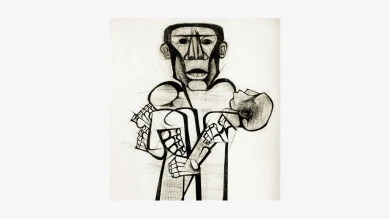
Curator Tamar Garb brings together a panel of specialists from different disciplines, ranging from Art and Social Anthropology to African Studies and the History of violence, on the occasion of the first edition of the series History Doesn’t Repeat Itself, but It Does Rhyme, starring African Guernica (1967) by Dumile Feni (Worcester, South Africa, 1942 – New York, 1991). The aim of this meeting is to collectively reflect on the points of convergence between the works of both Pablo Picasso and the South African artist.
African Guernica is the monumental drawing created by Dumile Feni in the 1960s. The piece is being shown for the first time outside South Africa, in dialogue with Picasso’s Guernica (1937). This provocative physical encounter invites us to consider both artworks as anti-war and anti-totalitarian manifestos, albeit relating to different places and moments.
For this panel, Siyabonga Njica presents the artistic and cultural context of 1960’s Johannesburg, contemporary to Feni’s work. Pumla Gobodo-Madikizela addresses the trauma of apartheid from both aesthetic and oneiric perspectives. Thozama April analyses the artist’s corpus in relation to archival practices and conservation. Finally, Elvira Dyangani Ose offers a reading of African Guernica through the lens of Pan-African modernity and the collapse of the centre-periphery duality.
These events, which form part of the core strands of the Public Programmes department, aim to provide deeper insight into and broaden public engagement with the Museum’s Collections and temporary exhibitions.
History Doesn’t Repeat Itself, but It Does Rhyme. Dumile Feni: African Guernica
Tuesday 24th March, 2026 – 6.30pm
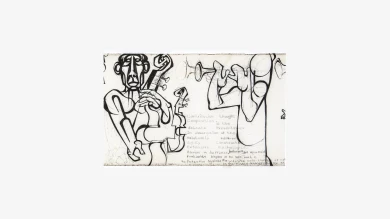
On the occasion of the exhibition History Doesn’t Repeat Itself, but It Does Rhyme. Dumile Feni: African Guernica, its curator Tamar Garb, introduced by Manuel Segade, Director of the Museo Reina Sofía, highlights the opportunities for reflection offered by the presentation at the Museum of African Guernica (1967), the African sibling to Pablo Picasso’s emblematic painting. The event concludes with the live premiere of a musical composition created especially for this event by the South African artists Philip Miller and Tshegofatso Moeng.
African Guernica, the monumental drawing produced by the South African artist Dumile Feni (Worcester, South Africa, 1942 – New York, 1991) in the 1960s, is presented for the first time outside South Africa in dialogue with Picassos’s Guernica (1937). Feni’s work is deeply connected to its place of origin, emerging from the context of state violence and institutionalised racial oppression under apartheid. Viewing both artworks side by side makes it possible to consider their shared references and strategies, their similarities and synergies, as well as the formal and figurative differences that largely result from their geographical and temporal separation.
The musical composition by Philip Miller and Tshegofatso Moeng intends to establish a parallel dialogue between traditional South African sounds and the classical repertoire for strings, voice and wind instruments. A full ensemble of performers from South Africa and Spain has been brought together for this purpose.
These inaugural conversations, which form part of the core strands of the Public Programmes Department, aim to explore in depth the content of the exhibitions organised by the Museum from the perspective of artists, curators and specialists.
Remedios Zafra
Thursday March 19, 2026 - 19:00 h
The José Luis Brea Chair, dedicated to reflecting on the image and the epistemology of visuality in contemporary culture, opens its program with an inaugural lecture by essayist and thinker Remedios Zafra.
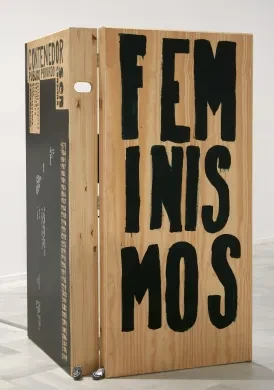
“That the contemporary antifeminist upsurge is constructed as an anti-intellectual drive is no coincidence; the two feed into one another. To advance a reactionary discourse that defends inequality, it is necessary to challenge gender studies and gender-equality policies, but also to devalue the very foundations of knowledge in which these have been most intensely developed over recent decades—while also undermining their institutional support: universities, art and research centers, and academic culture.
Feminism has been deeply linked to the affirmation of the most committed humanist thought. Periods of enlightenment and moments of transition toward more just social forms—sustained by education—have been when feminist demands have emerged most strongly. Awareness and achievements in equality increase when education plays a leading social role; thus, devaluing intellectual work also contributes to harming feminism, and vice versa, insofar as the bond between knowledge and feminism is not only conceptual and historical, but also intimate and political.
Today, antifeminism is used globally as the symbolic adhesive of far-right movements, in parallel with the devaluation of forms of knowledge emerging from the university and from science—mistreated by hoaxes and disinformation on social networks and through the spectacularization of life mediated by screens. These are consequences bound up with the primacy of a scopic value that for some time has been denigrating thought and positioning what is most seen as what is most valuable within the normalized mediation of technology. This inertia coexists with techno-libertarian proclamations that reactivate a patriarchy that uses the resentment of many men as a seductive and cohesive force to preserve and inflame privileges in the new world as techno-scenario.
This lecture will address this epochal context, delving into the synchronicity of these upsurges through an additional parallel between forms of patriarchal domination and techno-labor domination. A parallel in which feminism and intellectual work are both being harmed, while also sending signals that in both lie emancipatory responses to today’s reactionary turns and the neutralization of critique. This consonance would also speak to how the perverse patriarchal basis that turns women into sustainers of their own subordination finds its equivalent in the encouraged self-exploitation of cultural workers; in the legitimation of affective capital and symbolic capital as sufficient forms of payment; in the blurring of boundaries between life and work and in domestic isolation; or in the pressure to please and comply as an extended patriarchal form—today linked to the feigned enthusiasm of precarious workers, but also to technological adulation. In response to possible resistance and intellectual action, patriarchy has associated feminists with a future foretold as unhappy for them, equating “thought and consciousness” with unhappiness—where these have in fact been (and continue to be) levers of autonomy and emancipation.”
— Remedios Zafra