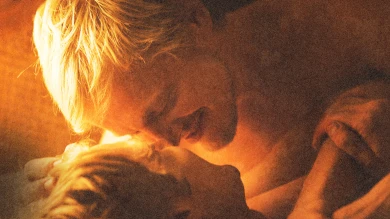
Ira Sachs, Keep the Lights On, 2012, film
Held on 20, 21, 22, 23 Nov 2025
The International Festival of LGBTQIA+ Cinema in Madrid (QueerCineMad) and the Museo Reina Sofía come together to organise a retrospective on Ira Sachs (USA, 1965), a pivotal film-maker in contemporary queer cinema whose work has charted, across three decades, the affects, losses and resistance that traverse the lives of the LGBTQIA+ community. Sachs is the creator of a filmography which conceives of New York as the emotional architecture of his narratives, and as a space of memory, struggle and community. This programme includes the premiere of his most recent film, Peter Hujar’s Day (2025), in Madrid, with the film-maker in attendance in three of its sessions.
Sachs has filmed, with delicacy and conviction, the tensions between desire, precarity and belonging, from his first feature-length film, The Delta (1996), set on the margins of the Mississippi, to Love Is Strange (2014), where a gay couple have to give up their Manhattan apartment after marrying. In Keep the Lights On (2012) intimacy becomes a battleground in confronting addiction and neglect, while Lady (1994), a short film on the solitude of an elderly woman in New York, anticipates his sensibility for bodies made invisible. Last Address (2010) is a silent homage to queer artists who died from AIDS/HIV-related illnesses — Robert Mapplethorpe, Keith Haring, David Wojnarowicz — whereby the façades of the buildings they lived in become intimate monuments, the remnants of history erased through windows. Thus, Ira Sachs’s body of work engages in a profound dialogue with film-makers such as Rainer Werner Fassbinder in situating the gaze at the centre of bodies, in exploring the complexity of the struggle between himself and his films. Further, his practice reverberates through New Queer Cinema, a 1990s film movement that transformed the representation of sexuality from difference.
The director’s presence in Madrid, coupled with the premiere of his new work, makes this film season an event which extols both his career and his form of gazing and inhabiting the city from the queer, the community and the poetic. In these times of eviction and urban homogenisation, Sachs’s film-making reminds us that the neighbourhood can also be a gesture of care, a form of resistance, a future promise.
Organised by
QueerCineMad (The International Festival of LGBTQIA+ Cinema in Madrid) and Museo Reina Sofía
Accessible activity
This activity has two spaces reserved for people with reduced mobility
Agenda
jueves 20 nov 2025 a las 19:00
Session 1. Ira Sachs. The Delta and Lady
The Delta. USA, 1996, colour, original version in English with Spanish subtitles, 85’
Lady. USA, 1994, black and white, colour, original version in English with Spanish subtitles, 28’
“Coming out means to put your authenticity first, before another attempt at pleasing others”, states the leading character of The Delta, Ira Sachs’s debut feature on the double life of a white, middle-class teenager in the 1990s. The film explores the character’s inability to be himself on account of the guilt that stymies his desire — cruising is his way out of being repressed, the only route to finding his own small fiction, the place where he feels he belongs. Sachs employs the stage of desire in the early Gus Van Sant of Mala Noche (1986) and his contemporary Wong Kar-wai with Happy Together (1997). In Lady (1994), meanwhile, an anonymous woman in a red wig welcomes a team of documentary makers into her New York apartment; the team record her daily life as she argues with her boyfriend and gossips with her friend. The scenes alternate with black-and-white images of a woman with a red wig who escapes from suburban life.
viernes 21 nov 2025 a las 19:00
Sesión 2. Ira Sachs. Keep the Lights On
USA, 2012, colour, original version in English with Spanish, 101’
—With a presentation by and conversation with Ira Sachs. In this session, the festival, led by filmmaker Diego Céspedes, presents the honorary award to the director.
Keep the Lights On (2012), winner of the Teddy Award at Berlinale in the same year, is an unembellished depiction of a relationship between two men shaped by addiction, desire and emotional frailty. Set in New York in the early 2000s, the film follows Erik, a Danish documentary film-maker, and Paul, a lawyer with drug addiction issues, in a decade-long vortex of sexual encounters, rifts and reconciliations. Sachs films their intimacy with illuminated rawness, where the body is at once shelter and self-destruction. A vibrant and lonely New York bears witness to a generation looking for meaning in galleries, parties and shared rooms.
sábado 22 nov 2025 a las 19:00
Session 3. Ira Sachs. Love Is Strange
USA, 2014, colour, original version in English with Spanish subtitles, 86’
—With a presentation by and conversation with Ira Sachs
After almost four decades together, Ben and George are finally able to marry after same-sex marriage is legalised in New York. However, shortly after their wedding George loses his job as a teacher at a Catholic school, forcing the couple to sell their apartment and temporarily lead separate lives as they stay with family and friends. This new situation puts their love, dignity and relationships with others to the test. Love Is Strange is a delicate, moving reflection on love later in life, family and the fragile stability of urban life.
domingo 23 nov 2025 a las 12:00
Session 4. Ira Sachs. Last Address and Peter Hujar’s Day
Last Address. USA, 2009, colour, original version in English with Spanish subtitles, 8’
Peter Hujar’s Day. USA, Germany, UK and Spain, 2025, colour, original version in English with Spanish subtitles, 76’
—With a presentation by and conversation with Ira Sachs and David Velduque, a film-maker and host of the podcast Sabor a Queer (Queer Flavour). Premiere in Madrid
Last Address is a short film made for World AIDS Day, in which Ira Sachs shows the façades of the buildings where different New York artists such as David Wojnarowicz, Robert Mapplethorpe and Peter Hujar lived before they died from complications related to the virus. Peter Hujar’s Day, for its part, is a silent elegy which captures the final hours of the New York photographer’s life before he died from AIDS in 1987. Sachs films the hospital, the body, the wait, with a containment that is moving through its integrity. The film, both brief and devastating, becomes an expression of queer memory, a tribute to those whom art and history have left out of the frame. As in Keep the Lights On and The Delta, New York appears as the backdrop to intimacy, desire and loss, yet here the city is reduced to a room, to a body that is extinguished. AIDS, more than an illness, is a context, a collective wound, and Sachs addresses it as an ethics of care in film-making that looks not for responses, but presence. That transforms mourning into image and image into resistance.


Más actividades

Cinema, for the First Time
7 and 14 June 2026 – 12:00 pm
The final session in this Moon Projector season contemplates the feeling around the first experience of cinema — cinema as revelation, magic, fantasy and mystery from the first gaze, from the first contact with the medium, and imagery etched on the retina of childhood. The programme shows Émile Cohl’s landmark Fantasmagorie (1908), the first ever hand-drawn animation, and Ignacio Agüero’s Cien niños esperando un tren (One Hundred Children Waiting for a Train, 1988), a feature-length film on play and the origins of cinema.
Fantasmagorie (1908)by Émile Cohl (Paris, 1857– Villejuif, 1938) is the first expression in the history of animated drawing. Émile Cohl was an illustrator who belonged to the Parisian art group Arts incohérents (1882–1895), who was bestowed with an absurdist and pre-Surrealist talent. Whereas the Lumière brothers were able get audiences out of their seats as they witnessed a train moving towards them in 1895, Fantasmagorie is a supernatural experience, akin to an apparition yet also innocuous and entertaining — the inanimate comes to life out of nothing and figures seemingly move with little sense. From the outset, animation was related to caricature, fabulation and the comical, a sweet spot for the dreams of the youngest audience.
From the discovery of new imagery arising from the animated line to knowledge of the world through a screen, Cien niños esperando un tren (1988), by Chilean director Ignacio Agüero (Santiago, 1952), narrates a group of young people’s discovery of cinema in a workshop on the origins of the medium in a poverty-stricken town on the outskirts of Santiago de Chile. Play, fun and learning combine with a fascination with images, as viewing Émile Cohl’s Fantasmagorie (1908) in the workshop becomes an act of freedom.
Institutional Decentralisation
Thursday, 21 May 2026 – 5:30pm
This series is organised by equipoMotor, a group of teenagers, young people and older people who have participated in the Museo Reina Sofía’s previous community education projects, and is structured around four themed blocks that pivot on the monstrous.
This fourth and final session centres on films that take the museum away from its axis and make it gaze from the edges. Pieces that work with that which is normally left out: peripheral territories, unpolished aesthetics, clumsy gestures full of intent. Instead of possessing an institutional lustre, here they are rough, precarious and strange in appearance, legitimate forms of making and showing culture. The idea is to think about what happens when central authority is displaced, when the ugly and the uncomfortable are not hidden, when they are recognised as part of the commons. Film that does not seek to be to one’s liking, but to open space and allow other ways of seeing and inhabiting the museum to enter stage.
![Joseph Kosuth. One and Three Chairs [Una y tres sillas]](https://recursos.museoreinasofia.es/styles/small_landscape/public/Actividades/joseph_kosuth.jpg.webp)
The (legal) person and the legal form. Chapter III
Monday 11, Wednesday 13 and Thursday 14 May 2026 - Registration deadline extended
As part of the Studies Constellation, the Study Directoship’s annual fellowship, art historian and theorist Sven Lütticken leads the seminar The (Legal) Person and the Legal Form: Theoretical, Artistic, and Activist Commitments to foster dialogue and deepen the hypotheses and questions driving his research project.
The seminar consists of eight sessions, divided into three chapters throughout the academic year. While conceived as non-public spaces for discussion and collective work, these sessions complement, nourish, and amplify the public program of the Studies Constellation.
First session of the third chapter focuses on the transformation of the artwork in the context and wake of Conceptual art. The very notion of the artwork, together with its ownership and authenticity, is reconsidered from a broad perspective open to new and alternative models of management, which could ultimately transform the relationship between artist, artwork and owner. Can some of the practices in question serve as critical models? To what extent is it possible to think and act with them, and extrapolate from them, beyond a beautiful niche?
The second session turns to the question of representation. While many (but not all) human natural persons can, in principle, represent themselves in legal matters, other needs representatives. This goes for minors as well for adults who have been placed under legal guardianship; it applies to fictitious persons such as corporations and states, who need human representatives to sign contracts or defend them in court. We will look into the question of legal representation in conjunction with other forms of representation, in the cultural as well as political register—taking cues from Spivak’s distinction between portrait (Darstellung) and proxy (Vertretung), which is an unstable and historically mutable one.
The seminar concludes with a closing session dedicated to collectively revisiting and reflecting on the themes and discussions that have emerged throughout the first Studies Constellation Residency Program.
Collection. Contemporary Art: 1975–Present
Miércoles 13 de mayo, 2026 - 19:00 h
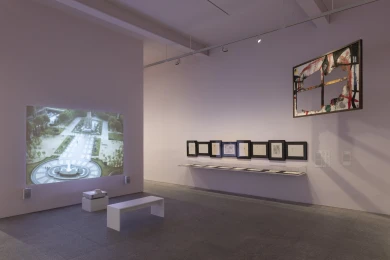
In this lecture, Museo Reina Sofía director Manuel Segade outlines the key readings of the new presentation of the Collection on Floor 4 of the Sabatini Building. This new arrangement is framed inside an ambitious rehang that harnesses the uses of the Museo’s architecture, in a plan that will continue in 2027 with the opening of Floor 3 in the same building, culminating with Floor 2 in 2028.
The new rehang of the Collections, unveiled on 16 February 2026, sets forth a journey through contemporary art history over the past fifty years in Spain. Rather than an unambiguous narrative, the floor recounts the same period — from the Transition to democracy in Spain to the present — in three different ways, starting back at the 1970s time and again.
The exhibition route gets under way with a prologue that travels through the affections, material culture and institutionalism of the Spanish Transition, serving as a starting point for the three routes that follow. The first, A History of Affect in Contemporary Art, advances from affective systems in artmaking linked to the second wave of feminism, arriving at grief as a tool to interpret new realities. The second route, The Powers of Fiction: Sculpture, New Materialisms, and Relational Aesthetics, is conceived as a sculpture gallery in which the artworks engage with the public, focusing on the performance side of the discipline. This route shows, among other aspects, how Spanish sculpture has gained significant international visibility since the 1980s, with women artists playing a key role in this display. The third route, A New Framework. The Institution, the Market, and the Art that Transcends Both, zooms in on the origins of the Museo and its role in the process of art’s institutionalisation in Spain. In May 1986 the Centro de Arte Reina Sofía opened, occupying the first and second floors of the former hospital: the forty years that have elapsed since then enable a re-evaluation of the effects of the Museo on Spanish art and art on the institution.
This talk strengthens the goal of socially integrating the narratives produced by the Museo at a time when the Collections are under permanent review.
Patricia Falguières
Tuesday May 12th 2026 – 19:00 h
Art historian Patricia Falguières inaugurates the María Luisa Caturla Chairwith the lecture Art History in Dark Times. This Chair, dedicated to the reflection on art in times «sick with uncertainty», is aimed at dismounting, digressing and imagining multiple temporalities and materialities in art history and cultural studies from an eccentric gaze, in the sense of being displaced, off-centre or with a centre that is different.
The lecture’s title references Hannah Arendt’s collection of essays Men in Dark Times, which in turn paraphrases a Bertol Brecht poem. In it, Arendt asserts «dark times are not only not new, they are no rarity in history».
Patricia Falguières also claims history knows many periods when the public realm has been obscured, when the world becomes so uncertain that people cease to ask anything of politics except to relieve them of the burden of their vital interests and their private freedom. The art historian —whose expertise is in the field of Renaissance art and philosophy but paying close attention to contemporaneity— invites us to a «chaotic and adventurous journey», from the Italian Renaissance to Fukushima, through which to delve into the questions: What can the practice of art history mean today, in a world ablaze with ominous glimmers and even more ominous threats, if not as mere entertainment or social ornament? Of what vital interests, of what freedom can it bear witness and serve as an instrument?