Matter, Structure, Fragility: Elena Asins’s Works on Paper
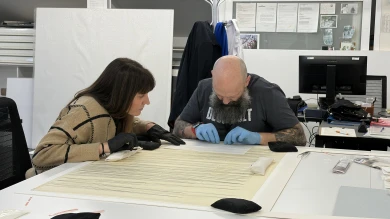
Juan Antonio Sáez and María Sierra preparing a work for framing
The Museo Reina Sofía’s Conservation and Restoration Department has carried out a comprehensive study of the conservation state of over eighty works by artist Elena Asins, pre-selected to be loaned for the exhibition Elena Asins. Structure, Space, Time, organised by the Kutxa Fundazioa, and undertaken the restoration of works that required intervention.
This team’s work has been key to defining the specific guidelines for framing, packing, transporting, installing and displaying the pieces, ensuring their physical integrity throughout the process and guaranteeing optimum conditions of preventive conservation during the loan.
The Conservation and Restoration Team
This conservation and restoration project, carried out from November 2025 to January 2026, has been led by Juan Antonio Sáez Dégano and María Sierra García.
Execution Methods
The ensemble of works is made with different materials — paper, wood, metal — and in an array of sizes, for instance large-scale pieces, sculptures and other supports. Within the selection, the works on paper are the largest in number and, from a conservation point of view, the most fragile, which is why this project has focused specifically on their analysis and treatment.
In Elena Asins’s works on paper, the fragile nature of the support is not merely an additional element but lies at the heart of her artistic practice. Therefore, conserving these pieces calls for a rigorous technical approach and a reading that is mindful of the relationship between form, matter and thought that defines her work as a whole.
Many of these pieces are made on parchment or grease-proof paper, an extremely fragile support characterised by its low mechanical resistance, transparency and high sensitivity to humidity, temperature and handling. In this instance, the paper does not act solely as a support but rather as a structural element within the formal and conceptual system of the work, conditioning both its material stability and decisions made during the conservation process.
State of Conservation
The case-specific, rigorous study of the conservation state of the artist’s works on paper has enabled a series of recurrent alterations to be identified, making an intervention prior to their outgoing loan necessary. The forms of deterioration observed include tears, particularly in the outer areas, warping of the support, adhesive residue from earlier mounting systems and the presence of adhesive tape.
Regarding the works made on parchment paper, the alterations are more pronounced owing to the conditions with which part of the series had entered the Museo Reina Sofía Collection. Some of the pieces had been rolled up when conserved, resulting in sustained stress to the support, persistent warping and a progressive structural deterioration, particularly on the edges and in areas with more frequent handling. This circumstance, coupled with the fragile nature of the material, increases the risk of tears and losses appearing during the handling, transport and installation processes.
The information was captured on maps outlining damages and detailed technical documentation, along with a systematic photographic survey carried out before, during and after the intervention. The resulting documentation was then entered into the Museo’s database to guarantee the traceability of the process and to facilitate both the monitoring of the loan and access to information with a view to future conservation procedures.
Treatment
The interventions have been considered via a framework of minimal intervention and reversible and compatible materials, prioritising the structural stability of the works and improvements made to their legibility, without altering their original appearance.
The treatments carried out include peripheral surface cleaning using erasers of varying degrees of hardness, selected according to the specific resistance of each support. The removal of adhesive tape has been carried out using a micro-jet of hot air, and with rigorous temperature control and application time to avoid warping the parchment paper. The other adhesives were locally removed with a swab and a mix of solvents.
The main tears have been stabilised with a mix of adhesives and reinforced with Japanese paper infills, selected by weight, fibre and tone. Where a particular tear affected the visual reading of the work, localised chromatic reintegration was carried out with an ultra-fine brush and matte paint, adhering to criteria of discernability and stability.
Secondary tears, especially around the edges, have been stabilised with Japanese paper infills and a mix of adhesives.
Conservation-Restoration in the Context of the Loan: Support and Supervision
The project has been developed by adhering to specific guidelines for the exhibition installation, adapted to the material characteristics of each work. Such indications take into consideration aspects such as mounting systems, frame type, handling during installation and recommended environmental conditions for display to ensure that any museological decisions are compatible with preventative conservation criteria.
Furthermore, the restoration team leading the project has actively participated in the mounting and dismounting phases, overseeing the correct handling of the works and verifying that all conditions agreed upon with the borrowing institution are upheld throughout the process. This technical support is especially relevant with works on paper, those which are extremely fragile, and where slight movements can have a major impact on their material stability.
As part of the monitoring of this loan, supervision has also included the transportation of works, which have travelled with a shipment courier, a conservation-restoration professional who is responsible for protecting the works during their transfer, supervising packing, handling and travel conditions and carrying out the necessary checks during the departure and the arrival at the exhibition destination. This role ensures the works’ state of conservation is continually controlled and allows for any potential incidents to be detected immediately.
A Comprehensive Approach
This comprehensive approach highlights how the conservation-restoration is not work in isolation but a transversal process which accompanies the pieces around different institutions. The conservation-restoration professional is, therefore, a key agent in the dialogue between conservation, museography and public display, ensuring that the artworks — in this case the works of Elena Asins — can be shown in optimum conditions, and without compromising their long-term preservation.
About the Artist
Elena Asins (Madrid, 1940–2015) was a Spanish visual artist, writer, lecturer and art critic, and widely regarded as one of the most relevant figures in Conceptual Art in Spain. She developed her work at the crossroads between art, thought and logical systems, situating the intellectual process at the heart of artistic practice.
Across her career, Asins based her visual language on systematic calculation and the exploration of formal structures, incorporating the pioneering use of new technology into Spain’s artistic landscape. This rigorous and analytical approach engendered a body of work which spans multiple formats and techniques, from works on paper to sculptures, video and large-format pieces, essential to which is the relationship between idea, structure and materiality.
Her contribution to contemporary art was honoured with different institutional awards, most notably the Gold Medal of Merit in the Fine Arts from the Spanish Government in 2006 and Spain’s National Prize for Plastic Arts in 2011.


