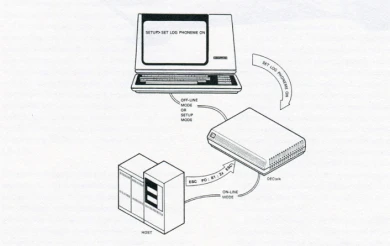
DECtalk DTC01 Owner's Manual, 2a ed, 1984, p.2, fig 1-1, DECtalk Operating Modes

Jaume Ferrete Vazquez. Your father is speaking with my father's voice

Ecolalias I

31 may 2016
8:04
Sound
Experimentation
Gender
Sound Art
Technology
Voice
Body

This piece forms part of Ecolalias (Echolalias), a series of podcasts centred on the paths traced by the voice when it is placed in circulation to become the echo of a body it is inseparable from. This series is also made up of the podcasts Ahora (Now) by Amaia Urra and Brandon LaBelle’s The Voice Agent.

If there are techniques of the body then there are also techniques of the voice, and these are transmitted, and learned and executed. And if there are body techniques of the body then our voices are the product and practice of these techniques; and our voices are the practice and product of those discourses on voices that determine who can speak and how, or that enable someone’s particular vocal qualities – and their character, their gender and other social categories - to be related.

Our voices are the product and practice of these techniques and discourses, and so are synthetic voices. Synthetic voices are also “our voices”. Thus, synthetic voices work as a representation of our voices and, consequently, as an index of those techniques and discourses. Yet synthetic voices are not just representations of our voices, for they are also “our voices”.

Those that we understand to be our own voices and those we understand to be constructed voices actually seem to quote one another.  

Your Father Is Speaking with My Father’s Voice sets out to discern what “our voices” are like and what they do, those that we understand to be constructed and appear to quote those voices that we see as our own, or vice versa.

It is not entirely clear who is speaking.

This podcast quotes or paraphrases texts and interventions by Marisa Belasteguigoitia, Nina Eidsheim, Maite Garbayo Maeztu, Josephine Hoegaerts, Greg Milner, Theo van Leeuwen and Amanda Weidman, in addition to sections from the BBC Radio 4 podcast Klatt’s Last Tapes and the online archive Dennis Klatt's History of Speech Synthesis.

The work of Jaume Ferrete Vazquez (Mollet del Vallés, 1980) revolves around voice politics and ideologies by way of concerts, performance, listening sessions, conversations, sound work and websites. He carries out his work in the spheres of visual arts (Secession, Vienna; Museo de Arte Contemporáneo, Barcelona; and the Urban Video Project, New York), music and stage (LEM Festival, Mercat de les Flors i Antic Teatre, in Barcelona; Poetas por Km2, Madrid; and Festival SOS, Murcia) and education (Creadors en Residencia, Barcelona), among others. His work has received acclaim through a number of grants, awards and residencies at institutions such as the Departamento de Cultura de la Generalitat de Catalunya; Matadero (Madrid); Helsinki International Artists in Residency Project; Vessel Art Projects (Bari); Q-O2 (Brussels) and Casa Vecina (Mexico City), to name but a few. Since 2008 he has coordinated the sound pedagogy project Sons de Barcelona, started by the Musical Technology Group from the Pompeu Fabra University in Barcelona.

Production

Jaume Ferrete Vazquez

License
Creative Commons by-nc-sa 4.0
Audio quotes
  • Marisa Belasteguigoitia. Performance at the opening of Entre palabra e imagen. Galería de pensamiento de Gloria Anzaldúa. 17 de marzo, 2016
  • Nina Eidsheim. Synthesizing Race: Towards an Analysis of the Performativity of Vocal Timbre [en línea]. Trans, Revista Transcultural de Música, 2009, nº 13. Available here.
  • Maite Garbayo Maeztu. Cuerpos que aparecen. Performance y Feminismos en el Tardofranquismo. Consonni, 2016
  • Josephine Hoegaerts. As it echoes South and North. Girls and Boys Singing Identity into the National Landscape. En: Music, Longing and Belonging: Articulations of the Self and the Other in the Musical Realm. Editado por Magdalena Waligórska. Cambridge Scholars Publishing, 2013, pp. 202-221
  • Theo van Leeuwen. Vox Humana: The Instrumental Representation of the Human Voice. En: VOICE. Vocal Aesthetics in Digital Arts and Media. Editado por Norie Neumark, Ross Gibson y Theo van Leeuwen. MIT Press, 2010, pp. 5-16
  • Greg Milner. Perfecting Sound Forever: An Aural History of Recorded Music. Faber & Faber, 2009
  • Amanda Weidman. Anthropology and Voice [en línea]. Annual Review of Anthropology, Octubre 2014, Vol.43: 37-51. Available here
  • Klatt’s Last Tapes [en línea]. BBC Radio 4. 2013. Available here
  • Dennis Klatt's History of Speech Synthesis [en línea]. Available here.  

Jaume Ferrete Vazquez. Your father is speaking with my father's voice

Ecolalias I

Your Father is Speaking with My Father’s Voice

E. Eh. 'E'. This, now, comma, blah. I am a synthetic voice. This, now, comma, blah. I am a synthetic voice. his is a computer’s vocal tract speakeaking. Welcome to the world of speech synthesis. (Pause).

1984, the engineer Dennis Klatt develops the commercial system of speech synthesis, DECtalk. The DECtalk voices are based on recordings of his own voice.

His wife´s

His daughter´s

2013, the daughter of physicist Stephen Hawking finds the daughter of engineer Dennis Klatt. She says to her: Laura, I have to tell you something. Perfect Paul sounds just like my dad. Is Perfect Paul based on your father’s voice?

And she says yes.

Which therefore means that my father is actually speaking with your father’s voice.

And she says yes. It’s amazing. He would be so thrilled. I think it’s been such an amazing experience for me to talk to you about how your father’s life has been transformed by my father’s research. And I had never really thought before that my father’s voice lives on.

My father is speaking with your father’s voice

My father is speaking with your father’s voice

My father is speaking with your father’s voice my father is speaking with your father’s voice

My father is speaking with your father’s voice

Your father, your father, my father’s research, my father’s research, your father’s life, your father’s life. How your father’s life has been transformed by my father’s research. My father is speaking with your father’s voice.

My father is speaking with your father’s voice.

tapapa

tapaba

tachacha

tadada

tafafa

tagaga

tacaca

talala

When I passed through the door I started to sing along with the record, trying to make my voice sound just like on the record.

Me. Singing. With my own voice, and my voice on the machine also singing.

The audience were leaning forward and trying to see my lips, to see if my lips moved. This was the only way of seeing, or knowing, if I was singing or not.

Then the lights went out. And the audience were looking but only saw darkness. And the sound of the music and the voice.

Only the ears could guide them. And their ears failed them.

The lights came on and there I was. Me. With a frozen smile and a still mouth, my mouth.

Now spell.

'Voice', as in: ‘Find your own voice’. 'V'. 'O'. 'I' ‘C’ ‘E’. ‘Find your own voice’.

'V'. 'O'. 'I' ‘C’ ‘E’. ‘Find your own voice’.

Correct! Now spell: ‘Mouth’, as in: ‘Find your own voice, bite your mouth’ 'M'.'O'.'U'.'T'.‘H’. ‘Bite your mouth’

'M'.'O'.'U'.'T'.‘H’. ‘Bite your mouth’ ‘Find your own voice, bite your mouth’

Correct! Now. ‘Bite your mouth, stick out your tongue’. 'T'.'O'.'N'.'G'.'U'.'E'. ‘Stick out your tongue’,

Tongue. 'T'.'O'.'N'.'G'.'U'.'E'. ‘Bite your mouth, stick out your tongue’.

Correct! Now. ‘Twist your tongue, put your body in’. 'T'.'O'.'N'.'G'.'U'.'E'. ‘Twist your tongue, put your body in’.

'T'.'O'.'N'.'G'.'U'.'E'.  ‘Twist your tongue’.

Put your body in.

'B'.'O'.'D'.'Y'. ‘Twist your tongue, put your body in’

Correct, now. Speech. 'S'.'P'.'E'.'E'.‘C’ ‘H’. 'Speech that doesn’t know what it is saying’.

‘S'.'P'.'E'.'E'.'C' ‘H’. 'Speech that doesn’t know what it is saying’.

Correct! Now. Voice. ‘As if your voice was not your own’.

'V'.'O'.'I' ‘C’ ‘E’. ‘As if your voice was not your own’.

Correct! Now. As in the echo.

In the echo, something I’m not, it speaks to me with my own voice, sounding just as I sound.

In the echo. Like the nymph called the the Echo.

A voice like this, what is it able to do?

Now. This is not a voice exactly.

This voice is not a voice exactly.

This voice is not a voice exactly. This voice is not a voice exactly. This voice is not a voice; it is a discourse. This voice is a discourse. This voice is a discourse. It is not clear whose it is exactly. This voice is not a voice inasmuch as it speaks. This voice is a voice inasmuch as it does. It is not clear who is doing it exactly. This voice is not a voice; it is a discourse. This voice is not a voice; it is a discourse. This voice is not a voice exactly. This voice is located in a continuum. This voice is a quote of other voices. This voice is located in the continuum. This one too. And this voice is a quote of other voices. This voice is a discourse. This voice is a discourse. It is not clear who is speaking exactly. Those who are speaking is not clear. Those who are speaking is not clear. Those who are speaking is not clear. Those who are speaking is not clear.

No. A voice is not tied to an identity or specific people.

No, no. A single voice can be produced collectively. A unique voice can be produced collectively.

A single voice can be produced collectively.

Has this voice been produced collectively?

Or not. As speakers we are not compact entities. Listen

You listen. No, no. I don’t have speech organs. My words are not a direct and transparent expression of my subjective experience.

Words are not the direct expression of their subjective experience.

My words are not the direct expression of your subjective experience. The direct and transparent expression of your subjective experience. Your father is speaking with my father’s voice your father is speaking with my father’s voice.

Your father is speaking with my father’s voice. No. Words are not the direct expression of a subjective experience. Are these words the direct expression of a subjective experience?

No, no?

No, listen to this. Vocal timbre is not the unmediated sound of an essential body.

Vocal timbre is not the unmediated sound of an essential body. It is the result of habitual performance that has shaped the physical body.

Vocal timbre is the result of  habitual performance that has shaped the physical body. Vocal timbre is the sound of a performance that has shaped the physical body. An habitual performance that has moulded the physical body.

This. This is performance. Welcome to the world of speech synthesis.