Presentation of the 2025–2026 Programme
The year ahead in the Museo Reina Sofía is shaped by the programme set in motion by the new Management team, encompassing a new presentation of the most contemporary collections in February 2026 and the unveiling of Public Programmes and new lines of research and studies.
The exhibitions, which comprehend the great diversity of modern and contemporary artistic practices, continue to explore the key significance of women in Spanish art-making. This begins with a pivotal artist from the Generation of ’27, Maruja Mallo, and continues with the retrieval of one of the twentieth century’s most important textile artists, Aurèlia Muñoz, from Catalonia. Painting will play a central role in a new retrospective on Juan Uslé twenty years on from the last, while exhibition cinema sees in the new programme in Space 1 through the work of Oliver Laxe. This year, the presence of Latin America will be twofold: firstly, with the intervention of Peruvian artist Andrea Canepa on the canvas covering the Palacio de Cristal and, secondly, with a retrospective on a key figure in the invention of Action Art in the 1960s, the Argentinian artist Alberto Greco, who lived in Spain in the final years of his life. Fernando Sánchez Castillo, an artist from Madrid, will be entrusted with reopening the Palacio de Velázquez following the recent restoration work on its roof. The exhibition programme culminates with a retrospective on the Cuban-born American artist Felix Gonzalez-Torres, one of the most influential artists in recent times and a pivotal figure in the aesthetics that materialised in response to the AIDS epidemic.
The presentation of the Museo Reina Sofía Collections will take place in February 2026, in a fresh narrative stretching across the past fifty years in Spain through the work of more than 200 artists, throwing into relief a new form of accommodating visitors and facilitating ease of access. March will see a unique series get under way which will continue in the coming years: History Does Not Repeat itself, But it Does Rhyme, which places major works with different geographical coordinates and chronologies in dialogue with Guernica. The programme will begin with a work made in the 1960s to decry apartheid in South Africa: African Guernica, by Dumile Feni, a foremost artist of African modernity.
New strands will run through the Museo’s Public Programmes to open its regular programme to new disciplines, for instance contemporary music and comic books, in addition to a series of encounters with agents from different museums, refreshing the debate around the present and future of international contemporary art institutions.
The Reina’s new Studies and Communications directorships join the Deputy Artistic Management Department in this process of renewal. Within the Studies Directorship area, the project from the Cáder Institute of Central American Art (ICAC) combines with the Laboratory of Shared Institutionalism, in addition to the ongoing MA, grant and chair programmes, which all expand the Museo’s academic and research orbits. Salient within Film and New Media is the in-house programme in the Museo’s Cinema, experimentation around exhibition cinema and the research and debate programmes centred on audiovisual creation. With regard to Communications, the publication of the new Museo Reina Sofía website culminates in a process a few years in the making to adapt the Museo’s digital media to user demands, making it not only a tool of dissemination but also a platform to produce content and as an archive of activities.
The transformations in which the Reina is currently immersed are also reflected in its buildings’ architecture — during autumn and winter, work being carried out on the Museo’s Sabatini and Nouvel Buildings will continue, as will the restoration work on the Palacio de Cristal. In the spring, however, the Palacio de Velázquez will re-open its doors with a new exhibition programme.
Finally, 26 May 2026 will mark forty years since the Museo unveiled the Sabatini Building as the Centro de Arte Reina Sofía. This programme is a celebration of this landmark.
Documents

2025-2026 Programme Presentation (English)
High resolution images
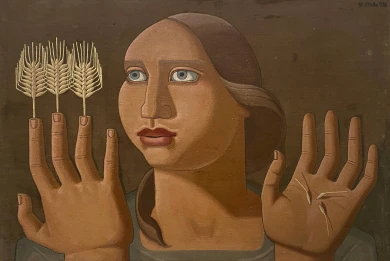
MARUJA MALLO. Wheat surprise (Sorpresa del trigo), 1936

ALBERTO GRECO. ¡Qué grande sos!, 1961

JUAN USLÉ. The Little human element. 1998-1999

AURÈLIA MUÑOZ. Àguila Beige (Brown Eagle), 1977

OLIVER LAXE. HU/هُوَ. Dance as if no one were watching you. 2025

FELIX GONZALEZ-TORRES. Untitled. 1992/1993

ANDREA CANEPA. 2025

FERNANDO SÁNCHEZ CASTILLO. La perla peregrina (proceso)