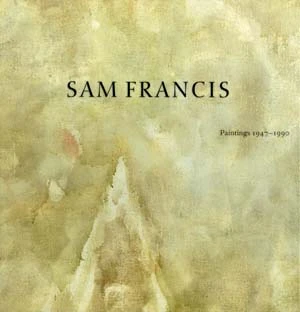
Sam Francis. Paintings 1947-1990

This exhibition of paintings by Sam Francis from 1947 to 1990 in the Museo Nacional Centro de Arte Reina Sofía is made up of sixty-five paintings and twenty-five drawings. Arranged in chronological order, the exhibit opens with California Grey Coast (1947), a small gouache, almost monochrome piece that portrays and outlines the north coast of California. This is the first of the aerial views that commonly appear in Francis' artwork - unsurprising considering his experience as a pilot.
Francis is more inclined to work with paper at the beginning and always deems this medium to be equally important as his canvases. His new ideas often materialise one year or more earlier on paper than on canvas.
Known for his chromatism, his accomplishments with colour begin early while still using a much darker palette than the fiery tones he his recognised for after 1952; the blacks and scales form an important part of his painting from 1950.
The white and grey paintings in the exhibition are the first to bring him recognition as he exhibits in the Galerie du Dragon in Paris in 1952. Quite possibly his most famous work Big Red (1953), acquired by the Museum of Modern Art and included in the 1956 exhibition Twelve Americans, devoted to emerging artists, can be seen in this exhibition. This exhibit and an article from Time Magazine describing him as one of the most sought after artists in Paris ensure his international reputation.
In Abstraction (1954) and Big Orange (1954-55) the forms are clearly larger, clearer and increasingly brighter, a trend that defines his output in the fifteen years that follow. Blue pervades his painting after his encounter with Monet's Nymphéas, a colour that he works with repeatedly once he leaves Paris. There are also some examples in the exhibition of the series Blue Balls, stemming from the recurring ill-health Francis suffers throughout his life and is proof of his dexterity with the mural painting commissions for Kunsthalle in Basel, Tokyo and Berlin.
gThe centre is reserved for youh Francis declares about his painting, revealing the greatest interpretational key to his work. Even in his 1973-1974 paintings, where he applies spattered grids, the centre remains clear. The influence of Jung on the Californian painter also forms a large part of his work in the Seventies. The explosion of colour, great emotional intensity and technical skill characterises his subsequent work in the Eighties and is present until the end of his days. Although decimated by illness, Sam Francis does not cease in his attempts to capture life-force with colour that leads him to work right up until the end; thus he produces a final series of one hundred and fifty-two small paintings, demonstrating the relentless will that drives all great painters.
Artists
The Museum of Contemporary Art, Los Angeles (March 7 - July 25, 1999); The Menil Collection, Houston (September 10, 1999 - January 2, 2000); Malmö Konsthall, Malmö, Sweden (January 29 - May 1, 2000); Galleria Comunale d'Arte Moderna e Contemporanea, Rome (October 30, 2000 - January 28, 2001)
Organised by
The Museum of Contemporary Art, Los Angeles, in collaboration with Museo Nacional Centro de Arte Reina Sofía
Image gallery
Itinerary
Museum of Contemporary Art, Los Angeles
7 March, 1999 - 25 July, 1999
The Menil Collection, Houston
10 September, 1999 - 2 January, 2000
Malmö Konsthall, Suecia
29 January, 2000 - 1 May, 2000
Museo Nacional Centro de Arte Reina Sofía, Madrid
6 June, 2000 - 14 August, 2000
Galleria Comunale d’Arte Moderna e Contemporanea, Roma
30 October, 2000 - 28 January, 2001