Esculturas de las Islas Cícladas. Colección de N.P. Goulandris en el MNCARS
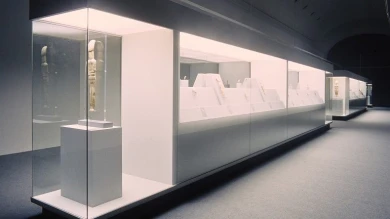
These figurines and heads, whose height fluctuates between 14 and 18 cm, bear witness to the primacy of human beings in the Cyclad culture in such a way that this anthropocentrism marks the repertoire and iconography of their artistic manifestations. The figurines, predominantly feminine, give recognition to people's symbolic will, either dead or alive, and the exaltation of fertility as they use relief to bring out timid facial features - slanting eyes - or those referring to the sex, for instance the pubic triangle.
In terms of the style of the figurines, the specialist Christos G. Doumaslists lists the canonical characteristics that are affirmed in the examples present in the exhibition: the lyre-shaped head, the backward slanting forehead, the arms folded above the abdomen, one over the other, the slightly flexed knees, the tiptoe position, the nose in relief and the pubic triangle. However, in relation to the criteria of scale and other variants, it is noteworthy that in the canonical type there are four varieties, sequenced according to time: Kapsala, Spedos, Dokathisama and Koumasa from the Chalandriani type, with flat forms, a triangular head placed at an angle on a large neck and square shoulders and a flat chest, one of the first signs of the decline of primitive Cyclad art.
In these examples artists found pure and original forms of beauty that they would quickly adopt as an expression of identity between primitive, timeless and universal forms. The significant role that art critics and magazines, poets and collectors, play is also worth noting for the general spread of Cyclad and primitive art; these include Guillaume Apollinaire, Christian Zervos, Tériade, Charles Rattton, George Bataille and the magazines Cahiers d´Art, Documents and Minotaure.
Organised by
Museo Nacional Centro de Arte Reina Sofía
Image gallery