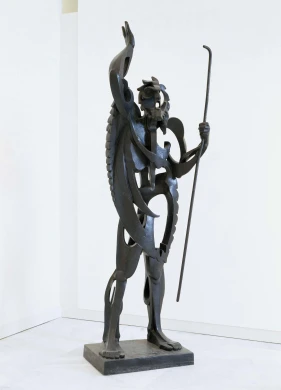
Grand prophète (Great Prophet)
Exhibited
- Date
1933 / Production of 1936
- Edition number
7/7
- Technique
- Sand molded casting
- Materia
Bronze
- Dimensions
- 236 x 75 x 45 cm
- Year of entry
- 1988
- Registration number
- AS02696
- Observations
Entry date: 1988 (from the redistribution of the Museo Español de Arte Contemporáneo [MEAC] collection)
- Credit
Donation of Pierrette Gargallo de Anguera, 1971
Pablo Gargallo, one of the three representatives of modern Spanish sculpture in Paris, along with Julio González and Pablo Picasso, stands out for his technical innovations and use of new materials, thereby unifying classical values and those of modernity in the first third of the twentieth century. A master of metal sculpture, his oeuvre is a compendium of visual, technical and formal wisdom in relation to integrating emptiness into his work, recreating nature via stylised forms sketched in space.
Grand Prophète (Great Prophet) is a large-scale sculpture made in cast bronze which could not have been realised, conceptually, in sheet or forged metal owing to the material’s thickness and the size in which it was conceived. Gargallo sculpted the figure in plaster before later intending to cast it in bronze; however, financial constraints meant it was made posthumously, in 1936.
The prophet theme runs through the early part of the artist’s practice. In 1904, he drew in pen — with fast, confident strokes — a bearded prophet figure, St. John the Baptist, preaching in the wilderness, his right arm raised in an unyielding gesture of predication and human sorrow. Gargallo would later test out the three-dimensional format in sheet metal with the copper bust of Étude de «Prophète» (Study of “Prophet”,1926), also part of the Museo’s Collection, before arriving at this Grand Prophète, an imposing work and iconic within twentieth-century avant-garde sculpture. In 1934, it was displayed at a successful monographic exhibition at the Brummer Gallery in New York and at Sala Parés in Barcelona (in the latter in its original plaster version). That same year, Émile Tériade, editor of the Cahiers d’Art journal, published the sculpture in issue 5 of the Surrealist magazine Minotaure.
Art critic Pierre Cabanne defined the work as a “piece of writing on spatial relations, volume and emptiness, where only the eye of the viewer reconstructs and completes it”. The same critic also highlighted how, if the sculptures of Picasso, Laurens and Lipchitz closed emptiness, then Gargallo managed in this work to open light through its formal structure, defining it as “the icon of the irregular, the unfinished and the full”.
Carmen Fernández Aparicio