Grants and Fellowships
Cáder Institute for Central American Art
The ICAC grants and fellowships programmes, awarded by the Museo Reina Sofía Foundation, seek to support researchers, art professionals and students in their contributions to the expansion and development of the Central American art ecosystem.
Research Fellowship
Each year, the Museo Reina Sofía Foundation awards an annual ICAC Research Fellowship, which includes financial support and mentorship from the Museum, for the development of an original research project on Central American art.
The fellowship lasts ten months and has the following main objectives:
- The development of an independent research project that explores in depth the questions that define and shape the scenes and histories of art in Central America. The fellow receives guidance and support from the Museum’s Study Center, which provides tools, resources, and networks, as well as a space for exchange and research alongside other residents.
- Active exchange with the Collections teams and with the Library and Documentation Center, with the aim of expanding knowledge of Central American artists within the Museum’s holdings.
- Collaboration with the departments of Museo Tentacular, Film and New Media, and Public Programs.

Antonio Pichillá, Anudar y desanudar (Knot and Untie), 2015
Museo Reina Sofía. Long-term loan of Fundación Museo Reina Sofía, 2020 (Donation of José Antonio Llorente)
2027 Call
- Call
- Contact: ICAC@museoreinasofia.es
- Fellowship application period: from 14 May to 30 June 2026.
Resident researcher
The 2026 Research Fellowship has been awarded to Liz Lasso.
Liz Lasso is an independent curator and researcher focused on archival processes, artistic research, and collective curatorial practices that explore affect as a working methodology. Her approach centers on collections from a critical perspective that connects memory, contemporary art, and community access, with an emphasis on decolonial rereadings of local narratives. Until 2025, she managed the collection of the Museo de Arte Contemporáneo de Panamá (MAC Panamá).
With the project This story has not been told many times. Experimental Art in Panama, Lasso seeks to study a little-documented generation of artists who, in a context of political and institutional change, became involved in avant-garde practices during the 1970s and 1980s in Panama.
The ICAC 2025 resident researcher was Salvadoran curator, artist, and professor Patricio Majano.
Patricio Majano is a curator and cultural manager. He holds a degree in Fine Arts from the University of El Salvador, and his work focuses on Central American artistic practices and their diasporas, in connection with the region’s political urgencies. His career has developed primarily within El Salvador’s art field: as curator and Head of Programming at Y.ES Contemporary, a pioneering platform for the promotion of contemporary art; as a professor at the School of Arts of the University of El Salvador; and as a collaborator in the educational programs of the Museo de Arte de El Salvador (MARTE) and Museo Forma in San Salvador, respectively. He is a member of the ICAC Advisory Committee.
Under the title Amputated Identities: Ghosts in Salvadoran Art, his research traces genealogies and resonances between contemporary Salvadoran art, the 1932 Indigenous genocide, and the civil war (1980–1992), examining how these unresolved forms of violence operate as artistic material.
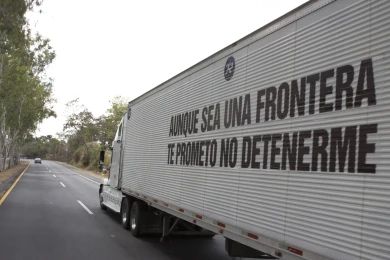
Ernesto Bautista, Nuevas promesas (New Promises), 1987
Museo Reina Sofía. Long-term loan of Fundación Museo Reina Sofía, 2020
(Donation of Patricia Phelps de Cisneros in honour of Mario Cáder-Frech)
In support of education and academic training, this annual scholarship is intended for students of Central American origin whose application has been accepted into the Master’s Degree in Contemporary Art History and Visual Culture, jointly offered by the Universidad Complutense de Madrid and the Universidad Autónoma de Madrid in collaboration with the Museo Reina Sofía.
Awarded by the Museo Reina Sofía Foundation, the fellowship covers full tuition for the Master’s program, as well as a travel and living allowance.
2026–2027 Call for Applications
- Call
- Resolution
- Contact: ICAC@museoreinasofia.es
The recipient of the 2026-2027 ICAC Scholarship is Ana Farach Corrales.
- Admission to the Master’s program (UCM):
First application period: January 28 – February 28, 2026
Second application period: April 27 – May 22, 2026 - Admission to the Master’s program (UAM):
Single application period: February 4 – April 1, 2026 - Fellowship application period:
March 24 – June 21, 2026. In order to apply for the scholarship, candidates must have successfully completed the admission process to the Master’s Degree in Contemporary Art History and Visual Culture (MHACV).
2025-2026 Call
The recipient of the 2025-2026 ICAC Scholarship is Josseline Pinto.
Josseline Pinto, independent curator, researcher, and lecturer.
She holds a degree in Art History from Centro de Cultura Casa Lamm (Mexico City, Mexico) and has served as Exhibitions Coordinator at the Centro Cultural de España in Guatemala. She has been co-founder and director of MANIFESTO-espacio, a curatorial project dedicated to contemporary art; Chief Curator of La Galería Rebelde (Guatemala); and a lecturer at the Escuela Municipal de Artes Visuales (Guatemala). She has collaborated with institutions such as the Bienal de Arte Paiz, Fundación Paiz, FUNBA, and La Fototeca, and has participated in curatorial training programs at TEOR/éTica in Costa Rica, as well as at ICI and La Tallera in Mexico.
Her essays have been published in books and specialized art journals in Latin America. Among her recent curatorial projects are exhibitions at the Centro Cultural de España in Guatemala and in Mexico, the United States, and Europe. Her practice brings together writing, teaching, and curating as forms of critical thinking and artistic mediation.
CIMAM Grant
ICAC seeks to serve as an instrument that provides an infrastructural dimension to the sustained work carried out in and on the Central American region, connecting it through international networks and alliances. Through the CIMAM Grant, ICAC supports Central American contemporary art professionals in traveling to attend the annual CIMAM conference and becoming part of this valuable professional network. This fellowship is granted by the Museo Reina Sofía Foundation (FMRS) on behalf of the Cáder Institute for Central American Art.
CIMAM (International Committee for Museums and Collections of Modern Art) is a global network of professionals and specialists working in modern and contemporary art museums. The network is composed of directors and curators working within the institutional field of art centers, collections, and archives.

Moisés Barrios, Banana Absolut, 1996
Museo Reina Sofía. Long-term loan of Fundación Museo Reina Sofía, 2020
2025–2026 Call for Applications
The recipient of the CIMAM Grant for the 2025–2026 call was Sofía Villena Araya.
Sofía Villena Araya, Chief Curator of the Museo de Arte y Diseño Contemporáneo (MADC) in San José, Costa Rica
She holds a Master’s degree in Contemporary Art Theory from Goldsmiths, University of London, and is currently a doctoral candidate in Society and Culture Studies at the University of Costa Rica. Her work interweaves historical research, artistic experimentation, and pedagogy to address issues related to collective processes in contemporary art, particularly in the Central American region.
She is part of the transnational curatorial collective Topsoil, together with Amelie Wedel (Berlin) and Deniz Kirkali (Istanbul), and has participated in international residencies such as the Performance Festival Reunión-Honduras (2023). Among the exhibitions she has curated are: Revocar by Guatemalan artist Yavheni de León (2022); Glosario para un gobierno vegetal by Costa Rican artist Christian Wedel (2023); Territorios domésticos, co-curated with Erika Martin at TEOR/éTica (2024); and Encuentros: poéticas del duelo y la regeneración at the Museo de Arte y Diseño Contemporáneo (MADC) in Costa Rica (2024–2025). Her publications appear in edited volumes such as Lo curatorial desde el Sur (2021) and Saber/desconocer: pedagogías relacionales y prácticas artísticas en Centroamérica (2022).
Subscribe to the ICAC Newsletter
Receive all updates from the Cáder Institute for Central American Art