
Held on 17 Mar 2023
Project 30. Sketches of Heights is a site-specific performance which reflects, through a collective footprint and oral storytelling, on the memory of women during Franco’s dictatorship. It stems from research —conducted in Madrid during July of 2022— into thirty women who explored the body at once as a wound and as a territory of resistance.
During the performance, artists and spectators establish a dialogue on the repression, and real experience within this framework, of some of the pieces that are part of the Museo Reina Sofía Collection. During this exercise, memory abandons the private sphere to become a public and common experience.
Project 30 is an international proposal which is part of the story Bosquejo de alturas (Sketches of Heights), by Argentinean writer Alicia Kozameh, reflecting on the footprint dictatorships leave impressed upon collective memory. It has been developed over the past ten years by director Sylvie Mongin-Algan and her theatre company Les Trois-Huit, with more than 160 artists participating and touring around France, Chile, Mexico, Uruguay, Brazil and Argentina.
The performance begins at the Meeting Point (Sabatini Building, main entrance), and continues with a tour around Episode 1. Avant-garde Territories: City, Architecture and Magazines on the Collection (Sabatini Building, Floor 2), concluding in the Sabatini Building’s Garden.
Credits
Artistic direction for Project 30:Sylvie Mongin-AlganArtistic direction in Madrid:Eva Redondo and Jana PachecoProduction:Les Trois Huit, Iberescena and Festival Ellas CreanExecutive production:Akiko Matignon and Daniela SchmidtPhotographs and promotional video:Sandra DominiqueActrices participantes en el proceso de investigación:Gabriela Alarcón Fuentes, Marta Alonso, Ana Benito, Alizée Bingöllü, Ascen Caballero, Tatiana Carel, Belén Chanes, Fátima Delgado, Patricia Domínguez, Vanessa Espín, Mara Guevara, Marina Herranz, Laura Jabois, Pilar Martín García, Patricia Medina, Amaranta Osorio, Leticia Pascual, Victoria Peinado, Denise Perdikiris, Antonella Pinto, Cristina R. Cejas, Georgina Rey, Lola Robles, Laura Rubio Galletero, Daniela Schmidt, Alba Taboada GarcíaActresses participating in the performance:Rocío Agost, Gabriela Alarcón Fuentes, Jessica Belda, Ana Benito, Alizée Bingöllü, Ascen Caballero, Gema Cañón Galeano, Joséphine Caraballo, Tatiana Carel, Belén Chanes, Fátima Delgado, Laura Jabois, Sarah Kristian, Charo Martín, Pilar Martín García, Nizra Martínez Dinamarca, Patricia Medina, Nicole Mersey, Amaranta Osorio, Victoria Peinado, Denise Perdikidis, Antonella Pinto, Claudia Quiroga, Georgina Rey, Manuela Rodríguez, Laura Rubio Galletero, Saida Santana, Verónica Santos, Alba Taboada García, Leticia Torres, Celina Fernández Ponte
Organised by
Museo Reina Sofía
With the support of
Acknowledgements
Teatro de La Abadía
Inside the framework of
TIZ 8. Feminist Power and Festival Ellas Crean
Más actividades
![Blake Edwards, The Party [El guateque], 1968, película](https://recursos.museoreinasofia.es/styles/small_landscape/public/Actividades/ciclocine-piscinas-14.jpg.webp)
Blake Edwards. The Party
Thursday, 20 August 2026
In The Party, actor Hrundi V. Bakshi (Peter Sellers) is mistakenly invited to a glamorous dinner party in Hollywood. His curiosity and two left feet lead to one funny mishap after the other. During the soiree he consoles Michèle, a young actress who has been fired by her producer, and the chaos gathers momentum when Bakshi accidentally opens a retractable floor, making the guests fall into a swimming pool. A small hippie-style elephant gatecrashes the party, brought by a group of young people, and Bakshi asks the guests to wash the elephant as it is a sacred animal in his country. The house fills with soap suds, culminating in a wackily chaotic party.
When Stanley Kubrick was once asked who Peter Sellers was, he replied: “There is no such person as Peter Sellers”. The Party is one of the most widely recognised comedies in the history of film, its director Blake Edwards and the English actor making an entertaining critique of a fading conservative society. The cultural revolutions of the 1960s fit into the container of a choppy swimming pool: people from high society, an elephant, a Russian ballet, waiters, beatnik youth… similar to Sellers’s own identity: an empty vessel that can be refilled. In the film, Edwards tapped into the ingenious actor’s innate improvisation and the swimming pool as a container for revolutionary intent.
Lucrecia Martel. La ciénaga (The Swamp)
Viernes 21 de agosto, 2026
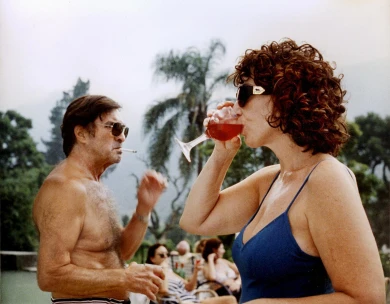
A couple of families spend the summer in a country cottage. The relationship between them exposes a crisis. The alcoholism of Mecha (Graciela Borges) and Gregorio (Martín Adjemián) becomes clear, leading to a drift in the education of their children and impacting relationships of respect and affect. Weariness expresses the lackadaisical environment.
In La ciénaga Lucrecia Martel approaches the decadence of a middle-class Argentinian family. The pool of dirty, stagnant water reflects the economic and social collapse of a whole country, yet reflects more than economic crisis as it becomes a murky well feeding off the pain of those living in the house. An erstwhile space of joy, the swimming pool becomes a reflection of adult depression, resulting in apathy. And the children, especially the girls, seem to be the only people awake in this drift. Barring a flicker of unawareness, the young people immerse themselves in rainwater or the water from the river, in water that flows, but are cautious of getting too close to the swimming pool.
![Yorgos Lanthimos, Kynodontas [Canino], 2009, película](https://recursos.museoreinasofia.es/styles/small_landscape/public/Actividades/ciclocine-piscinas-16_00.jpg.webp)
Yorgos Lanthimos. Dogtooth
Saturday, 22 August 2026
A couple with three adult children live in a modern country cottage. A large swimming pool takes centre stage in a sizeable garden. The property is skirted by a large fence that blocks a view of the outside. Here, the father has educated his children without outside contact, maintaining their belief in a false world: aeroplanes fall in the garden like toys and they must act like dogs to defend themselves from the ferocious cats that surround the house. The promise of going out into the world when they lose their dogtooth is proof of their maturity.
Lanthimos builds a world that is surreal, comical and terrible. The swimming pool is the house’s central element, a limited, controlled space assimilated like the sea, yet under the father’s supervision. A space of imagination, but with sinister intentions: the children are indoctrinated under the water as they believe in a better world. Far from reality. The swimming pool’s limits are the limits of their freedom, a false state of well-being expressed in the weightless bodies in the water. The liquid element is an analgesic magma with the power to educate offspring under the latent fear of a shark bite.
![Binka Zhelyazkova, Baseynat [La piscina], 1977, película](https://recursos.museoreinasofia.es/styles/small_landscape/public/Actividades/ciclocine-piscinas-17_00.png.webp)
Binka Zhelyazkova. The Swimming Pool
Viernes 28 de agosto, 2026
The young, bright Bella (Yanina Kasheva), after unforeseen heartbreak at her graduation party, meets Apostol (Kosta Tsonev), a reserved architect, and Boyan (Kliment Denchev), a comedy actor who is cynical about his country. The three characters climb up to a diving board in a municipal swimming pool, where they begin a strange relationship of friendship, love and despair which reflects a generational clash.
Binka Zhelyazkova, the great enfant terrible of Eastern European cinema, critic of the communist system and widely acclaimed film-maker beyond Bulgarian borders, made in The Swimming Pool a masterly metaphor for a country in decline. The public pool symbolises a closed, immovable enclosure where society is festering. From the height of a diving board she sees, in a panoptic view, the different generations living underneath a limited space. On one side, older people attempt to preserve the old revolutionary spirit with constant collective swimming exercises while, on the other, young people don’t hide the desire for freedom that remains unrealised. The result is an ideological clash in how to act and move in the enclosure, unearthing vast hypocrisy in the lost ideals of socialism, reflected in the total apathy of youth. The Swimming Pool for Zhelyazkova is a reflection of the disillusionment and existential void of a whole country and system.
![Jacques Deray, La piscine [La piscina], 1969, película](https://recursos.museoreinasofia.es/styles/small_landscape/public/Actividades/ciclocine-piscinas-18.jpg.webp)
Jacques Deray. The Swimming Pool
Saturday, 29 August 2026
The characters played by Alain Delon (Jean-Paul) and Romy Schneider (Marianne) experience their love in apparent splendour. A sun-drenched house, a blissful swimming pool, beautiful bodies, sexuality in abundance. The visit of Harry (Maurice Ronet), a successful musician, friend of Jean-Paul and ex-lover of Marianne, accompanied by his young and beautiful daughter Penélope (Jane Birkin), rocks their relationship, bringing to light the jealousy and insecurities of each one in a dark game of possession and male rivalry.
If there was a definition of the glistening blue pool in this sexual thriller, it would be the paradise of Adam and Eve, represented by the shots of happiness of Romy Schneider and Alain Delon in this swimming pool on France’s Côte d’Azur. The appearance of these two beautiful creatures kissing semi-naked by the water is one of film’s resonant images. The paradise cannot be fractured, not even by death. As in the crossing of the Tigris and Euphrates rivers, where humanity’s first lovers bathed naked in the water, innocent to their imminent end, the reflection of the crystalline water of The Swimming Pool shows this game, and the deep traumas which, under this mantle, are hidden in the amorous relationships and limits that only love is capable of breaking to solve.
In this session both endings to the film are screened: the original version, open and symbolic, and the Spanish version, marked by censorship during Francoism, and its sequence for a Spanish premiere — a stereotypical and reductive vision reflecting the sociological condition of the country.