-
Thursday, 5 October 2023 – 7pm / Second session: Saturday, 21 October 2023 – 7pm Sabatini Building, Auditorium
Session 1. Non-Human Montage
Emilio Vavarella. Animal Cinema
Italy, 2017, colour, sound, DA, 11’Artavad Peleshian. La nature
Armenia, Germany and France, 2020, b/w, sound, DA, 63’— With a presentation by James Lattimer in the first session
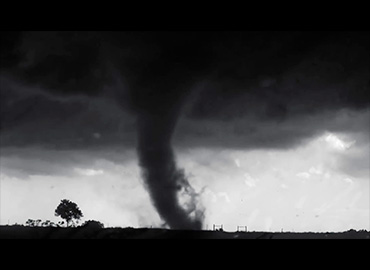
Film has many specific tools available to capture non-human perspectives, with montage being one of them. Animal Cinema offers a fascinating compendium of YouTube videos showing animals stealing cameras and operating them instinctively: a film co-directed by squirrels, monkeys, lions and birds, in which Vavarella’s flexible and subtle editing combines these different perspectives in a free-flowing and non-human view of the world. La nature, the first work by Artavazd Pelechian after a twenty-five-year film-making hiatus, also belongs to the found footage genre, its title referring directly to the Armenian film-maker’s interest in the patterns of nature. This documentary film on natural catastrophes fuses black-and-white images from disparate sources with grainy textures and layers: views from heights, volcanic explosions, lava flows, avalanches, icebergs melting, storms, tsunamis, hurricanes and tornadoes which evoke a world on the precipice that is all too current — an instructive reminder of the dominance of nature before human efforts to contain it.
-
Friday, 6 October 2023 – 7pm / Second session: Friday, 20 October 2023 – 7pm Sabatini Building, Auditorium
Session 2. Nobody Is an Island
Helena Girón y Samuel M. Delgado. Bloom
Spain, 2023, colour, original version in Spanish, DA, 17’Mark Jenkin. Enys Men [Isla de piedra]
UK, 2022, colour, original version in English with Spanish subtitles, DA, 91’— With a presentation by and conversation with Helena Girón and Samuel M. Delgado in the first session
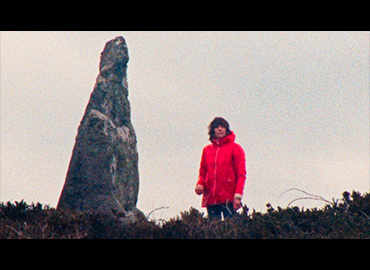
Islands are like miniature worlds, small-scale ecosystems demarcated by water and with landscapes and specific cycles that can highlight global trends and changes. They are also perceived as places of isolation, spaces removed from the concerns of the continent which appear to possess their own rhythms and ways of life. Bloom refers to the legend of Saint Brendan, the mythical and mysterious ninth island of the Canary Islands archipelago which appears and disappears at will: mountains rising above sandy beaches, stretches of tropical plants as far as the eye can see, underwater rock formations undergoing scientific research through robotic tools. Enys Men, meanwhile, speaks of an island off the coast of Cornwall, also a place of scientific interest which, simultaneously, is inhabited by spirits from an era in which people went to extract tin from its land and left behind a landscape where nature erases all traces of human intervention. The year is 1973 and a volunteer begins living on the otherwise deserted island to observe the unique flowers that grow there. As the days unfold in their monotony, the environment increasingly engulfs her and the lichens start to grow on her flesh as well as the flowers. Her relationship with the landscape brings to mind the verses of English poet John Donne: “No man is an island, entire of itself. Every man is a piece of the continent, a part of the main”.
-
Saturday, 7 October 2023 – 7pm / Second session: Thursday, 19 October 2023 – 7pm Sabatini Building, Auditorium
Session 3. Telling Stories of the Non-Human
Sky Hopinka. Fainting Spells
USA, 2018, colour, original version in English with Spanish subtitles, DA, 11’Deborah Stratman. Last Things
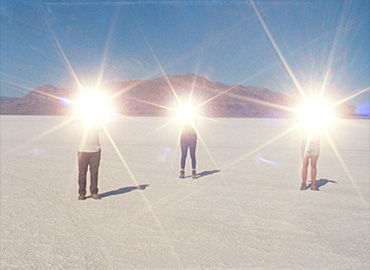
France, USA and Portugal, 2023, colour, original version in English and French with Spanish subtitles, DA, 50’Non-human realities have always been customary themes of narrations and myths, yet all film-makers depend on the power of the imagination if they wish to represent their vision of the world. In Fainting Spells, Sky Hopinka weaves a series of stories around Xąwįska (the Indian Pipe Plant), used by the Ho-Chunk Nation to revive those who have fainted. We witness conversations with a plant as guide, protector and friend, and which also shows a unique Indigenous concept of nature. Last Things takes as its point of departure two short novels by J.-H. Rosny, the pseudonym of French-Belgian Joseph-Henry-Honoré and Séraphin-Justin-François Boex, to explore the perspective of rocks. These early works of speculative fiction are coupled with, via strangely sensual scientific diagrams, references to a broad array of theoretical and fictional texts (among them, by Donna Haraway and Clarice Lispector) and successive images of the mineral world and its most astounding aspects. The latest work by Deborah Stratman, with its characteristic density and digressions, is at once apocalyptic and optimistic: stones survive everything, even us, and there is a strange consolation in them.
-
Wednesday, 11 October 2023 – 6pm / Second session: Monday, 23 October 2023 – 7pm Sabatini Building, Auditorium
Session 4. The Outside World Unseen
Rose Lowder. La source de la Loire
France, 2022, colour, sound, 16mm, 20’Jacquelyn Mills. Geographies of Solitude
Canada, 2022, colour, original version in English with Spanish subtitles, DA, 103’— With a video presentation by Jacquelyn Mills
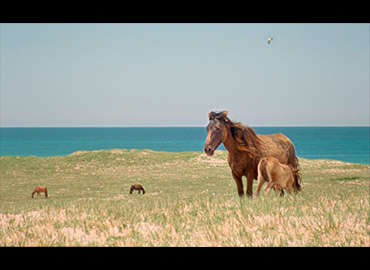
Allowing time to explore a specific place is also often the best way to evoke the world that lies outside, and with all the tensions this entails. In her recent short film The Birth of the Loire, Rose Lowder, a film-maker who has devoted her life to examining the relationship between human beings and nature, travels through the upper course of the Loire River, a stretch considered the last wild river in Europe but one which is little more than a murmuring stream in the mountains. In the process, she separates sound and image to single out the perception of each one. As the stream becomes a torrent and despite the natural serenity of the zone, the city constantly looms in the background of the frame. In Geographies of Solitude, meanwhile, Jacquelyn Mills travels to a tiny and uninhabited Canadian island called Sable Island to weave a tender and clever portrait of aficionado naturalist Zoe Lucas, who has devoted her life to classifying the island’s plant and animal life. With wild horses, insects and grasses and herbs there are also growing quantities of waste plastic that wash onto the beach, the effects of an unruly ecosystem of consumption which still, from a distance, exerts pressure on this remote location.
-
Thursday, 12 October 2023 – 7pm / Second session: Wednesday, 25 October 2023 – 7pm Sabatini Building, Auditorium
Session 5. Without Clear Borders
Kantarama Gahigiri. Terra Mater - Mother Land
Rwanda and Switzerland, 2023, colour, original version in English and Swahili with Spanish subtitles, DA, 10’Mary Helena Clark y Mike Gibisser. A Common Sequence
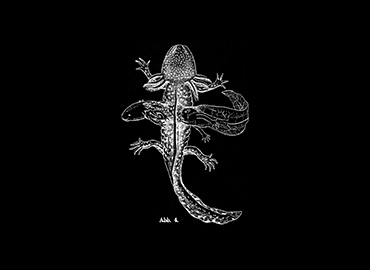
Mexico and USA, 2023, colour, original version in English, Spanish and Lakota with Spanish subtitles, DA, 78’Although dividing the world into the human and the non-human is a comfortable way to measure our impact on nature, the reality is inevitably more complex since human beings are part of the natural world and are inseparable from it. Terra Mater - Mother Land shapes an oneiric picture of a perfectly hybrid landscape: a landfill in Rwanda surrounded by trees and populated with birds and human beings, resulting from both colonialism and the extraction of minerals and globalisation. A Common Sequence is an essay which also follows the traces of a border running between the natural and the human that is increasingly blurring, establishing connections between a Mexican axolotl which only continues to exist through scientific interference, recently patented apples from an orchard in the USA collected through artificial intelligence and Indigenous efforts to protest against the commercialisation of the human genome. In a film packed full of paradoxes, perhaps the most severe is the fact that human intervention is the only way to inhabit a world that becomes a wreck precisely through our intervention.
-
Friday, 13 October 2023 – 7pm / Second session: Friday, 27 October 2023 – 7pm Sabatini Building, Auditorium
Session 6. The Life of Plants
A Selection of Films Chosen by Leandro Listorti
Courtesy Museo del Cine de Buenos Aires— With a presentation by Leandro Listorti
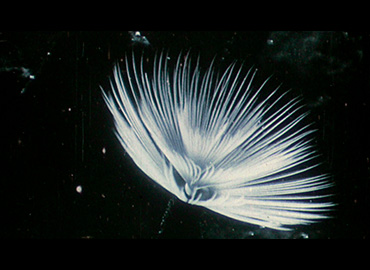
Despite this series focusing on how contemporary film-makers have captured the relationship between humanity and the natural world, its subject matter is inscribed within a long tradition of filmic commitment to nature stretching back to the dawn of cinema. In this special session, film-maker and archivist Leandro Listorti, the director of Herbaria (2022) and the current beneficiary of the Joaquim Jordà residency organised by the Museo Reina Sofía, presents and contextualises a selection of 16mm films on nature and botany belonging to the archive of the Museo del Cine in Buenos Aires, where Listorti has worked since 2016.
-
Saturday, 14 October 2023 – 7pm / Second session: Saturday, 28 October 2023 – 7pm Sabatini Building, Auditorium
Session 7. Natural Immersion
Apichatpong Weerasethakul. Night Colonies
USA and Thailand, 2021, colour, original version in Thai with Spanish subtitles, DA, 14’Carlos Casas. Cemetery
France, UK, Poland and Uzbekistan, 2019, colour and b/w, original version in Sinhalese with Spanish subtitles, DA, 85’— With a presentation by and conversation with Carlos Casas in the first session
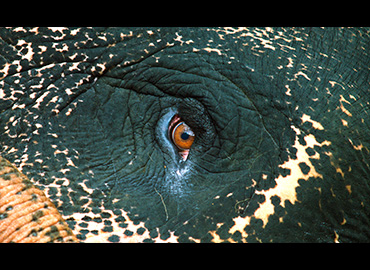
There is not one unique nature and film is an indispensable medium for visiting, experimenting with and becoming immersed in the richness and diversity of the natural world. An immersive quality owing largely to sound, which can take us to specific environments images alone cannot. The films of Apichatpong Weerasethakul have always put forward fluid borders between the human and the non-human, particularly through his exquisite soundscapes, with Night Colonies no exception. This hypnotic short film transports the viewer to a cabin, seemingly devoid of human life in the middle of the jungle, during a storm. A swarm of buzzing insects gather in the cabin’s bed to soften, with their din and the howling wind, any human concern. The Sri Lankan jungle is also depicted with an immense richness of sound in Carlos Casas’s Cemetery, the story of a mythical and sensorial journey to an elephants’ graveyard. Poachers who try to capture a hundred-year-old elephant and its carer are progressively engulfed by the sound of animals, trees and water until there is only a darkness which fuses into that of the auditorium.
-
Wednesday, 18 October 2023 – 7pm / Second session: Thursday, 26 October 2023 – 7pm Sabatini Building, Auditorium
Session 8. Bringing Nature to the City
Nour Ouayda. The Secret Garden
Lebanon, 2023, colour, original version in Arabic with Spanish subtitles, DA, 27’Phillip Warnell. Ming of Harlem: Twenty One Storeys in the Air
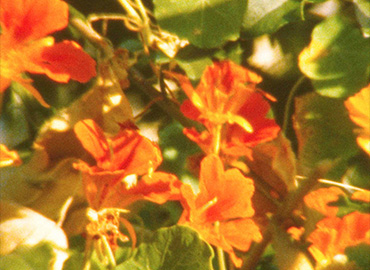
UK, Belgium and USA, 2014, colour, original version in English with Spanish subtitles, DA, 71’There are numerous examples in film of encounters that occur when humans move deeper into nature, but what materialises when the opposite happens? What occurs when nature interferes in the city, the human habitat par excellence? In The Secret Garden, a thicket of plants, flowers and trees appears overnight around the streets and squares of an anonymous city in the Near East. Across eight chapters narrated with a voice-over, two women attempt to discover the reason behind this sudden upsurge of plant life, both literal and allegorical. Fragments of audio from different genres transmit agitation while spellbinding images in 16mm show flowers and foliage of every type, but without a human being in sight. Ming of Harlem: Twenty One Storeys in the Air, for its part, tells the unusual true story Antoine Yates, arrested in 2003 after it was discovered he was sharing his apartment in Harlem, New York, with a tiger called Ming and an alligator called Al. The director Philip Warrell reconstructs part of the apartment in the cages of two animals that share similarities with a zoo, recording their movements with static cameras. The images are contrasted with an extensive interview with Yates, whose claim that “true wild nature no longer exists” is hard to refute in the present day, despite the clear eccentricity of this example.

Held on 05, 06, 07, 11, 12, 13, 14, 18, 19, 20, 21, 25, 26, 27, 28 Oct 2023
Do different animals behave differently in front of camera? Given the chance, what films would they make? When plants grow uncontrollably, is it a source of horror or an amazing opportunity? If rocks could think and feel, what would they say? Where is the border, if indeed there is one, between the natural and the man-made? And how can film, with its set of tools and its specific way of seeing the world, help us to understand the relationship between humans and nature at a time in which this link is increasingly fraught?
The Nature Camera is a film series which gathers recent films in different genres — fiction, documentary, essay, experimental film — from different countries around the world, works with their gaze fixed on the relationship between the human and the non-human. The eight sessions in the series combine short, medium- and feature-length films by emerging artists and by established names, some of whom have devoted their whole career to examining how we relate to the natural world. The works explore a broad variety of questions from new, non-anthropomorphic perspectives, blurring the boundaries established between nature and culture and demonstrating film’s staggering versatility in painting a picture of the natural world surrounding us when animals, minerals and plants take centre stage. Further, listening to nature becomes necessary for comprehending the magnitude of our impact on the planet, with film the perfect medium for such purposes.
Accordingly, the films in this series contain the buzz of insects flying around a bed at night, an elephant trumpeting as it crosses the jungle, the incessant babbling of a stream and the wind that blows on deserted islands; a cinematic submersion in place without leaving the film theatre. They contain a large feline and an alligator ambling around an apartment, observe extinct species or a view of the world through the eyes of animals when they take control of the camera. It is possible to be stunned by plants that open a path through concrete or spread over our flesh, making us reach elated states of contemplation and, at the same time, understand the extent to which survival depends on human technology. We can feel the shaking and quaking of the earth around us, wander around landscapes created by our actions and imagine a time in which rocks are the only things that endure.
Curator
James Lattimer
Organised by
Museo Reina Sofía
Acknowledgement
Goethe-Institut Madrid
Más actividades
Central American Designation of Origin
Thursday, 18 and 25 June 2026 - 7pm
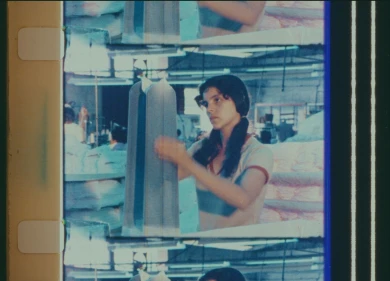
Fertile lands, farmers’ hands, rural faces. This first programme in the series Reframing Banana Imagery understands the foundations of the Central American experience from exploitation, extractivism and displacement, and from the organisation and resistance that emerged as a reaction. The four films within extend from a lyrical documentary on farmers’ solidarity to the playful subversion of the institutional format of the United Fruit Company.
Bananeras (Banana Growers) is a combative portrait of the inhumane conditions of the American banana plantations located in Nicaragua through much of the twentieth century. Costa Rica Banana Republic is a perspicacious satire via an institutional documentary of banana production, spotlighting the extractive nature of this agro-exporting model in the 1970s. Organización Campesina (Farmers’ Organisation) frames rural resistance in Honduras from a direct depiction and lyrical documentary, while Dos veces mujer (Two Times a Woman) dissects the invisibility of the double-shift working day Central American women farmers endure: working in the countryside and working in the home. As a whole, the works here present the earth at once as a wounded body and a space of dignity.

Cinema, for the First Time
7 and 14 June 2026 – 12:00 pm
The final session in this Moon Projector season contemplates the feeling around the first experience of cinema — cinema as revelation, magic, fantasy and mystery from the first gaze, from the first contact with the medium, and imagery etched on the retina of childhood. The programme shows Émile Cohl’s landmark Fantasmagorie (1908), the first ever hand-drawn animation, and Ignacio Agüero’s Cien niños esperando un tren (One Hundred Children Waiting for a Train, 1988), a feature-length film on play and the origins of cinema.
Fantasmagorie (1908)by Émile Cohl (Paris, 1857– Villejuif, 1938) is the first expression in the history of animated drawing. Émile Cohl was an illustrator who belonged to the Parisian art group Arts incohérents (1882–1895), who was bestowed with an absurdist and pre-Surrealist talent. Whereas the Lumière brothers were able get audiences out of their seats as they witnessed a train moving towards them in 1895, Fantasmagorie is a supernatural experience, akin to an apparition yet also innocuous and entertaining — the inanimate comes to life out of nothing and figures seemingly move with little sense. From the outset, animation was related to caricature, fabulation and the comical, a sweet spot for the dreams of the youngest audience.
From the discovery of new imagery arising from the animated line to knowledge of the world through a screen, Cien niños esperando un tren (1988), by Chilean director Ignacio Agüero (Santiago, 1952), narrates a group of young people’s discovery of cinema in a workshop on the origins of the medium in a poverty-stricken town on the outskirts of Santiago de Chile. Play, fun and learning combine with a fascination with images, as viewing Émile Cohl’s Fantasmagorie (1908) in the workshop becomes an act of freedom.
Elisa González and Leah Pattem. Soy Tribulete 7
13 JUN 2026
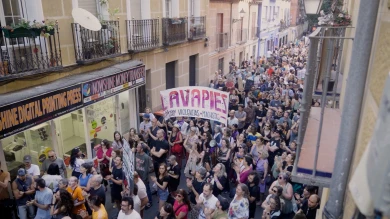
Framed inside this year’s Neighbourhood Picnic is the screening, in the Museo’s Cinema, of a film related to the life and protests of the Lavapiés neighbourhood, addressing issues of gentrification and the right to housing: Soy Tribulete 7 (I Am Tribulete 7, 2026), directed by Elisa González and Leah Pattem.
As the Spanish housing crisis takes hold in Lavapiés, this story begins in February 2024, when the residents of Calle Tribulete, 7, a block of apartments on a street in this Madrid barrio, receive a letter informing them that their building has been sold to a vulture fund. The news spreads quickly around the neighbourhood and, when it comes to the attention of González and Pattem, they grab their cameras and head straight for the building, where they encounter one hundred or so residents still in shock. The film Soy Tribulete 7 flows into the building and the daily lives of a community united, whose looming eviction occasions the fight of their lives. Ultimately, a path of resistance that will turn the community into a symbol of struggle for the right to housing.
Both film-makers worked closely with a group of tenants — Cris, Nani, Blanca, José, María Jesús and Antonia — to tell the story of how the building became the most creative stage of resistance ever witnessed in the area. The work presents the daily life of these residents in Madrid’s now-iconic “building fighting eviction”, depicting their collective struggle and the violent disruption to their lives. Through personal interviews, observational footage, archive material, music and a narration by eighty-year-old actress Ana Martín García, the film casts light on the human stories behind a community struggle.
The Neighbourhood Picnic is an annual gathering of festivities organised by Museo Situado, a network made up of associations, activists and residents from Lavapiés, a racially diverse, working-class neighbourhood where the Museo Reina Sofía is located.
Exile and Alienation
Saturday 30 May and 6 Jun, 2026 - 18:00 H
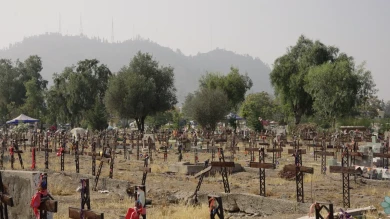
In the years of the Popular Unity Government in Chile, three young film-makers, Marilú Mallet, Valeria Sarmiento and Angelina Vázquez, went to the offices of Chile Films to present a film project. This session screens three films which convey the three directors’ experience of exile. In Dos años en Finlandia (Two Years in Finland), Angelina Vázquez depicts the social and working conditions of Chileans exiled in the Nordic country. The fictional work Lentement, directed by Marilú Mallet, follows a young Chilean exile around spaces of Montreal blighted by nostalgia and political rage. In Huellas (Fingerprints), Valeria Sarmiento returns to Chile to explore the memory of violence inflicted by Pinochet’s military dictatorship. The session culminates in a talk with the three directors, gathered here for the first time.
From North to South and South to North
Sunday 31 May and Friday 5 June, 2026
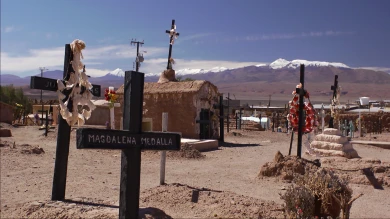
In a kind of road movie, Marilú Mallet travels across her native Chile after forty years of exile. The journey is an exploration of the dynamism of national identity, leading the film-maker to return to questions previously explored in her filmography and to search for new forms of filming the encounter between body and landscape.