-
Nouvel Building, Auditorium 400
Saturday, 23 February 2019
Lucinda Childs’ Solos, Performed by Ruth Childs
Lucinda Childs is one of postmodern dance's pre-eminent icons, and a founding member of the Judson Dance Theater. She also happens to be my aunt. We decided to work on a revival project of three solos that she choreographed and performed herself in the 1960s at the Judson Dance Theater in New York: Pastime, Carnation and Museum Piece.
We revived these three solos to be as close as possible to the original versions, knowing that there are no film archives of her solos during the Judson period. Lucinda gave me very exact choreographic indications. She shared anecdotes and archives from that period. She then left me with room to explore my own way to perform these three solos.
With the exception of Carnation, these solos are quite unknown and have never been presented outside of the USA. This work of revival, handing-down and re-creation is essential because it allows a new generation of audiences to discover these historic pieces.
(Ruth Childs)
7pm
Calico Mingling (1973), 10’, film
Filmed in a large plaza in New York, four performers execute a series of circular and linear trajectories forwards and backwards, repeating them infinitely in complete silence.Pastime (1963), 10’
This short solo, Lucinda Childs’ first, explores the relationship between movement and object. The piece plays with – and distorts – the typical postures of postmodern dance through a piece of stretchable fabric which is pulled across the shoulders, to the tips of the toes, thus evoking a boat, cradle or bathtub.Carnation (1964), 20’
This work is the upshot of a decision: to conceive a choreography and all possibilities of movement – excluding those which belong to dance – with everyday objects: sponges, hair rollers and rubbish bags. Here, the three objects are used to create a method, not a story.Katema (1978), 10’, film
This video, recorded at Kunsthaus Zürich, offers a personal and intimate moment with Lucinda as she revisits her work on the act of walking diagonally, forwards and backwards, until she starts again. Exhausting all possibilities and finding value in repetition, it reveals a poetic flow upheld by a simple and insistent work material.Museum Piece (1965), 10’
More than a choreographed dance, this solo is an artistic performance or ironic lecture that deconstructs and transforms dance. Adhering to artist Marcel Duchamp and his idea of the objet trouvé, the found object, Lucinda takes Georges Seurat’s work Le Cirque (1891) and, with a touch of humour, places herself inside the painting in order to discover itCredits:
Pastime, Carnation and Museum Piece credits:
Choreography: Lucinda Childs
Performance: Ruth Childs
Lighting design: Eric Wurtz
Technical manager: Pierre Montessuit
Touring: Tutu ProductionCaliclo Mingling (film) credits:
Choreography: Lucinda Childs
Performance: Susan Brody, Lucinda Childs, Nancy Fuller and Judy Padow.
Film-maker: Babette Mangolte
Location: Robert Moses Plaza, Fordham University, New York.Katema (film) credits:
Choreography: Lucinda Childs
Performance: Lucinda Childs
Film-maker: Renato Berta
Location: Kunsthaus Zürich
Production: SCARLETT’S
Co-production: ADC - Association pour la danse contemporaine
Support: the city of Geneva, the Stanley Johnson Foundation, Loterie Romande, Fondation Nestlé pour l’art and the L. Vuitton Foundation, Corodis, and the State of Geneva.8pm
Encounter: a conversation between Lucinda Childs and Ruth Childs, presented and moderated by Lou Forster. -
Sabatini Building, Room 102
Sunday, 24 February 2019
Presentation of the solo Katema
11am and 1pm – Presentation of the solo Katema (performed by Ruth Childs), in two sessions:
Katema (1978) 12’
The collaboration between Lucinda and Ruth Childs began in 2015, leading to the recreation of the three solos presented in the previous session, and carried on two years later with a second series of performances from the 1970s, among them Katema (1978). This solo is part of the aesthetic transition of choreography that gave rise to ensemble pieces like Dance (1979), presented in Teatros del Canal as part of this programme. Lucinda created Katema for herself after participating in collective projects, seeking to regain focus on the body and its movements – the piece explores the act of walking diagonally, always returning to the same point of anchorage, which, nevertheless, yields and moves with each iteration.
Credits:
Choreography: Lucinda Childs
Performance: Ruth Childs
Assistant: Ty Boomershine
Lighting design: Joana Oliveira
Wardrobe: Severine Besson
Production: SCARLETT’S
Production representative and touring: Tutu Production
Co-production: La Bâtie Festival de Genève, Arsenic - Centre d’art scénique contemporain, Lausanne.
Support: the city of Geneva, Pro Helvetia, Fondation Suisse des Artistes
Interprètes, Fond Mécénat SIG, Fondation Nestlé pour l’art, the Stanley Thomas Johnson Foundation, Ernst Göhner Stiftung, Corodis, Loterie Romande.
Touring support: Pro Helvetia, Canton de Genève, Corodis, Loterie Romande, Pour-cent culturel Migros.

Ruth Childs, Pastime, by Lucinda Childs © Gregory Batardon
Held on 23 Feb 2019
Museo Reina Sofía presents a selection of solos, held across two sessions, by Lucinda Childs, a pre-eminent choreographer from so-called minimalist dance and founder of New York’s Judson Dance Theater.
The Judson Dance Theater, in operation from 1962 to 1964, was a choreographic collective of dancers such as Trisha Brown, Simone Forti, Deborah Hay and Lucinda Childs and artists like Robert Rauschenberg, Carolee Schneemann and Robert Morris, who moulded the foundations of postmodern dance. During that period, the majority of these artists regularly attended Anna Halprin’s workshops in San Francisco, made up of creators from an array of disciplines to establish influences and displacements between practices. They would also attend the composition classes given by Robert Dunn, who, in collaboration with Merce Cunningham, developed new choreographic and composition methods, drawing inspiration from the ideas of John Cage.
In the first session, Ruth Childs, Lucinda Childs’ niece, will perform the pieces Pastime (1963), Carnation (1964) and Museum Piece (1965), which render an account of the initial investigations that gestated from dialogue and the intersection of dance, performance and sculpture – fertile ground for experimentation, such was New York in the 1960s. Moreover, a recording of two other pieces, Calico Mingling (1973) and Katema (1978), will be screened, followed by a coda to the session in the form of a conversation between choreographer and performer, presented and moderated by Lou Forster.
Sunday’s session will conclude the programme with a presentation, also by Ruth Childs, of the aforementioned Katema, which, created more than a decade after the three initial solos, augured subsequent ensemble choreographies.
Curatorship
Isabel de Naverán
Organised by
Museo Reina Sofía
Participants
Lucinda Childs (New York, 1940) began her career as a choreographer in 1963 at the Judson Dance Theater collective in New York. Since forming her dance company in 1973, she has created over fifty works, both solo and ensemble. In 1976, she collaborated with Robert Wilson and Philip Glass on the acclaimed opera Einstein on the Beach as principal choreographer and dancer. Since 1979, she has collaborated with numerous composers and designers to create several now-emblematic pieces, for example Dance (1979). The great many awards she has received throughout her career include: the Bessie Award for Sustained Achievement in 2001; her elevation from the rank of Officier (1996) to Commandeur in France’s Ordre des Arts et des Lettres (2004); and the NEA/NEFA American Masterpiece Award (2006). In 2016 the National Center for Dance in Paris held the first retrospective on her work, entitled Lucinda Childs. Nothing Personal 1963-1989, organised by Lou Forster, in collaboration with the Thaddaeus Ropac gallery and inside the framework of the Festival d'Automne. More recently, in 2017, she received the Golden Lion award at the Venice Biennale in recognition of her body of work.
Ruth Childs (London, 1984) British-American dancer and performer. She grew up in the United States where she studied dance (classical and contemporary) and music (violin). In 2003 she moved to Geneva to finish her dance training with the Ballet Junior de Genève. Following this, she started working with many internationally known choreographers and directors including Foofwa d’Imobilité, La Ribot, Gilles Jobin, Massimo Furlan, Marco Berrettini and Yasmine Hugonnet. In 2014 she founded her company SCARLETT’S in order to develop her own work through dance, performance, film and music and collaborates with Stéphane Vecchione on musical project “SCARLETT’S FALL”. This same year she inherited the reproduction rights for the three Lucinda Childs solos presented in this programme, and was also invited by La Ribot to perform the second series of the Piezas distinguidas( Distinguished Pieces), entitled Más distinguidas (More Distinguished). In 2016 the state of Geneva awarded her a scholarship and research residency in Berlin of 6 months to develop her own work. Her first stage piece in collaboration with Stéphane Vecchione, The Goldfish and the Inner Tube, premiered in April 2018. She will premiere fantasia, her first solo at the ADC, Geneva in October 2019
Lou Forster (Paris, 1988) has worked as a critic for the magazines A prior and Art21, co-directing the latter in 2012 and 2013. He has worked with Jeanne Revel and Joris Lacoste in the development of the W method, a critical, practical and theoretical approach to representing actions. Since 2010, he has collaborated with Lënio Kaklea, creating O, a platform to produce choreographic pieces, programmes, publications and exhibitions, including Lucinda Childs. Nothing Personal 1963-1989, a retrospective on the choreographer held in the Paris National Dance Centre in the autumn of 2016.


Más actividades
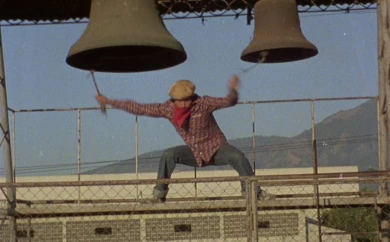
Files of Tropical Revolutions
Sábado 20 y 27 de junio, 2026 - 19:00 H
The Reframing Banana Imagery series concludes with two works that condense the height and twilight of this period in history, epic sagas that cross borders and registers to embody experiences of armed struggle in the region. Cameras mix with firearms, borders between nations blur and patience reaches breaking point. This is where the tipping point lies, where the bloodshed weighs heavy and the murmurings of regional brotherhood are buried in the ground again.
Pan y dignidad (Carta abierta de Nicaragua) [Bread and Dignity (An Open Letter to Nicaragua)] recounts the historical records and process of national reconstruction in Nicaragua via the Sandinista popular uprising. Historias prohibidas de Pulgarcito (Forbidden Tales of Tom Thumb) places the camera at the heart of the El Salvador revolutionary struggle, interspersing testimonies of daily violence with the verses of the poet Roque Dalton.
Both works understand the armed revolution as an open file under construction. The insurgent brotherhood, although dissolved, still resounds in regional history.
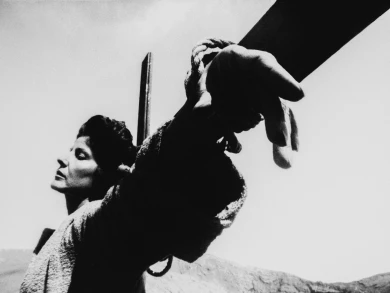
Circling Over Exploited Bodies
Friday, 19 and 26 June 2026 - 7pm
When forms of violence are inflicted on society, film responds from urgency. Images become abstract, sounds fade and the register of dissidence comes from the gut. La zona intertidal (The Intertidal Zone) is an essayistic and poetic approach to the repression of teachers in El Salvador in the 1970s — a teacher studies the biodiversity of the El Salvador coast as a boy finds a body on the same beach. A propósito de la mujer (About Women) interweaves testimonies of misery and rage towards patriarchal structures with fictional scenes of a symbolic procession through a harsh desert.
Both films understand the body as a target of violence and a territory of insurrection, a space where the blood shed by militancy and the patriarchal yoke turn pain into denouncement and existence outside the status quo into an act of political dissidence.
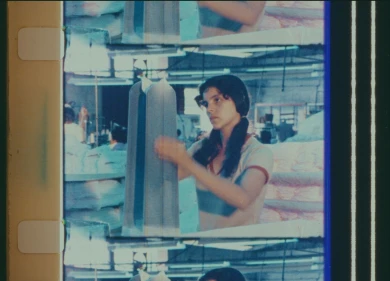
Central American Designation of Origin
Thursday, 18 and 25 June 2026 - 7pm
Fertile lands, farmers’ hands, rural faces. This first programme in the series Reframing Banana Imagery understands the foundations of the Central American experience from exploitation, extractivism and displacement, and from the organisation and resistance that emerged as a reaction. The four films within extend from a lyrical documentary on farmers’ solidarity to the playful subversion of the institutional format of the United Fruit Company.
Bananeras (Banana Growers) is a combative portrait of the inhumane conditions of the American banana plantations located in Nicaragua through much of the twentieth century. Costa Rica Banana Republic is a perspicacious satire via an institutional documentary of banana production, spotlighting the extractive nature of this agro-exporting model in the 1970s. Organización Campesina (Farmers’ Organisation) frames rural resistance in Honduras from a direct depiction and lyrical documentary, while Dos veces mujer (Two Times a Woman) dissects the invisibility of the double-shift working day Central American women farmers endure: working in the countryside and working in the home. As a whole, the works here present the earth at once as a wounded body and a space of dignity.

Cinema, for the First Time
7 and 14 June 2026 – 12:00 pm
The final session in this Moon Projector season contemplates the feeling around the first experience of cinema — cinema as revelation, magic, fantasy and mystery from the first gaze, from the first contact with the medium, and imagery etched on the retina of childhood. The programme shows Émile Cohl’s landmark Fantasmagorie (1908), the first ever hand-drawn animation, and Ignacio Agüero’s Cien niños esperando un tren (One Hundred Children Waiting for a Train, 1988), a feature-length film on play and the origins of cinema.
Fantasmagorie (1908)by Émile Cohl (Paris, 1857– Villejuif, 1938) is the first expression in the history of animated drawing. Émile Cohl was an illustrator who belonged to the Parisian art group Arts incohérents (1882–1895), who was bestowed with an absurdist and pre-Surrealist talent. Whereas the Lumière brothers were able get audiences out of their seats as they witnessed a train moving towards them in 1895, Fantasmagorie is a supernatural experience, akin to an apparition yet also innocuous and entertaining — the inanimate comes to life out of nothing and figures seemingly move with little sense. From the outset, animation was related to caricature, fabulation and the comical, a sweet spot for the dreams of the youngest audience.
From the discovery of new imagery arising from the animated line to knowledge of the world through a screen, Cien niños esperando un tren (1988), by Chilean director Ignacio Agüero (Santiago, 1952), narrates a group of young people’s discovery of cinema in a workshop on the origins of the medium in a poverty-stricken town on the outskirts of Santiago de Chile. Play, fun and learning combine with a fascination with images, as viewing Émile Cohl’s Fantasmagorie (1908) in the workshop becomes an act of freedom.
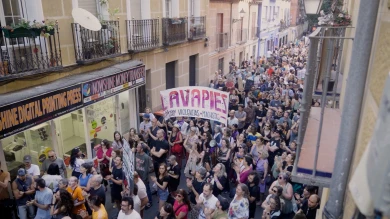
Elisa González and Leah Pattem. Soy Tribulete 7
13 JUN 2026
Framed inside this year’s Neighbourhood Picnic is the screening, in the Museo’s Cinema, of a film related to the life and protests of the Lavapiés neighbourhood, addressing issues of gentrification and the right to housing: Soy Tribulete 7 (I Am Tribulete 7, 2026), directed by Elisa González and Leah Pattem.
As the Spanish housing crisis takes hold in Lavapiés, this story begins in February 2024, when the residents of Calle Tribulete, 7, a block of apartments on a street in this Madrid barrio, receive a letter informing them that their building has been sold to a vulture fund. The news spreads quickly around the neighbourhood and, when it comes to the attention of González and Pattem, they grab their cameras and head straight for the building, where they encounter one hundred or so residents still in shock. The film Soy Tribulete 7 flows into the building and the daily lives of a community united, whose looming eviction occasions the fight of their lives. Ultimately, a path of resistance that will turn the community into a symbol of struggle for the right to housing.
Both film-makers worked closely with a group of tenants — Cris, Nani, Blanca, José, María Jesús and Antonia — to tell the story of how the building became the most creative stage of resistance ever witnessed in the area. The work presents the daily life of these residents in Madrid’s now-iconic “building fighting eviction”, depicting their collective struggle and the violent disruption to their lives. Through personal interviews, observational footage, archive material, music and a narration by eighty-year-old actress Ana Martín García, the film casts light on the human stories behind a community struggle.
The Neighbourhood Picnic is an annual gathering of festivities organised by Museo Situado, a network made up of associations, activists and residents from Lavapiés, a racially diverse, working-class neighbourhood where the Museo Reina Sofía is located.