-
Thursday, 24 January
Session 1
Radical Citizen and Aesthetic Politics
An introduction to the Spanish Transition as a critical device. The myth and its different counternarratives. The conceptual aporias of the 1970s: citizen/State, history/memory, aesthetics/history, politics/culture, counterculture/official culture. Five transitional models: heroic, melancholic, civic-popular, memorial and necropolitical. Networks of counterculture and the civic-popular paradigm: relationships between social movements and cultural actionism in the 1970s. Citizen forms and ephemeral aesthetics. Documentary devices and memory.
-
Friday, 25 January
Session 2
Poetics of Democracy
This session is structured around a conversation between the Museo Reina Sofía’s Rosario Peiró, Lola Hinojosa and Carla Giachell.
Architecture from the exhibition The Poetics of Democracy. Images and Counter-Images from the Spanish Transition. The Venice Pavilion of 1976 and mutations from the Anti-Franco cultural field. Curatorial archaeology and exhibition machines. Street documents: artistic forms of social movements. The new transitional left and its historical subjects: feminisms, neighbourhood associations, neighbourhood culture and the libertarian movement. Counterculture and its spaces: festivals, hangouts and magazines. A transitional subject: dangers to society, psychiatric patients and gender dissidents. Vampire imagery from the Transition. Figures and forms of constitutional culture.
-
Monday, 28 January
Session 3
The Sides of Shadows. Critical Aesthetics from the 1970s
This session is structed around a conversation with Anxo Rabuñal, curator of O lado da sombra: sedición gráfica e iniciativas raras ou desacreditadas entre 1971 e 1989 (A Coruña, Seoane Foundation, 2005).
A curatorial history of Iberian countercultures (i). The Sides of Shadows: the story of a Galicia-based exhibition project. Alternative genealogies: centre-periphery dynamics in the transitional archive. Seville, Galicia, Barcelona and the Basque Country: centrifugal and centripetal logics of 1970s countercultures. Artistic and exhibition devices from counterculture in Galicia, between the popular and the avant-garde: publishing, poetry, music and performing arts. Félix Guattari and Allen Ginsberg in Santiago: the history of Conxo and the impossible archive of transitional anti-psychology. Iberian-Galician machines for living: the curatorial circulation of Llorenç Soler, Anna Turbau and César Portela.
-
Wednesday, 30 January
Session 4
Prohibited Archives. The Impossible Imaginary of the Democracy
Memory and form in post-Francoism: the formal construction of hegemonic accounts of the Transition and capturing civil imaginaries from the 1970s. Co-opting, erasing, displacing and resemantization: formal mechanisms of the foundational discourse of democracy. The privatisation and nationalisation of collective heritage. A curatorial history of Iberian countercultures (ii). Lines of shadow: underground continuities, interposed inheritances and civil re-appropriations of 1970s forms. Ephemeral Transition archives today: online archivists, citizen memories and network culture in the crisis of the 1978 regime. Other transitions: remakes and revivals.
-
Thursday, 31 January
Session 5
Oral Memories and the Democracy to Come
This session constitutes a survey of urban space in the Transition, in the form of a critical-memorial wander around Madrid’s Malasaña neighbourhood with a testimony mediation.
The Transition and its (non)places of memory. Institutional memory and underground memories of the (post)transitional city. The visible and invisible marks of counterculture in public space. The Movida Movement and the city-Movida: an urban account of the spatial metamorphoses from the Maravillas neighbourhood to present-day Malasaña. From neighbourhood struggles to fights against gentrification: political mutations of space in the shift towards immaterial capitalism. Plaza Dos de Mayo and its civic and national monumentalities. Archaeologies of the glance and the poetics of testimony: accounts and figures of 2 May 1977. The history and memory of a transitional icon: the photography of Félix Lorrio.
A Change of Aesthetics: Citizen Ruptures in the Spanish Transition
A course conducted by Germán Labrador
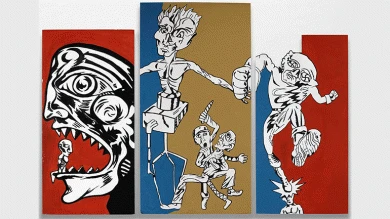
Held on 24, 31 Jan 2019
This course, with its design rooted in the exhibition The Poetics of Democracy. Images and Counter-Images from the Spanish Transition, explores the imaginary of 1970s Spain from a central hypothesis: the articulation, in the confrontation with Francoism and post-Francoism, of citizens’ breakaway resulting from an upsurge in certain aesthetic practices. Through these practices, new political subjects were shaped in opposition to the regime’s institutions and forms of discipline. This other society included women, young people, neighbourhood groups and “dangers to society”, the last of which refer to the Francoist Law that stigmatised those considered a menace to the regime, from beggars to homosexuals. In parallel, the emergence of this multifarious civil society and its struggles for emancipation questions the limits of the dictatorship and the transition to democracy, its practices producing and organising alternative forms of culture and social and urban models, in addition to ways of life referred to here inside this framework as ‘transitional’. The documents of such actions and proposals constitute a democratic archive, susceptible to questioning, in exhibition terms, and intervened in from the present. Thus, to think about the transitional legacy means to reflect upon the origins, devices and limits of democracy, and imagine its possible transformations.
Across five sessions and in conversation with other voices, Germán Labrador Méndez, a professor and researcher of Cultural Studies at Princeton University, sets forth a critical survey of the accounts of democracy founded through the tension between archive and myth, challenging predominant expectations surrounding the period through diverse analytical strategies. Oral memory and documents from other transitions which occurred at the time (neighbourhood, youth, autonomous, psychiatric, gender…) speak of unrepresented historical experiences in the official foundational discourse of post-Francoism and the utopian potential they possess with respect to an alternative citizen genealogy.
Consequently, drawing on the exhibition The Poetics of Democracy. Images and Counter-Images from the Spanish Transition as a critical and methodological tool, this course explores aesthetic mechanisms from 1970s Spain to focus on their transformative potential. Approaching the crossroads between culture and politics in the framework of a democracy still to come, discussions will revolve around notions of public space, the urban experience, aesthetic ruptures, the subversion of daily life, bio-literature, civil imagination, generational destruction and ephemeral memory. Moreover, the issue of transient cultural forms – minor and often anonymous – will thread together the different sessions, each analysing the way in which a time of civil conversation, the occupation of public space, the affirmation of subaltern political subjects or aesthetic disputes involve the questioning of democracy.
The sessions will take place both in the Museo, in a lecture room and in different exhibition rooms, and in Madrid’s Malasaña neighbourhood, in wanderings around and explorations of the city. Upon the conclusion of the course, on Friday 1 February, the Museo will go on to hold the conference Abductions of the Imagination. A Conference on Post-Francoism Counterculture, a public activity centred on examining Spanish counterculture during the Transition.
Organised by
Museo Reina Sofía
Participants
Course director
Germán Labrador Méndez is head professor in the Spanish and Portuguese Department at Princeton University. His research in the field of cultural history specialises in the relationship between aesthetics and politics, citizenship and memory in a contemporary Iberian context. He is the author of Letras arrebatadas. Poesía y química en la transición española (Devenir, 2009) and Culpables por la literatura. Imaginación política y contracultura en la transición española (1968-1986) (Akal, 2017), and is currently writing a paper on the political and cultural responses to the 2008 crisis and working on an anthology of underground poetry. He is also one of the curators of the exhibition The Poetics of Democracy. Images and Counter-Images from the Spanish Transition.
Participants
Carla Giachello is an intern in the Museo Reina Sofía Collections Department and assistant curator of the exhibition The Poetics of Democracy. Images and Counter-Images from the Spanish Transition.
Lola Hinojosa is a curator of Performing Arts and Intermedia at the Museo Reina Sofía and co-curator of the exhibition The Poetics of Democracy. Images and Counter-Images from the Spanish Transition.
Rosario Peiró is head of the Museo Reina Sofía Collections Department and co-curator of the exhibition The Poetics of Democracy. Images and Counter-Images from the Spanish Transition.
Anxo Rabuñal is a curator and researcher. He is the curator of O lado da sombra: sedición gráfica e iniciativas ignoradas, raras ou desacreditadas entre 1971 e 1989 (Luis Seoane Foundation, 2005), a show which seeks to trace popular culture in the non-institutional scene in Galicia at the end of Francoism and during the Transition.

Más actividades
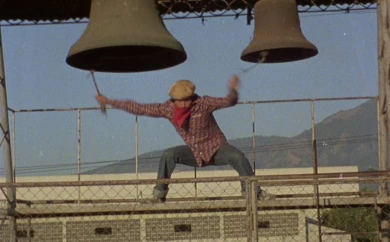
Files of Tropical Revolutions
Sábado 20 y 27 de junio, 2026 - 19:00 H
The Reframing Banana Imagery series concludes with two works that condense the height and twilight of this period in history, epic sagas that cross borders and registers to embody experiences of armed struggle in the region. Cameras mix with firearms, borders between nations blur and patience reaches breaking point. This is where the tipping point lies, where the bloodshed weighs heavy and the murmurings of regional brotherhood are buried in the ground again.
Pan y dignidad (Carta abierta de Nicaragua) [Bread and Dignity (An Open Letter to Nicaragua)] recounts the historical records and process of national reconstruction in Nicaragua via the Sandinista popular uprising. Historias prohibidas de Pulgarcito (Forbidden Tales of Tom Thumb) places the camera at the heart of the El Salvador revolutionary struggle, interspersing testimonies of daily violence with the verses of the poet Roque Dalton.
Both works understand the armed revolution as an open file under construction. The insurgent brotherhood, although dissolved, still resounds in regional history.
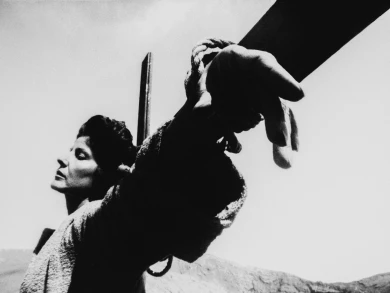
Circling Over Exploited Bodies
Friday, 19 and 26 June 2026 - 7pm
When forms of violence are inflicted on society, film responds from urgency. Images become abstract, sounds fade and the register of dissidence comes from the gut. La zona intertidal (The Intertidal Zone) is an essayistic and poetic approach to the repression of teachers in El Salvador in the 1970s — a teacher studies the biodiversity of the El Salvador coast as a boy finds a body on the same beach. A propósito de la mujer (About Women) interweaves testimonies of misery and rage towards patriarchal structures with fictional scenes of a symbolic procession through a harsh desert.
Both films understand the body as a target of violence and a territory of insurrection, a space where the blood shed by militancy and the patriarchal yoke turn pain into denouncement and existence outside the status quo into an act of political dissidence.
Central American Designation of Origin
Thursday, 18 and 25 June 2026 - 7pm
Fertile lands, farmers’ hands, rural faces. This first programme in the series Reframing Banana Imagery understands the foundations of the Central American experience from exploitation, extractivism and displacement, and from the organisation and resistance that emerged as a reaction. The four films within extend from a lyrical documentary on farmers’ solidarity to the playful subversion of the institutional format of the United Fruit Company.
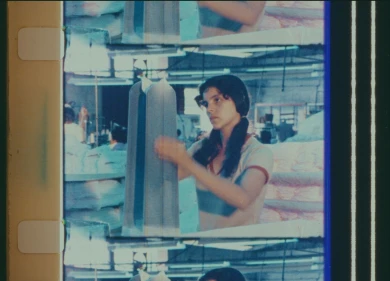
Bananeras (Banana Growers) is a combative portrait of the inhumane conditions of the American banana plantations located in Nicaragua through much of the twentieth century. Costa Rica Banana Republic is a perspicacious satire via an institutional documentary of banana production, spotlighting the extractive nature of this agro-exporting model in the 1970s. Organización Campesina (Farmers’ Organisation) frames rural resistance in Honduras from a direct depiction and lyrical documentary, while Dos veces mujer (Two Times a Woman) dissects the invisibility of the double-shift working day Central American women farmers endure: working in the countryside and working in the home. As a whole, the works here present the earth at once as a wounded body and a space of dignity.

Cinema, for the First Time
7 and 14 June 2026 – 12:00 pm
The final session in this Moon Projector season contemplates the feeling around the first experience of cinema — cinema as revelation, magic, fantasy and mystery from the first gaze, from the first contact with the medium, and imagery etched on the retina of childhood. The programme shows Émile Cohl’s landmark Fantasmagorie (1908), the first ever hand-drawn animation, and Ignacio Agüero’s Cien niños esperando un tren (One Hundred Children Waiting for a Train, 1988), a feature-length film on play and the origins of cinema.
Fantasmagorie (1908)by Émile Cohl (Paris, 1857– Villejuif, 1938) is the first expression in the history of animated drawing. Émile Cohl was an illustrator who belonged to the Parisian art group Arts incohérents (1882–1895), who was bestowed with an absurdist and pre-Surrealist talent. Whereas the Lumière brothers were able get audiences out of their seats as they witnessed a train moving towards them in 1895, Fantasmagorie is a supernatural experience, akin to an apparition yet also innocuous and entertaining — the inanimate comes to life out of nothing and figures seemingly move with little sense. From the outset, animation was related to caricature, fabulation and the comical, a sweet spot for the dreams of the youngest audience.
From the discovery of new imagery arising from the animated line to knowledge of the world through a screen, Cien niños esperando un tren (1988), by Chilean director Ignacio Agüero (Santiago, 1952), narrates a group of young people’s discovery of cinema in a workshop on the origins of the medium in a poverty-stricken town on the outskirts of Santiago de Chile. Play, fun and learning combine with a fascination with images, as viewing Émile Cohl’s Fantasmagorie (1908) in the workshop becomes an act of freedom.
Elisa González and Leah Pattem. Soy Tribulete 7
13 JUN 2026
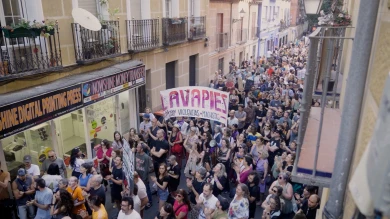
Framed inside this year’s Neighbourhood Picnic is the screening, in the Museo’s Cinema, of a film related to the life and protests of the Lavapiés neighbourhood, addressing issues of gentrification and the right to housing: Soy Tribulete 7 (I Am Tribulete 7, 2026), directed by Elisa González and Leah Pattem.
As the Spanish housing crisis takes hold in Lavapiés, this story begins in February 2024, when the residents of Calle Tribulete, 7, a block of apartments on a street in this Madrid barrio, receive a letter informing them that their building has been sold to a vulture fund. The news spreads quickly around the neighbourhood and, when it comes to the attention of González and Pattem, they grab their cameras and head straight for the building, where they encounter one hundred or so residents still in shock. The film Soy Tribulete 7 flows into the building and the daily lives of a community united, whose looming eviction occasions the fight of their lives. Ultimately, a path of resistance that will turn the community into a symbol of struggle for the right to housing.
Both film-makers worked closely with a group of tenants — Cris, Nani, Blanca, José, María Jesús and Antonia — to tell the story of how the building became the most creative stage of resistance ever witnessed in the area. The work presents the daily life of these residents in Madrid’s now-iconic “building fighting eviction”, depicting their collective struggle and the violent disruption to their lives. Through personal interviews, observational footage, archive material, music and a narration by eighty-year-old actress Ana Martín García, the film casts light on the human stories behind a community struggle.
The Neighbourhood Picnic is an annual gathering of festivities organised by Museo Situado, a network made up of associations, activists and residents from Lavapiés, a racially diverse, working-class neighbourhood where the Museo Reina Sofía is located.