
Held on 01, 01, 01 Oct 2021
Scala’s new work has been conceived on just one sheet of laid paper, offset printed and 1500 metres in length, its unfolding bearing the concept of time. It is part of a group of works he identifies as continuous, cylindrical peoms, in which the materiality, spiritualty and rituality from 500,000 or more sacred papyruses safeguarded in the Library of Alexandria is revived. The poem conjugates writing with intangible aspects such as the rhythm, trance and incantation generated by geometric repetition.
This new poem-landscape is dedicated to the memory of Peruvian poet Carlos Oquendo de Amat (1905–1936), the author of 5 Metros de poemas (5 Metres of Poems, Lima, Minerva, 1927) and who, in 1936, confronted his hopeless illness in Madrid’s General Hospital, the site of the Museo Reina Sofía today. Just a few months later he would die of tuberculosis at the age of thirty in the Royal Sanatorium of Guadarrama, in Navacerrada.
The activity starts with a brief introduction by the artist on the process of conceiving and producing his new work, leading on to a meditative reading, also led by Scala, in which participants can roam the poem in silence to perceive the transience-eternity of existence.
Eduardo Scala (Madrid, 1945) is one of the main points of reference in experimental poetry — spiriential, as he terms it — in Spain. His books, most notably SOLUNA (1977), CIELOLEUS (Madrid City Council, 2006) and VISUALBREV (La Oficina Ediciones, 2011), form a constellation of new poetic models, the manifestation of a language project of totality.
Organised by
Museo Reina Sofía
Más actividades

Cinema, for the First Time
7 and 14 June 2026 – 12:00 pm
The final session in this Moon Projector season contemplates the feeling around the first experience of cinema — cinema as revelation, magic, fantasy and mystery from the first gaze, from the first contact with the medium, and imagery etched on the retina of childhood. The programme shows Émile Cohl’s landmark Fantasmagorie (1908), the first ever hand-drawn animation, and Ignacio Agüero’s Cien niños esperando un tren (One Hundred Children Waiting for a Train, 1988), a feature-length film on play and the origins of cinema.
Fantasmagorie (1908)by Émile Cohl (Paris, 1857– Villejuif, 1938) is the first expression in the history of animated drawing. Émile Cohl was an illustrator who belonged to the Parisian art group Arts incohérents (1882–1895), who was bestowed with an absurdist and pre-Surrealist talent. Whereas the Lumière brothers were able get audiences out of their seats as they witnessed a train moving towards them in 1895, Fantasmagorie is a supernatural experience, akin to an apparition yet also innocuous and entertaining — the inanimate comes to life out of nothing and figures seemingly move with little sense. From the outset, animation was related to caricature, fabulation and the comical, a sweet spot for the dreams of the youngest audience.
From the discovery of new imagery arising from the animated line to knowledge of the world through a screen, Cien niños esperando un tren (1988), by Chilean director Ignacio Agüero (Santiago, 1952), narrates a group of young people’s discovery of cinema in a workshop on the origins of the medium in a poverty-stricken town on the outskirts of Santiago de Chile. Play, fun and learning combine with a fascination with images, as viewing Émile Cohl’s Fantasmagorie (1908) in the workshop becomes an act of freedom.
Elisa González and Leah Pattem. Soy Tribulete 7
13 JUN 2026
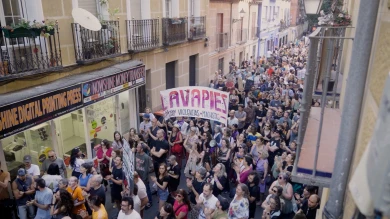
Framed inside this year’s Neighbourhood Picnic is the screening, in the Museo’s Cinema, of a film related to the life and protests of the Lavapiés neighbourhood, addressing issues of gentrification and the right to housing: Soy Tribulete 7 (I Am Tribulete 7, 2026), directed by Elisa González and Leah Pattem.
As the Spanish housing crisis takes hold in Lavapiés, this story begins in February 2024, when the residents of Calle Tribulete, 7, a block of apartments on a street in this Madrid barrio, receive a letter informing them that their building has been sold to a vulture fund. The news spreads quickly around the neighbourhood and, when it comes to the attention of González and Pattem, they grab their cameras and head straight for the building, where they encounter one hundred or so residents still in shock. The film Soy Tribulete 7 flows into the building and the daily lives of a community united, whose looming eviction occasions the fight of their lives. Ultimately, a path of resistance that will turn the community into a symbol of struggle for the right to housing.
Both film-makers worked closely with a group of tenants — Cris, Nani, Blanca, José, María Jesús and Antonia — to tell the story of how the building became the most creative stage of resistance ever witnessed in the area. The work presents the daily life of these residents in Madrid’s now-iconic “building fighting eviction”, depicting their collective struggle and the violent disruption to their lives. Through personal interviews, observational footage, archive material, music and a narration by eighty-year-old actress Ana Martín García, the film casts light on the human stories behind a community struggle.
The Neighbourhood Picnic is an annual gathering of festivities organised by Museo Situado, a network made up of associations, activists and residents from Lavapiés, a racially diverse, working-class neighbourhood where the Museo Reina Sofía is located.
Exile and Alienation
Saturday 30 May and 6 Jun, 2026 - 18:00 H
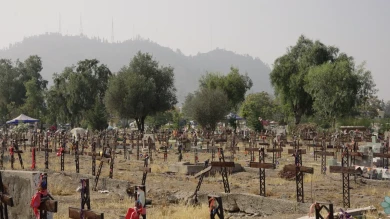
In the years of the Popular Unity Government in Chile, three young film-makers, Marilú Mallet, Valeria Sarmiento and Angelina Vázquez, went to the offices of Chile Films to present a film project. This session screens three films which convey the three directors’ experience of exile. In Dos años en Finlandia (Two Years in Finland), Angelina Vázquez depicts the social and working conditions of Chileans exiled in the Nordic country. The fictional work Lentement, directed by Marilú Mallet, follows a young Chilean exile around spaces of Montreal blighted by nostalgia and political rage. In Huellas (Fingerprints), Valeria Sarmiento returns to Chile to explore the memory of violence inflicted by Pinochet’s military dictatorship. The session culminates in a talk with the three directors, gathered here for the first time.
From North to South and South to North
Sunday 31 May and Friday 5 June, 2026
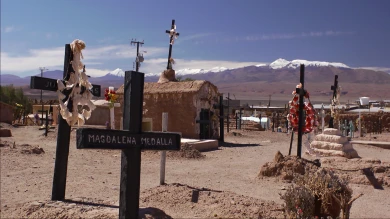
In a kind of road movie, Marilú Mallet travels across her native Chile after forty years of exile. The journey is an exploration of the dynamism of national identity, leading the film-maker to return to questions previously explored in her filmography and to search for new forms of filming the encounter between body and landscape.
Dear Americas
Friday 29 May and 5 June, 2026
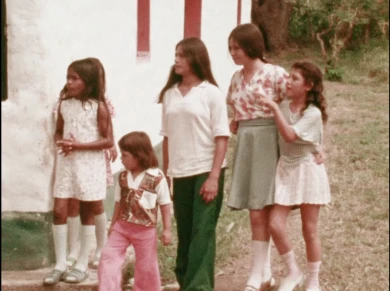
In these films, Marilú Mallet travels to Solentiname, in Nicaragua, and Andahuaylillas, in Peru, to paint a portrait of communities which resist the severity of forced industrialisation. In Solentiname, the focus is on the poet and priest Ernesto Cardenal’s founding of a Christian, poetic and revolutionary utopia, while in Andahuaylillas, a town close to Cuzco, Mallet explores the multiple layers of Andean culture.