-
November 12 and December 5, 2015 Sabatini Building, Auditorium
The 1920s
Presentation of the film series by Bruce Posner (video conference)
Charles Sheeler and Paul Strand. Manhatta. 11’41’’. 1920-21. 1ª version with the Donald Sosin orchestra
Fernand Léger and Dudley Murphy. Ballet mecánico. 15’53’’. 1923-24
Rrose Sélavy a.k.a. Marcel Duchamp. Anémic Cinéma. 6’40’’. 1924-25
Robert Florey and Slavko Vorkapich. The Life and Death of 9413-A Hollywood Extra. 13’20’’. 1927
Robert Florey. Skyscraper Symphony. 8’53’’. 1929
Duración: 55 minutes
Early avant-garde cinema was torn between fetishistic enthusiasm and scepticism towards the industrial and technological progress in the aftermath of World War One. This cinema finds one of its central objects in the modern city, conceived as an organism of precise operation – resulting in the birth of the urban symphony. Manhattan juts out as the prototype of this utopian metropolis, for instance in Manhatta and Skyscraper Symphony. The combination of fascination and perplexity is also unveiled in the arrival of European avant-garde aesthetics: the sense of mechanistic comicality in Ballet mécanique, the tragic parody of the urban landscape and the anti-hero in The Life and Death of 9413, or, more conceptually, the inquiries into language and the vision set out by Marcel Duchamp in Anémic Cinéma.
-
November 13 and December 6, 2015 Sabatini Building, Auditorium
The 1930s
Ralph Steiner. Mechanical Principles. 10’18’’. 1930
Jay Leyda. A Bronx Morning. 14’05’’. 1931
J.S. Watson, Jr., Melville Webber, Alec Wilder, Remsen Wood and Bernard O’Brien. Lot in Sodom. 25’53’’. 1930-32
Emlen Etting. Poem 8. 19’40’’. 1932-33
Oskar Fischinger. An Optical Poem. 7’02’’. 1937
Joseph Cornell. Thimble Theatre. 6’07’’.1938-1968
Duration: 83 minutes
A greater expansion of avant-garde ideas defined the experimental cinema of the thirties as it refined and expanded what had been passed on from the previous decade. The legacy of the urban symphony took on a more poetic and intimate side in films like A Bronx Morning. The predominance of rhythms and song from the machine age were once again present in Ralph Steiner’s Mechanical Principles, whereas films like Poem 8 and Lot in Sodom augmented choreographies of sensual or openly sexual bodies. With the aim of giving shape to mental images, Oskar Fischinger explored the expressive capacities of the medium through exclusively abstract references, while an interest in decontextualising quintessential collage images led Joseph Cornell to deploy a combination of found footage cinema and surrealist strategies alloyed with alien materials, between a fascination in performance and child-like nostalgia.
-
November 19 and December 9, 2015 Sabatini Building, Auditorium
The 1940s
Mary Ellen Bute and Ted Nemeth. Tarantella. 4’24‘’. 1940
Rudy Burckhardt. The Pursuit of Happiness. 8’09’’. 1940
Francis Lee. 1941. 4’. 1941
Maya Deren and Alexander Hackenschmied. Meshes of the Afternoon. 13’46’’. 1943
Maya Deren. Meditation on Violence. 12’27’’. 1948
Helen Levitt, Janice Loeb and James Agee. In the Street. 16’50’’. 1945-1952
Duration: 59 minutes
Over the course of the 1940s, some films fell back into the autonomy of the image and into worlds created inside it. Musical orchestration and abstract forms built the cornerstone of Tarantella, while Meshes of the Afternoon demonstrates the endurance of automatism in film. The Pursuit of Happiness sees the metropolis reflected as a space of chance encounters and the search for meaning in each apparently free individual through consumption and the alienation that confined urban symphonies in the preceding years. The USA’s emergence in the Second World War shrouded a large part of avant-garde cinema productions, loading them with violence: 1941 recreates the Japanese attack on Pearl Harbor, for instance. The directors of In the Street unequivocally place the New York neighbourhood Harlem between the battlefield and the theatre, imbuing it with the aesthetics of street photography. More explicit violence is displayed in the camera-director-performance choreography that unfurls in Meditation on Violence.
-
November 20 and December 11, 2015 Sabatini Building, Auditorium
The 1950s
James Broughton. Four in the Afternoon. 14’. 1950-51
Mary Ellen Bute and Ted Nemeth. Abstronic. 5’45’’. 1952
Kenneth Anger. Eaux d’Artifice. 12’57’’. 1953
Ian Hugo. Bells of Atlantis. 9’27’’. 1952-53
Jim Davis. Evolution. 8’01’’. 1954
Hy Hirsh. Gyromorphosis . 6’40’’. 1954
Marie Menken. Hurry, Hurry. 4’27’’. 1957
Francis Thompson. N.Y., N.Y. 15’10’’. 1949-1958
Duration: 75 minutes
The fifties ebbed and flowed between two poles: on one extreme, the persistence and enrichment of abstract experiments that spanned Abstronic, Evolution, Gyromorphosis and N.Y, N.Y., and on the other, the playfulness and ritual of erotic desire present in Four in the Afternoon and Eaux d'Artifice, where water takes on an abstract and oneiric role. In Bells of Atlantis the mythopoeic references, akin to an exercise in automatic confessional writing, operate as an exploration into subconscious and intrauterine recollections. The interplay between organicism and abstraction reappear, once again with an undercurrent of desire in Hurry, Hurry! as microscopic images of sperms are juxtaposed with others from men anxiously seeking a sexual partner.
-
November 26 and December 17, 2015 Sabatini Building, Auditorium
The 1960s
Hilary Harris. 9 Variations on a Dance Theme. 12’39’’.1966-67
Bruce Baillie. Castro Street (The Coming of Consciousness). 9’59’’. 1966
Owen Land [George Landow]. Film That Rises to the Surface of Clarified Butter. 8’26’’. 1968
Jonas Mekas. Walden: Diaries, Notes and Sketches. [Extracto] 13’05’’. 1969
Lawrence Jordan. Our Lady of the Sphere. 9’14’’. 1969
PeUnnamed Film
Duration: 53 minutes
The sixties shared a common reduced narration and an awareness that turned towards actions giving rise to explorations into elements from the film medium. 9 Variations on a Dance Theme underscores the camera movements that set a specific artistic language in motion, in this case dance. Film That Rises to the Surface of Clarified Butter reiterates the animator’s gesture to return to the metaphor surrounding the misleading relationship between the two-dimensional reality of film and the real world. The multiple superimpositions in Castro Street (The Coming of Consciousness) and the continual tracking shot reveal a walker in a paralysed industrial landscape. The fragment from Walden: Diaries, Notes and Sketches focuses on simple and immediate experiences from the snapshots of Jonas Mekas’s lived moments. The recovery of an aesthetic of surrealist appropriation turns Our Lady of the Sphere into a deliberately illegible tale between sci-fi, the world of children’s fantasy and dreams. The session concludes with an unexpected and surprising film alluding to how experimental film has previously been exhibited.
-
November 27 and December 18, 2015 Sabatini Building, Auditorium
The 1970s
Tom Palazzolo. Love it / Leave it. 14’07’’. 1970
Lawrence Janiak. DL2 (Disintegration Line #2). 11’46’’. 1970
Amy Greenfield. Transport. 5’43’’. 1970
Bruce Posner. Sappho and Jerry, Pts. 1-3. 5’35’’. 1977-78
Francis Lee. Ch’an. 6’08’’. 1983
Phil Solomon and Stan Brakhage. Seasons... 16’00’’. 2002
Charles Sheeler and Paul Strand. Manhatta. 11’41’’. 1920-21, 2ª version with soundtrack by Wolfe and Carluzzo
Duration: 70 minutes
The development of video and its popularisation in the seventies pushed experimental film to look at its own nature. Similarly, the new socio-political climate in the USA in the era of protests surfaced in films such as Love it / Leave it, an essay on patriotism and consumption. The focus shifts towards the film medium located at the heart of DL2 (Disintegration Line #2), based on abstract animations, while Transport returns to the idea of human choreography. In Sappho and Jerry, Bruce Posner reverts to the strategy of alteration in found footage, contrasting his own film-making practice with his work restoring the landmark Manhatta. The session ends with three films from outside the chronological timeframe that enter into dialogue between the past and present in experimental cinema: Francis Lee’s Cha'an, in which a film treatment intensifies the aquatic quality of ink paintings by the film-maker and implies the reappearance of cinema-poetry; Phil Solomon’s film Seasons…, which recovers and reactivates the film painted and torn by Stan Brackhage; and the aforementioned Manhatta.

Held on 12, 13, 19, 20, 26, 27 Nov, 05, 06, 09, 11, 17, 18 Dec 2015
Avid Eyes is an anthology of experimental American cinema curated by researcher Bruce Posner, who also oversaw the landmark film series Unseen Cinema, held in the Museo Reina Sofía in 2006. Avid Eyes features a selection of 37 recently remastered films that introduce the multiple pathways traced by American avant-garde cinema between 1920 and 1970.
According to Walter Benjamin, the viewer accesses their “optical unconscious” through the functions of the eye and the camera’s ability to capture and pinpoint something transparent, invisible or elusive in everyday life. For Benjamin, this is the basic experience of cinema, based on the fascination it produces, and one of the driving forces behind avant-garde cinema across the 20th century. At the core of experimental film a search for responses to these agitations of the eye are discerned, a desire to transcend reality – this eye, conceived as the visual organ belonging to a hungry and non-conformist viewer, determines the films that make up this series.
The selection centres on the productions of different generations of film-makers working out of the United States, where the early reception of the avant-garde and its transformation into outsider film converges with classical cinema, albeit whilst moving in the opposite direction. The 1920s mark the start of the programme, and the 1960s its end point and the advent of video practices and the subsequent reframing of specific roles in the medium of film. The productions in this series express concepts, feelings, moods and productions of intellect in absolute visual terms, and all have diverse principles in common: a recurrence to poetry as a model, the use of visual tools, the rejection of a narrative thread, the challenge to temporal logic and, above all, the mode of production and personal distribution.
Just as poetry feeds prose without disappearing altogether, these films reflect the resistance of a series of film-makers who were aware they were clutching an instrument of thought. In hindsight, Maya Deren would write: “I thought about how interesting it would be to use film differently. Until then, it had been used as if it were a novel telling a story, or as a documentary. Between those two poles there was nothing, and I wanted to use film as a poetic medium […]”. Thus, the murmurings from César Vallejo’s poetry becomes apparent, and runs through the whole series: “Avid eyes, but from poetry!”.
Itinerary
CGAI-Filmoteca de Galicia (February 4 - February 25, 2016).
TABAKALERA (San Sebastian) (January 15 - February 19, 2016)
Curatorship
Bruce Posner
Itinerancies
CGAI-Filmoteca de Galicia
4 February, 2016 - 25 February, 2016
TABAKALERA
15 January, 2016 - 19 February, 2016
Más actividades
Files of Tropical Revolutions
Sábado 20 y 27 de junio, 2026 - 19:00 H
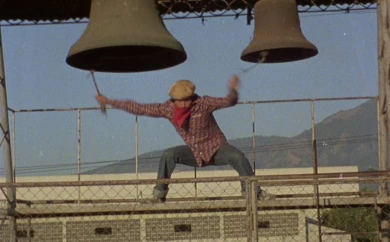
The Reframing Banana Imagery series concludes with two works that condense the height and twilight of this period in history, epic sagas that cross borders and registers to embody experiences of armed struggle in the region. Cameras mix with firearms, borders between nations blur and patience reaches breaking point. This is where the tipping point lies, where the bloodshed weighs heavy and the murmurings of regional brotherhood are buried in the ground again.
Pan y dignidad (Carta abierta de Nicaragua) [Bread and Dignity (An Open Letter to Nicaragua)] recounts the historical records and process of national reconstruction in Nicaragua via the Sandinista popular uprising. Historias prohibidas de Pulgarcito (Forbidden Tales of Tom Thumb) places the camera at the heart of the El Salvador revolutionary struggle, interspersing testimonies of daily violence with the verses of the poet Roque Dalton.
Both works understand the armed revolution as an open file under construction. The insurgent brotherhood, although dissolved, still resounds in regional history.
Circling Over Exploited Bodies
Friday, 19 and 26 June 2026 - 7pm
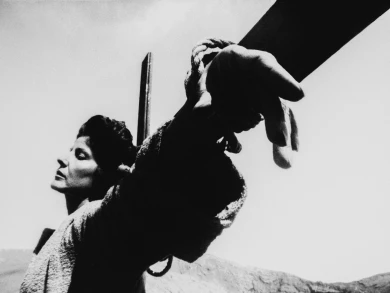
When forms of violence are inflicted on society, film responds from urgency. Images become abstract, sounds fade and the register of dissidence comes from the gut. La zona intertidal (The Intertidal Zone) is an essayistic and poetic approach to the repression of teachers in El Salvador in the 1970s — a teacher studies the biodiversity of the El Salvador coast as a boy finds a body on the same beach. A propósito de la mujer (About Women) interweaves testimonies of misery and rage towards patriarchal structures with fictional scenes of a symbolic procession through a harsh desert.
Both films understand the body as a target of violence and a territory of insurrection, a space where the blood shed by militancy and the patriarchal yoke turn pain into denouncement and existence outside the status quo into an act of political dissidence.
Central American Designation of Origin
Thursday, 18 and 25 June 2026 - 7pm
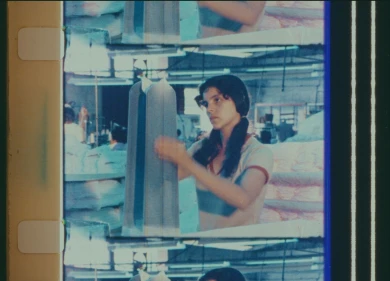
Fertile lands, farmers’ hands, rural faces. This first programme in the series Reframing Banana Imagery understands the foundations of the Central American experience from exploitation, extractivism and displacement, and from the organisation and resistance that emerged as a reaction. The four films within extend from a lyrical documentary on farmers’ solidarity to the playful subversion of the institutional format of the United Fruit Company.
Bananeras (Banana Growers) is a combative portrait of the inhumane conditions of the American banana plantations located in Nicaragua through much of the twentieth century. Costa Rica Banana Republic is a perspicacious satire via an institutional documentary of banana production, spotlighting the extractive nature of this agro-exporting model in the 1970s. Organización Campesina (Farmers’ Organisation) frames rural resistance in Honduras from a direct depiction and lyrical documentary, while Dos veces mujer (Two Times a Woman) dissects the invisibility of the double-shift working day Central American women farmers endure: working in the countryside and working in the home. As a whole, the works here present the earth at once as a wounded body and a space of dignity.

Cinema, for the First Time
7 and 14 June 2026 – 12:00 pm
The final session in this Moon Projector season contemplates the feeling around the first experience of cinema — cinema as revelation, magic, fantasy and mystery from the first gaze, from the first contact with the medium, and imagery etched on the retina of childhood. The programme shows Émile Cohl’s landmark Fantasmagorie (1908), the first ever hand-drawn animation, and Ignacio Agüero’s Cien niños esperando un tren (One Hundred Children Waiting for a Train, 1988), a feature-length film on play and the origins of cinema.
Fantasmagorie (1908)by Émile Cohl (Paris, 1857– Villejuif, 1938) is the first expression in the history of animated drawing. Émile Cohl was an illustrator who belonged to the Parisian art group Arts incohérents (1882–1895), who was bestowed with an absurdist and pre-Surrealist talent. Whereas the Lumière brothers were able get audiences out of their seats as they witnessed a train moving towards them in 1895, Fantasmagorie is a supernatural experience, akin to an apparition yet also innocuous and entertaining — the inanimate comes to life out of nothing and figures seemingly move with little sense. From the outset, animation was related to caricature, fabulation and the comical, a sweet spot for the dreams of the youngest audience.
From the discovery of new imagery arising from the animated line to knowledge of the world through a screen, Cien niños esperando un tren (1988), by Chilean director Ignacio Agüero (Santiago, 1952), narrates a group of young people’s discovery of cinema in a workshop on the origins of the medium in a poverty-stricken town on the outskirts of Santiago de Chile. Play, fun and learning combine with a fascination with images, as viewing Émile Cohl’s Fantasmagorie (1908) in the workshop becomes an act of freedom.
Elisa González and Leah Pattem. Soy Tribulete 7
13 JUN 2026
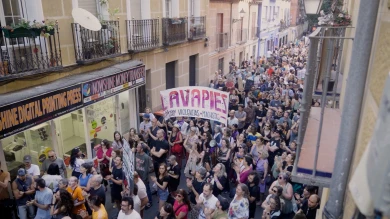
Framed inside this year’s Neighbourhood Picnic is the screening, in the Museo’s Cinema, of a film related to the life and protests of the Lavapiés neighbourhood, addressing issues of gentrification and the right to housing: Soy Tribulete 7 (I Am Tribulete 7, 2026), directed by Elisa González and Leah Pattem.
As the Spanish housing crisis takes hold in Lavapiés, this story begins in February 2024, when the residents of Calle Tribulete, 7, a block of apartments on a street in this Madrid barrio, receive a letter informing them that their building has been sold to a vulture fund. The news spreads quickly around the neighbourhood and, when it comes to the attention of González and Pattem, they grab their cameras and head straight for the building, where they encounter one hundred or so residents still in shock. The film Soy Tribulete 7 flows into the building and the daily lives of a community united, whose looming eviction occasions the fight of their lives. Ultimately, a path of resistance that will turn the community into a symbol of struggle for the right to housing.
Both film-makers worked closely with a group of tenants — Cris, Nani, Blanca, José, María Jesús and Antonia — to tell the story of how the building became the most creative stage of resistance ever witnessed in the area. The work presents the daily life of these residents in Madrid’s now-iconic “building fighting eviction”, depicting their collective struggle and the violent disruption to their lives. Through personal interviews, observational footage, archive material, music and a narration by eighty-year-old actress Ana Martín García, the film casts light on the human stories behind a community struggle.
The Neighbourhood Picnic is an annual gathering of festivities organised by Museo Situado, a network made up of associations, activists and residents from Lavapiés, a racially diverse, working-class neighbourhood where the Museo Reina Sofía is located.