
SECOND READING
A reading allows insight into another world, another time or an experience. Like a travel, once made, a reading leaves one with a knowledge of a place, a knowledge of some experience, some thoughts and sometimes a desire for re-reading.
A second reading is a revisit of a familiar text, like a revisit of a familiar place, like a second encounter of a person, who might have left in you a desire to meet again. A second reading is inevitably conscious of the first; it does not want to « know » from the text, for it knows already. A second reading wants to repeat that familiar pleasure one has enjoyed, once, in a reading.
A photograph of a place or of a person allows endless revisits of that place or that person, through virtually. The photograph itself substitutes its referent making virtual revisits possible even in the referent’s absence.
In 1980 Egyptian filmmaker Mohamed Khan made his first feature film Darbet Shams (Sunstroke), in which a photographer finds himself by chance holder of evidence against a band of traffickers. In one of his rare interviews, and when asked about his retirement plans, Khan said I want to stop working, live quietly and enjoy watch again all the films that marked me in my life.
Egyptian cinema very often included photographs that decorated film sets, but rarely featured photographers in the actual film narratives. Although Khan’s plot shows clear kinship to Michelangelo Antonioni’s Blow Up (1966), yet the film is also part of a family of earlier Egyptian films notably Al hob Al Kabir (The Great Love, 1968), in which a suspicious husband asks a photographer to follow his wife secretly, and take pictures of her to prove she has an affair with a famous singer. Another film is Youm men Omri, (A Day of My Life, 1961) in which a journalist falls in love with a rich man’s daughter he’s supposed to report on.
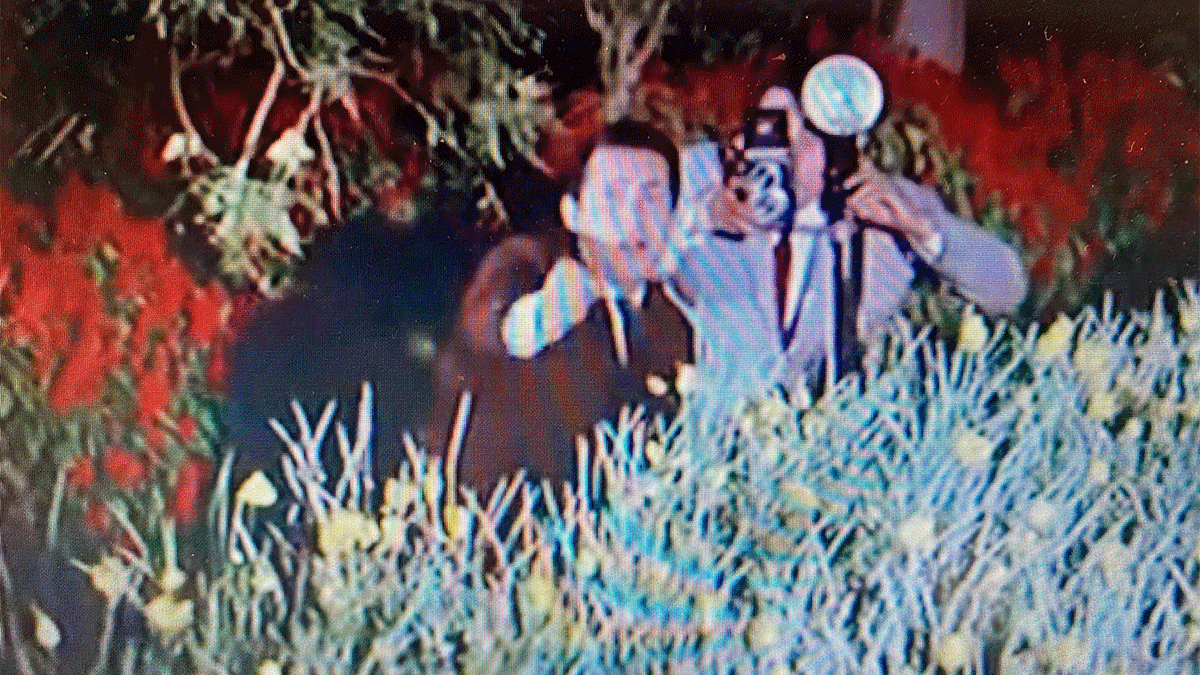
This small clip wants to be the virtual memory of Darbet Shams, in the sense that it uses the films that were produced prior to its production, before the 1980s. It points at a marginal, often misunderstood practice of photographers in Egyptian cinema. Most Egyptian films use the photographer in an anecdotal way, a funny character sometimes, an old-fashioned person other times, almost never a complex character explored in depth.
Excerpts:
Mohamed Khan. Darbet Shams (Sunstroke), 1980
Henri Barakat. Al hob Al Kabir (The Great Love), 1968
Atef Salem. Youm men Omri (A Day of My Life), 1961
Helmy Raflah. Maaboudat al Gamahreer, 1967
Bio
Akram Zaatari (Sidon, Lebanon, 1966) lives and works in Beirut (Lebanon). His body of work includes video, film, photography, installation and writing. Zaatari studied Architecture at the American University in Beirut, and then moved to New York (United States) to study Media at The New School University. In the mid-nineties, he began working at Future TV in Beirut, where he made experimental short films that were a blend of documentary and video art. Zaatari’s work focuses on the military conflicts in Lebanon and in contemporary Muslim societies, and explores the power and bias of the media. He approaches politics through everyday life, the use of the body and social relations.
Akram Zaatari
SECOND READING
Video (5’ 38’’)
2020
