-
Thursday, 12 April / Nouvel Building, Auditorium 200
A Theatre of the Present
Session 1
Presentation – 4:30pm
Participants: Ruth Estévez, Ana Longoni, Isabel de Naverán and José A. Sánchez, with an intervention by Javier del Olmo (Fundación León Ferrari)The Words of Others: A Research Account – 4:45pm
Lecture by Ruth Estévez
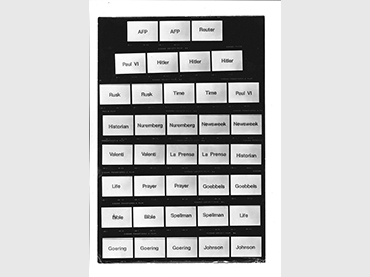
In 2013, Ruth Estévez embarked upon a research project that would last for four years. Her work explored León Ferrari’s literary collages, concentrating on his The Words of Others and its relevance as a pool of resources for the rest of his visual output. These colleges condemned the hypocrisy of political rhetoric and blew the whistle on the complicity of different bodies of military, political and religious power. Therefore, Estévez’s intervention sets forth a survey of this work in order to gain an understanding of the aspects underpinning Ferrari’s political thinking and critical viewpoint.Art/Politics in León Ferrari and the Avant-garde in 1960s Argentina – 5:30pm
Lecture by Ana Longoni
The artistic practice of León Ferrari changed forever with the profound impact the Vietnam War and the US invasion of Santo Domingo had on him, and many others. From 1965 until the end of his life, one axis to intersect his work highlighted the complicity between the Catholic Church and Imperialism. When some critical voices railed against “Western and Christian civilization”, dubbing it propagandist, Ferrari replied: “It’s what I have to say and I say it with the tools available to me”. Experimental art devised as a political stance is integral to an interpretation of experiments such as The Words of Others and an understanding of the collective course of radicalisation, both artistic and political, undertaken by the avant-garde in 1960s Argentina.Idea exchange – 6:15pm
Participants: Ruth Estévez y Ana Longoni
Moderated by: Isabel de NaveránTower of Babel – 7:30pm
A performance lecture by José A. Sánchez and artists and researchers linked to ARTEA
Participants: Ignacio de Antonio Antón, Amaia Bono Jiménez, Janaína Carrer, Cristina Cejas, Gisela Cortés, Andrea Dunia, Juan Pablo Fuentes Villarroel, Ksenia Guinea, David Hernández Vargas, Jessica Huerta, Katty López Soto, Ana Luiza Fortes , Fernando Mena, Eliana Murgia, Noemí Oncala, Laila Tafur Santamaría.In 2017, after staging The Words of Others at REDCAT in Los Angeles, the same team of curators looked towards the appropriation of the Ferrari method to speak about what we are affected by today, subsequently giving rise to “Babelism”. Tower of Babel (1963) is a wire sculpture made by Ferrari two years before The Words of Others, and refers to the idea of: “Making something without unity, with different sensibilities […], or making something with several”. This premise led them to thinking that the author composed The Words of Others single-handedly, rallied by the gravity of the war, violence, and torture, unable to wait any longer to become the producer. With a little more time, he would have opted, as in fact he finally did, for Babelism. And if this “Tower of Babel” were to take shape today, what would our present-day wars be?
-
Friday, 13 April / Nouvel Building, Auditorium 200
A Theatre of the Present
Session 2
The Political Nature of Affection – 4:30pm
Lecture by Ileana Diéguez
How do we think and speak about what hurts? What can art do to hold up an injured body of work? Where do actions happen if there are no longer crowds? When a certain policy is exercised and curtails affection, artistic experience attempts to provide political forms in which this lost affectivity survives. Under such circumstances, political art must produce something other than subversion — it is not just about what can make us rise up; it is perhaps less epic that that: we stand to continue.Theatre and Politics - 5:15pm
Lecture by Akira Takayama
In 2011, the biggest earthquake ever to strike Japan devastated the region of Tohoku. The magnitude of this earthquake unleashed a tsunami with up to 41-metre-high waves, destroying many towns and cities and causing a malfunction in the cooling systems of the Fukushima nuclear power plant. Moreover, with a state of emergency declared, an explosion in the plant caused a wave of radiation within a 20-metre radius. These events prompted theatre director Akira Takayama to create a series of plays and initiatives, for instance the Referendum Project, Kein Licht II and Tokyo Heterotopia, through which he addressed the treatment of social trauma, political action and the effects on a community dealing with survival in their everyday lives. This lecture, therefore, will survey and explore these projects.Idea exchange – 6pm
Participants: Rolf Abderhalden, Ileana Diéguez y Akira Takayama
Moderated by: José A. SánchezThe Media Rhetoric. Post-truth, Fake News, Populism, Neo-censorship and Social Media – 7:30pm
Round-table discussion
Participants: Germán Cano, Lucía Méndez y Marta Peirano
Moderated by: Miguel Álvarez Peralta
In The Words of Others, León Ferrari reflects on politics-media logics and the relationship the rhetoric of journalism bears to the truth and smokescreens, key factors in the political conflicts of his time. More recently, the term post-truth (posverdad in Spanish), has entered the RAE, the Royal Spanish Academy Dictionary, and was voted Word of the Year by Oxford English Dictionary (OED) in 2016. This is testament to the validity, forty years on, of Ferrari’s concerns over media and political rhetoric and human rights. Consequently, this round-table discussion will focus on the role of the media — now digitalised and globalised — in the contemporary public sphere and will run through some of the focal points that galvanised Ferrari, issues we know today as controversies like fake news, which bring to bear new determining factors in political relations and the power of current societies.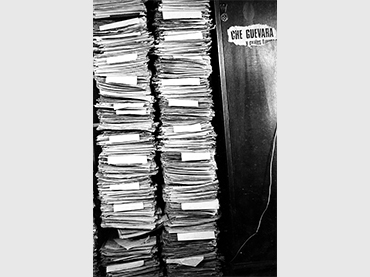
-
Saturday, 14 April / Nouvel Building, Auditorium 400
The Words of Others
A Literary Collage of León Ferrari
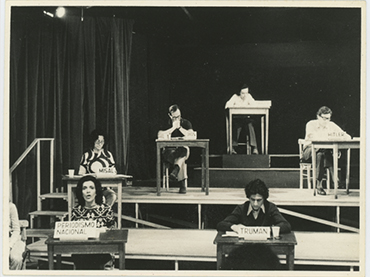
For the first time in Spanish, the Museo Reina Sofía presents León Ferrari’s The Words of Othersin its entirety. The piece, seven hours in duration, encapsulates the history of violence meted out by and in the West as a result of the complicity of political and religious power, an issue Ferrari explored throughout his career. Through words, The Words of Others visualises scenarios ranging from the punishment and redemption in the Judaeo-Christian doctrine and the horrors of the Second World War — Nazi Germany, concentration camps, the Nuremburg trials — to contexts closer and more contemporary to the artist, for instance the Vietnam War and the imperialist expansion of the USA during the Cold War. The artist created an extensive dialogue between such far-flung leading figures as Adolf Hitler, Pope Paul VI, God and the US President Lyndon B. Johnson, along with the voices of war correspondents, local and international journalists, servicemen, prophets and political advisors. These figures converse by way of quotes taken from history books and literature, the Bible, and particularly the printed press, magazines and national newspapers, as well as international agency cables.
This presentation seeks to raise awareness of a key piece in the artistic oeuvre of León Ferrari, and to pay homage to Ferrari as an artist, as well as constituting a gesture in defence of culture, democracy and human rights — issues which were imperative to Ferrari.
A Theatre of the Present
Rhetoric and Power in León Ferrari’s The Words of Others
Held on 12, 13, 14 Apr 2018
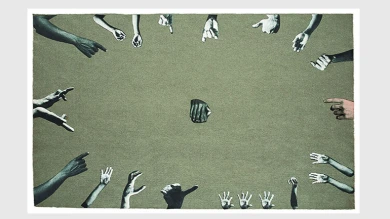
León Ferrari (Buenos Aires, 1920–2013) assembled the literary collage Palabras ajenas (The Words of Others) between 1965 and 1967, his rationale driven by the violence and extreme cruelty that appeared in news reports of the Vietnam War. These reports heralded a way of exercising power which would soon be imposed upon vast swathes of Latin America. Yet this power-driven violence was in sharp contrast to the intentions and carefree rhetoric of the “shows” put on and headed by political leaders, who cynically justified the violation of human rights. The literary collage method enabled Ferrari to stage the false neutrality of the media, debunking fabricated narratives and laying bare the continuity between past — the Bible, Fascism — and present propaganda.
The Words of Others remains a theatre of the present because the condemnation of stances and modes is repeated, as are the authoritarian drift, inequality and segregation as forms of domination. It is no wonder that an artist hitherto focused on producing ceramics, sculptures and drawings ended up creating a theatrical collage with which to intervene in the present he faced: the real-time clash with the public sphere proved to be the most effective approach for a practice in need of becoming politically active.
With few concerns over being branded non-theatre or non-art, Ferrari’s work demonstrated how art and theatre could be performed as a committed action, an outcry in which war, economy and politics were already one big show.
The first day in this seminar will explore the distinctiveness of The Words of Others and its importance to the development of the thought and practice of its author. Moreover, it sets out to carve this and other Ferrari works into the historical and political contexts of the 1960s, punctuating the realm of Latin America, particularly Argentina. The second day will look at how the piece resonates in the present, thereby surveying the practices of different contemporary artists that stand at that sharp-edged junction of political action, reissuing modes of commitment that share similarities with those upheld by Ferrari throughout his life. On a further note and as an accompaniment to these reflections, an analysis will be conducted on the rhetoric of today’s media: how “post-truth” works and the possible critical alternatives.
The coda to the seminar will be a seven-hour presentation of The Words of Others in its entirety.
Acknowledgements
The Words of Others was originally produced by REDCAT/CalArts, with the support of the Getty Foundation. The performance was part of Pacific Standard Time: LA/LA, in Los Angeles. A special thank you to the Fundación Augusto y León Ferrari. Arte and Acervo (FALFAA)
Within the framework of the research project
Expanded Theatricalities (MINECO. HAR2015-63984-P), by the research group ARTEA
Activity inside the programme
Organised by
Museo Reina Sofía and ARTEA
Participants
Miguel Álvarez Peralta. Professor of Political Communication and the Global Media System at the University of Castilla la Mancha (UCLM), with a PhD in Mass Communication from the Complutense University of Madrid (UCM). Previously, he worked as a coordinator in the Scientific Culture Department at Spain’s National Distance Education University (UNED) and as a research fellow at Harvard University (USA) and the University of Bolonia (Italy). He is currently conducting research into the emergence of new narratives and political identities as a member of different R&D projects in Spain, for instance the Grupo CAPEP’s work on the Construction of Affairs in the Public Sphere.
Germán Cano. Head professor of Philosophy at the University of Alcalá de Henares, and a translator and analyst with an interest in social movements. He is also the author of Como un ángel frío (2000), Nietzsche y la crítica de la modernidad (2001); Hacer morir, dejar vivir. Biopolítica y capitalismo (2010) and Adoquines bajo la playa. Escenografías biopolíticas del 68 (2011), and is currently a contributor to “Cuarta Página” in Spain’s El País newspaper.
Ileana Diéguez. Research professor in the Humanities Department at the Universidad Autónoma Metropolitana (UAM)-Cuajimalpa, Mexico City, and coordinator of the programme Cartografías Críticas. Her work focuses on reflections connected to dismounting artistic processes, mourning and memory, and ‘necro-theatre’, and her most recent publications include Cuerpos sin duelo. Iconografías y teatralidades del dolor (2013) and Escenarios liminales. Teatralidades, performatividades, políticas (2014), among others.
Ruth Estévez. Curator, writer and set designer. She studied Fine Art at the
University of the Basque Country (UPV/EHU) and obtained an MA in Art History from the Universidad Nacional Autónoma de México (UNAM). Since 2012, she has been a director and head curator at RedCat/California Institute of the Arts (CalArts), a multidisciplinary space, centred on visual and performance arts, in the centre of Los Angeles (USA). Moreover, as an independent curator she has worked on projects at the Graham Foundation for Advanced Studies in Art and Architecture, in Chicago; the Los Angeles Public Art Biennial; Solo Projects at ARCO, Madrid, and the Palaix des Beaux Art Brussels.
Ana Longoni. Researcher, member of the Southern Conceptualisms Network, and incumbent director of Public Activities at the Museo Reina Sofía. With a PhD in the Arts from the University of Buenos Aires (UBA), she is a specialist in the crossroads between art and politics in Argentina and Latin America from the middle of the 20th century to the present day. Her publications include: Roberto Jacoby. El deseo nace del derrumbe (2011), Leandro Katz (2013) and Vanguardia y revolución (2014). Moreover, she curated Roberto Jacoby. Desire is Born from Collapse (Museo Reina Sofía, 2011) and Losing the Public Form. A Seismic Image of the 1980s in Latin America (Museo Reina Sofía, 2012/Museo de Arte de Lima (MALI), 2013 /Museo de la Universidad Nacional de Tres de Febrero (MUNTREF), 2014).
Lucía Méndez. With a degree in Information Science from the Complutense University of Madrid, she is an editor-in-chief and columnist for Spanish newspaper El Mundo, where she has worked since it was founded. She previously contributed to the newspapers El Norte de Castilla and Diario 16, and radio station cadena SER. Moreover, she is a contributor and analyst with cadena SER’s Hoy por Hoy, TVE’s (Spain’s public service television) Los desayunos de TVE, and a number of news programmes on Spanish TV channel La Sexta. She is the author of Duelo de titanes (2008) and Morder la bala. Relato íntimo del gobierno del PP (2012), and editor of Cristina Alberdi’s book El poder es cosa de hombres (2001).
Isabel de Naverán. Stage and theatre researcher. With a PhD in Fine Arts from the University of the Basque Country (UPV/EHU), she is a member of the Bulegoa z/b office for art and knowledge (Bilbao), part of ARTEA, and a lecturer on the MA in Performing Arts Practices and Visual Culture (UCLM and Museo Reina Sofía), and the MA in Research and Creation in Art (UPV/EHU). Furthermore, she has edited the books Hacer historia. Reflexiones desde la práctica de la danza (2010) and Lecturas sobre danza y coreografía (2013), among others, and, since 2016, has coordinated the dance series Elipsiak in AZ (Bilbao). She is also a dance instructor at the Museo Reina Sofía, in Madrid.
Marta Peirano. Deputy editor of Eldiario.es. Founder of CryptoParty Berlin and Elástico, multidisciplinary collectives with which she co-directed the project COPYFIGHt on free culture. The themes of her publications focus on digital art, surveillance, automata, and technological Futurism. Her most recent publication, El Pequeño libro rojo del activista en red (2015), with a preface by Edward Snowden, serves as an introduction to cryptography for journalists, reference material and the media.
José A. Sánchez. Researcher, teacher and the author of books and texts on contemporary artistic practice in the sphere of performance, cinema and literature. A professor in the Fine Arts Department of UCLM, he is the editor of the Virtual Archive of Performing Arts and director of the research group ARTEA. Furthermore, he has edited and contributed to publications such as Isadora Duncan. El arte de la danza y otros escritos (2003), Cuerpos sobre blanco (2003), Situaciones: un proyecto multidisciplinar en Cuenca (2003), Práctica artística y políticas culturales. Algunas propuestas desde la Universidad (2003), Artes de la escena y de la acción en España: 1978-2002 (2006), and No hay más poesía que la acción. Teatralidades expandidas y repertorios disidentes (2015).
Akira Takayama. Theatre director and founder, in 2002, of the project Unit Port B, a space for creating so-called site-specific performances. His work, shaped by this genre, is a theatre and performance hybrid, whereby interaction with the public is part of the mise en scène. His most recent works of note include The Complete Manual of Evacuation (2010), Referendum project (2011), Kein Licth II (2012) and Tokyo Heterotopia (2013).
Más actividades
![Binka Zhelyazkova, Baseynat [La piscina], 1977, película](https://recursos.museoreinasofia.es/styles/small_landscape/public/Actividades/ciclocine-piscinas-17_00.png.webp)
Binka Zhelyazkova. The Swimming Pool
Viernes 28 de agosto, 2026
The young, bright Bella (Yanina Kasheva), after unforeseen heartbreak at her graduation party, meets Apostol (Kosta Tsonev), a reserved architect, and Boyan (Kliment Denchev), a comedy actor who is cynical about his country. The three characters climb up to a diving board in a municipal swimming pool, where they begin a strange relationship of friendship, love and despair which reflects a generational clash.
Binka Zhelyazkova, the great enfant terrible of Eastern European cinema, critic of the communist system and widely acclaimed film-maker beyond Bulgarian borders, made in The Swimming Pool a masterly metaphor for a country in decline. The public pool symbolises a closed, immovable enclosure where society is festering. From the height of a diving board she sees, in a panoptic view, the different generations living underneath a limited space. On one side, older people attempt to preserve the old revolutionary spirit with constant collective swimming exercises while, on the other, young people don’t hide the desire for freedom that remains unrealised. The result is an ideological clash in how to act and move in the enclosure, unearthing vast hypocrisy in the lost ideals of socialism, reflected in the total apathy of youth. The Swimming Pool for Zhelyazkova is a reflection of the disillusionment and existential void of a whole country and system.
![Jacques Deray, La piscine [La piscina], 1969, película](https://recursos.museoreinasofia.es/styles/small_landscape/public/Actividades/ciclocine-piscinas-18.jpg.webp)
Jacques Deray. The Swimming Pool
Saturday, 29 August 2026
The characters played by Alain Delon (Jean-Paul) and Romy Schneider (Marianne) experience their love in apparent splendour. A sun-drenched house, a blissful swimming pool, beautiful bodies, sexuality in abundance. The visit of Harry (Maurice Ronet), a successful musician, friend of Jean-Paul and ex-lover of Marianne, accompanied by his young and beautiful daughter Penélope (Jane Birkin), rocks their relationship, bringing to light the jealousy and insecurities of each one in a dark game of possession and male rivalry.
If there was a definition of the glistening blue pool in this sexual thriller, it would be the paradise of Adam and Eve, represented by the shots of happiness of Romy Schneider and Alain Delon in this swimming pool on France’s Côte d’Azur. The appearance of these two beautiful creatures kissing semi-naked by the water is one of film’s resonant images. The paradise cannot be fractured, not even by death. As in the crossing of the Tigris and Euphrates rivers, where humanity’s first lovers bathed naked in the water, innocent to their imminent end, the reflection of the crystalline water of The Swimming Pool shows this game, and the deep traumas which, under this mantle, are hidden in the amorous relationships and limits that only love is capable of breaking to solve.
In this session both endings to the film are screened: the original version, open and symbolic, and the Spanish version, marked by censorship during Francoism, and its sequence for a Spanish premiere — a stereotypical and reductive vision reflecting the sociological condition of the country.
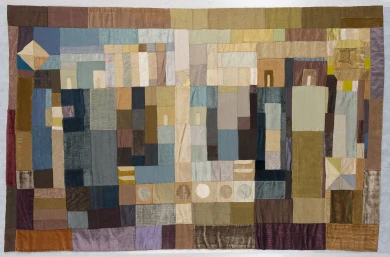
Transnational Perspectives on Aurèlia Muñoz and Fibre Art
Wednesday, 2 September 2026
Coinciding with the end of the Aurèlia Muñoz. Beings exhibition, this study day gathers international experts to explore the connections and affinities between the different movements that renovated languages of contemporary Textile Art from the late 1960s. Movements such as Nouvelle Tapisserie and Fibre Art found, from that decade onwards, epicentres in places as diverse as Lausanne, Warsaw, New York, São Paulo and Barcelona, their key figures, including Aurèlia Muñoz, embodying a community of artists engaged in constant dialogue and formal evolution.
The study day Transnational Perspectives on Aurèlia Muñoz and Fibre Art offers, by way of experts and the show’s curatorial team, keys to situating the artist’s work within a framework crossed by major debates — both eco-political and aesthetic — that resonate strongly in today’s artistic dynamics.

University Micro-Credential in Intercultural and Multilingual Mediation within Artistic Contexts
Miércoles, del 12 de septiembre al 16 de diciembre, 2026
Micro-credentials are short-term learning experiences (up to 150 hours/15 ECTS) which are certified at a European level. They aim to certify key competences of lifelong learning through eminently practical proposals, and with an active methodological approach.
The University Micro-Credential in Intercultural and Multilingual Mediation within Artistic Contexts, organised by the Autonomous University of Madrid (UAM), in a collaboration with the Museo Reina Sofía, seeks to develop knowledge around intercultural mediation to be practised in museum and art contexts, and from a perspective which integrates linguistic diversity to impart a more just, diverse and plural experience of contemporary art and culture. The micro-credential goes towards a university qualification issued by UAM.
This initiative is the outcome of a shared research undertaking of linguistic justice between the Museo Reina Sofía’s Studies Directorship and UAM’s Centre for Research in Multilingualism, Discourse and Communication (MIRCo). Following over twenty years of experience as a research group, MIRCo established itself in 2021 as an open science and citizen-engagement space that drives research on multilingual practices, speech and speakers in diaspora, interrelations between discourse and power, intercultural communication and the transformation of space via communicative linguistic spaces.
This common interest materialises through ReDes_Ling, an interdisciplinary research and action project that studies language as a vehicle which reproduces social inequality, seeking to design actions that reduce its effects in society. The creation of this micro-credential constitutes one of these actions.
Furthermore, the programme is rooted in the experience of the Aissatou Ndiaye School of Situated Mediation, propelled since 2022 by Museo Situado, in collaboration with teams from the Museo Reina Sofía’s Tentacular Museum and Education Department. By way of contact with works conserved in the Museo and with different professionals from the cultural sphere and social activists, mediators from this school will develop their own routes in different languages, including Spanish, Wolof, Bengali, Darija, Arabic, Tagalog and French, enriching the narratives in the Museo Reina Sofía Collections. Therefore, the school is encompassed within a reflection on and continuing work with cultural mediation to dissolve any barriers that stand in the way of practices, discourses and contemporary artworks and people of any age or social status.
The convergence of these experiences makes the micro-credential a space of training which blends academic reflection, professional practice and a commitment to linguistic justice and cultural rights.
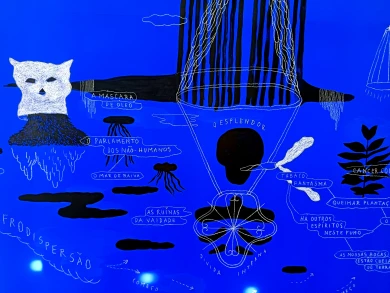
Olivier Marboeuf
Wednesday, 23 September, 2026 - 7pm
In this first public presentation of his annual research fellowship at Museo Reina Sofía, entitled The Rioter and the Witch: Rehearsals on Cultural and Para-Institucional Mediation, Olivier Marboeuf addresses the question that guides his research: how might we summon the emancipatory power of rioting and storytelling as tools for mediation and institutional transformation, without succumbing to the heritagisation, depoliticisation or commodification of the ways of life that are inherent to them?
Whilst introducing the questions that guide his research project at the Museum, this presentation explores some of the central notions that underpin his artistic and research practice, such as ‘witch mediation’, the construction and legitimisation of ‘interpretative communities’, and the creation of speculative cartographies and archives. The concepts coined by Marboeuf arise from a back-and-forth between theory and his sustained career as an artist, cultural organiser, community storyteller and film producer, always concerned with the conditions of presence, representation, autonomy and visibility of minority practices within the cultural institution.
By understanding mediation as a bewitched practice, Marboeuf proposes kindle this practice as a politics of collective hallucination which, by re-enacting the emancipatory potential of Caribbean storytelling, destabilises and negotiates who can appear, speak, interpret and narrate, and which stories become legible, without renouncing opacity. Hence, in his work, cartography emerges as a speculative methodology that does not rely on representation, but rather on the presence of a community that collectively interprets a plural and cacophonous narrative, one that is never transparent or definitive.