-
November 12 Sabatini Building, Auditorium
Theatricalizing the Colonial Past
7:00 p.m. Introduction to the Film Series by the curator, TJ Demos. 7:30 p.m. Projections:
Vincent Meessen. Vita Nova, 2009
Digital, Original version, subtitled, 26’Mathieu Kleyebe Abonnenc. Ça va, ça va, on continue, 2012
Digital HD, Original version, subtitled, 26’Pedro Costa. Sweet Exorcist, 2012
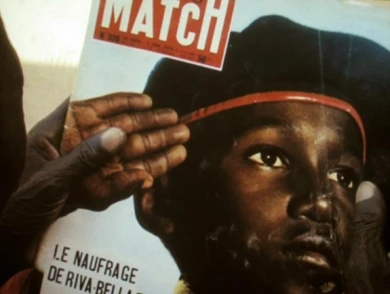
Digital, Original version, subtitled, 20’In recalling colonial life and the revolutionary moment of liberation, the diverse films of Vincent Meessen, Mathieu Abonnenc, and Pedro Costa, offer poignant entrances into current collective memory, overdetermined by the will-to-forget as much as by the painful reminders of what could have been but never was. How are current-day figures haunted by that past and its erstwhile dreams of emancipation? What can present archaeologies into the ghostly realm turn up, for instance, in regards to past critical studies of colonialism (as by Roland Barthes, as examined in Vita Nova)? And how are such visitations comparable to the troubled remembrance of former freedom fighters who struggled in now-forgotten movements of decolonization and socialist liberation, as in Portugal’s Carnation revolution of 1974, which ended the fascist regime of Estado Novo, a history alluded to in the work of Costa and Abonnenc?.
-
November 13 Sabatini Building, Auditorium
Songs against Caste in India
Anand Patwardhan. Jai Bhim Comrade, 2011
Digital, Original version, subtitled, 199’Premiering in Spain with this screening, Jai Bhim Comrade traces the atrocity of caste in India through the songs, poetry, and resistance culture from below. Shot over fourteen years, this masterpiece made by the foremost Indian documentarian investigates the fraught circumstances of the country’s Dalits, denigrated as “untouchables” for thousands of years, denied education, access to religious institutions, and allotted the lowest forms of manual labor. The film investigates the revolutionary figure of Bhimrao Ambedkar, who led the struggle for emancipation of his people, earned doctorates abroad, and came to write the country’s Constitution, eventually rejecting Hinduism’s repressive castism in favor of Buddhism. Patwardhan shows how Ambedkar’s demands for liberation and equality —comprising steps more radical than Gandhi had envisaged— live on in legend, storytelling, and collective song, in the subaltern aesthetics and just reason of India’s contemporary underclass, as revealed in the tragic story of Vilas Ghogre, a leftist poet and beloved street singer who hung himself in protest over the suppressed unrealized promise of Ambedkar’s vision.
-
November 19 Sabatini Building, Auditorium
Aesthetics after Genocide
Rithy Panh. The Missing Picture, 2013
Digital, Original version, subtitled, 90’Motivated by Panh’s desire to find photographic documentation of the Khmer Rouge’s brutal rule in Cambodia between 1975 to 1979, The Missing Picture confronts not only the absence of actually existing visual evidence that can prove mass murder, but the irrevocable fact of representation’s inadequacy in recording the definitive History and Truth of events. What results is a moving tale about the Cambodian Security Prison S-21, told using clay figures, archival footage, and Panh’s voiceover that narrates the filmmaker’s searching quest for an image of atrocity that can only ever go missing.
-
November 20 Sabatini Building, Auditorium
Past Potential Futures
Sven Augustijnen. Spectres, 2011
Digital HD, Original version, subtitled, 104’The Otolith Group. In the Year of the Quiet Sun, 2013
Digital HD, Original version, subtitled, 33’The era of postwar decolonization in Africa was one filled with the imagined futures of liberation and independence, futures gradually clouded over by neocolonial regimes of financial servitude to world markets enabled by dictatorial regimes. In some cases, the leaders of newly independent nations who promised self-determination, were brutally arrested, tortured, and summarily executed (as in the case of Patrice Lumumba, the first democratically elected leader of postcolonial Congo), the history of which is shown to be obsessively reconstructed by a former Belgian diplomat and colonial apologist in Augustijnen’s film. Against such historiographic domination, The Otolith Group (composed of British artists and theorists Kodwo Eshun and Anjalika Sagar) rescues the diplomacy of 1960s Pan-Africanism, focusing on the emerging material culture of independence, specifically as constituted by the form of the postage stamp whose imagery proclaimed a new dawn of sovereignty. Yet it was also one that, in its iconography of monumentalized leaders, also divulges signs of the eventual eclipse of those imagined futures of emancipation also announced in this postal imaginary.
-
November 26 Sabatini Building, Auditorium
Spectral Ecologies
Ursula Biemann. Deep Weather, 2013
Digital HD, Original version, subtitled, 9’Ursula Biemann & Paulo Tavares. Forest Law/Selva jurídica, 2014
Video installation, 41’. Screening format: one-channel version digital file. 30'Zanny Begg y Oliver Ressler. The Right of Passage, 2013
Digital HD, Original version, subtitled, 19’Ursula Biemann’s Deep Weather examines ecologies of devastation, including industrial destruction of the earth, looking closely at the hydrocarbon extraction taking place in Canada’s Alberta tar sands. This fossil fuel geo-engineering project produces ever more greenhouse gases, leading to rising seas, and Biemann also investigates the contemporary effects as felt in Bangladesh’s delta. The short video brings visual appearance to areas that put the lie to global neoliberalism’s growth model of “sustainable development.” In a second film, Biemann and Paulo Tavares investigate recent legal developments in Ecuador regarding “the rights of nature,” bringing legal standing to non-human subjects in order to protect against environmental destruction. These films share with Begg and Ressler’s The Right of Passage a re-arrangement of what counts in the realm of the visible, in their case, bringing attention to the ghostly presences of migrant subjects who, in an act of counter-spectralization that rejects a depoliticizing invisibility, contest the normalization of national identity and xenophobic policies in the EU.
-
November 27 Sabatini Building, Auditorium
Commemorating Postcolonial Subjects
John Akomfrah. The Stuart Hall Project, 2013
Digital, Original version, subtitled, 100’The Stuart Hall Project, 2013, is a masterful recent film by veteran member of Black Audio Film Collective John Akomfrah. It explores the professional life of Stuart Hall, the renowned Cultural Studies theorist and British-Jamaican public intellectual. Constructed from documentary footage sourced from the BBC’s archive, the film builds on the now-disbanded Black Audio Collective’s filmic studies (the focus of a recent film series held in the Museo) of great twentieth century intellectuals, activists, and cultural figures, such as Malcolm X, Martin Luther King Jr., and Michael X, and influential musicians like Sun Ra and George Clinton. In his new work, Akomfrah sets himself the challenge of giving aesthetic expression to Hall’s fundamental insight that “identities are formed at the unstable point where the ‘unspeakable’ stories of subjectivity meet the narratives of history,” including political narratives, postcolonial experience in postwar Britain, and contentious media archives. The piece materializes the subject within a heterogeneous image-archive resonating with the lived experience of migratory displacement—Hall moved to Britain in 1951 and lived there till his death in 2014—and the deterritorialized drift of recall between history and memory.
-
December 3 Sabatini Building, Auditorium
Militant Environments
Brad Butler y Karen Mirza. The Unreliable Narrator, 2014
Digital, Original version, subtitled, 16’Sanjay Kak. Red Ant Dream, 2013
Digital, Original version, subtitled, 120’This session looks to a younger generation of contemporary moving image practitioners that address military conflict in India.
Karen Mirza and Brad Butler’s Unreliable Narrator examines the traumatic events of 2008 when Mumbai was hit with a series of coordinated bombing and shooting attacks carried out by Pakistani members of Lashkar-e-Taiba, an Islamist militant group based in Pakistan dedicated to establishing a Muslim state in South Asia. Examining violence and mediatization, sacrifice and the contested power of narrative, the film mixes documentary and CCTV footage with shots from a 2013 Bollywood Hindu docudrama of the events. We learn how terrorism increasingly haunts in the guise of spectacle, and how it is exorcized through the entertainment industry. Meanwhile, Sanjay Kak’s Red Ant Dream looks at the militant guerilla revolution taking place in India’s rural forests of Chhatisgarh, the site of a Maoist struggle against both the state’s economics of inequality and its pro-industry disregard for tribal ecosystems and natural rights. The specter of a future eco-catastrophe, propelled by India’s Western-style development, in this case drives the militant defense of the survival of India’s impoverished tribals and agrarian villagers.
-
December 4 and 10 Sabatini Building, Auditorium
Hauntologies, Near and Far
December 4
Salomé Lamas. No Man’s Land, 2012
Digital HD, Original version, subtitled, 72’December 10
Los Hijos. Trees, 2013
Digital HD, 61’
Introduction by the authors
In Salomé Lamas’s No Man’s Land, we encounter a Portuguese mercenary and hit-man who tells of his experiences fighting in the final days of colonial Africa, and as an agent of GAL (Grupos Antiterroristas de Liberación), participating in the state-sponsored death squads directed against the Basque separatists of ETA and the latter’s safe havens in France. We learn of his relations to the cruelties and paradoxes of power, only to face his tortuous ethical justifications for his horrible crimes, leaving us to wonder: Is he haunted by the violence he’s committed? With Trees, the focus is on the survivors of colonial terror. The film depicts the visit of Antonia Pilar to Bioko, the island off the coast of Equatorial Guinea, where she hears stories of the Spanish colonial past. Created by Colectivo Los Hijos (comprising Spanish artists Javier Fernández Vázquez, Luis López Carrasco, and Natalia Marin Sancho), the film relates legends of the native Bubi people, and juxtaposes it to the contemporary experiences of a young white Spanish couple living in a residential colonies in the periphery of Madrid during financial crisis and confronting persistent unemployment. Trees shows how colonial violence and creative resistance live on in poetic fragments marooned in the present.
Specters. A Cinema of Haunting
Held on 12, 13, 19, 20, 26, 27 Nov, 03, 04, 10 Dec 2014
Specters: A Ciné-politics of Haunting gathers a selection of recent international film and video that conjures the hauntings of our collective cultural imaginary. Some phantoms arise from past injustices and political traumas, some apparitions, of catastrophic times to come. Still others speak to the unfulfilled promises of the past that continue to live on, dormant in our present. The inclusions, diverse and necessarily incomplete, represent powerful examples that join poignant aesthetic formulation to inspiring political commitment, and have been drawn from a range of geographical contexts that reference history, culture, and politics in Europe, Asia, and the Americas.
The series borrows its title from the recent film Spectres of Sven Augustijnen (2011), examining the disquieting presences from times outside of the contemporary, it offers less an iconography of otherworldly beings than a conjuring of haunting disturbances existing at the edges of representation. At the same time, the program alludes to the history of militant cinema, what the Argentine Octavio Getino, a film-maker and theorist of Third Cinema, would call ciné-politics, a popular and radical image that embodied the critical legacy of Avant-garde movements.
To be sure, most of the films in this series bear little resemblance to the collective revolt of militant cinema; yet they do advance the erstwhile commitment to documenting violence, struggling against repression, refusing to forget, and striving for a better world. As such, this series offers a ciné-politics of decolonization that offers a critical antidote to pervasive amnesia, and a space where the post-militant image can be revisited. This coming-into-being, however, is no exorcism or redemptive return-to-forgetting, but, to reanimate Derrida’s words, presents an ethico-political imperative: to “learn to live with ghosts, more justly.”
Curatorship
TJ Demos
Más actividades
![Joseph Kosuth. One and Three Chairs [Una y tres sillas]](https://recursos.museoreinasofia.es/styles/small_landscape/public/Actividades/joseph_kosuth.jpg.webp)
The (legal) person and the legal form. Chapter III
Monday 11, Wednesday 13 and Thursday 14 May 2026
As part of the Studies Constellation, the Study Directoship’s annual fellowship, art historian and theorist Sven Lütticken leads the seminar The (Legal) Person and the Legal Form: Theoretical, Artistic, and Activist Commitments to foster dialogue and deepen the hypotheses and questions driving his research project.
The seminar consists of eight sessions, divided into three chapters throughout the academic year. While conceived as non-public spaces for discussion and collective work, these sessions complement, nourish, and amplify the public program of the Studies Constellation.
First session of the third chapter focuses on the transformation of the artwork in the context and wake of Conceptual art. The very notion of the artwork, together with its ownership and authenticity, is reconsidered from a broad perspective open to new and alternative models of management, which could ultimately transform the relationship between artist, artwork and owner. Can some of the practices in question serve as critical models? To what extent is it possible to think and act with them, and extrapolate from them, beyond a beautiful niche?
The second session turns to the question of representation. While many (but not all) human natural persons can, in principle, represent themselves in legal matters, other needs representatives. This goes for minors as well for adults who have been placed under legal guardianship; it applies to fictitious persons such as corporations and states, who need human representatives to sign contracts or defend them in court. We will look into the question of legal representation in conjunction with other forms of representation, in the cultural as well as political register—taking cues from Spivak’s distinction between portrait (Darstellung) and proxy (Vertretung), which is an unstable and historically mutable one.
The seminar concludes with a closing session dedicated to collectively revisiting and reflecting on the themes and discussions that have emerged throughout the first Studies Constellation Residency Program.
Patricia Falguières
Tuesday May 12th 2026 – 19:00 h
Art historian Patricia Falguières inaugurates the María Luisa Caturla Chairwith the lecture Art History in Dark Times. This Chair, dedicated to the reflection on art in times «sick with uncertainty», is aimed at dismounting, digressing and imagining multiple temporalities and materialities in art history and cultural studies from an eccentric gaze, in the sense of being displaced, off-centre or with a centre that is different.
The lecture’s title references Hannah Arendt’s collection of essays Men in Dark Times, which in turn paraphrases a Bertol Brecht poem. In it, Arendt asserts «dark times are not only not new, they are no rarity in history».
Patricia Falguières also claims history knows many periods when the public realm has been obscured, when the world becomes so uncertain that people cease to ask anything of politics except to relieve them of the burden of their vital interests and their private freedom. The art historian —whose expertise is in the field of Renaissance art and philosophy but paying close attention to contemporaneity— invites us to a «chaotic and adventurous journey», from the Italian Renaissance to Fukushima, through which to delve into the questions: What can the practice of art history mean today, in a world ablaze with ominous glimmers and even more ominous threats, if not as mere entertainment or social ornament? Of what vital interests, of what freedom can it bear witness and serve as an instrument?
![Tracey Rose, The Black Sun Black Star and Moon [La luna estrella negro y negro sol], 2014.](https://recursos.museoreinasofia.es/styles/small_landscape/public/Obra/AD07091_2.jpg.webp)
On Black Study: Towards a Black Poethics of Contamination
27, 28, 29 ABR 2026
The seminar On Black Study: Towards a Black Poethics of Contamination proposes Black Study as a critical and methodological practice that has emerged in and against racial capitalism, colonial modernity and institutional capture. Framed through what the invited researcher and practitioner Ishy Pryce-Parchment terms a Black poethics of contamination, the seminar considers what it might mean to think Blackness (and therefore Black Study) as contagious, diffuse and spreadable matter. To do so, it enacts a constellation of diasporic methodologies and black aesthetic practices that harbor “contamination” -ideas that travel through texts, geographies, bodies and histories- as a method and as a condition.
If Blackness enters Western modernity from the position of the Middle Passage and its afterlives, it also names a condition from which alternative modes of being, knowing and relating are continually forged. From within this errant boundarylessness, Black creative-intellectual practice unfolds as what might be called a history of touches: transmissions, residues and socialities that unsettle the fantasy of pure or self-contained knowledge.
Situated within Black radical aesthetics, Black feminist theory and diasporic poetics, the seminar traces a genealogy of Black Study not as an object of analysis but as methodological propositions that continue to shape contemporary aesthetic and political life. Against mastery as the horizon of study, the group shifts attention from what we know to how we know. It foregrounds creative Black methodological practices—fahima ife’s anindex (via Fred Moten), Katherine McKittrick’s expansive use of the footnote, citation as relational and loving labour, the aesthetics of Black miscellanea, and Christina Sharpe’s practices of annotation—as procedures that disorganise dominant regimes of knowledge. In this sense, Black Study is approached not as a discrete academic field but as a feel for knowing and knowledge: a constellation of insurgent practices—reading, gathering, listening, annotating, refusing, world-making—that operate both within and beyond the university.
The study sessions propose to experiment with form in order to embrace how ‘black people have always used interdisciplinary methodologies to explain, explore, and story the world.’ Through engagements with thinkers and practitioners such as Katherine McKittrick, C.L.R. James, Sylvia Wynter, Christina Sharpe, Fred Moten, Tina Campt, Hilton Als, John Akomfrah, fahima ife and Dionne Brand, we ask: What might it mean to study together, incompletely and without recourse to individuation? How might aesthetic practice function as a poethical intervention in the ongoing work of what Sylvia Wynter calls the practice of doing humanness?

Mediations of the Archive: Art, Community, and Political Action
Tuesday 7, and Thursday 23, April, 2026 – 17:00 h
The online seminar Archival Mediations: Art, Community, and Political Action, curated by Sofía Villena Araya, examines the role of archival practices in caring for, dignifying, and activating memory in Central America. As part of the Cáder Institute for Central American Art’s first line of research, driven by the question “What Art Histories does Central America produce?”, this seminar proposes an approach to the archive as a mediator that articulates relationships between art, community, and political action, while engaging with the historiographical questions raised by their intersections.
Although the proposal is not limited to discussions of the Central American isthmus, it is framed by the particular conditions under which memory has been constructed in the region. Central America is a territory vulnerable to natural and geological disasters, marked by political violence exercised by authoritarian states and fragile institutions, a persistent colonial and imperial legacy, and the social fragmentation resulting from these factors. It is also a context in which the archive does not necessarily refer to a specific place —such as a building or documentary collection— nor does it primarily follow the protocols of a discipline such as archival science. Rather, the seminar explores how the archive operates, through art, as a dispositif that forges connections, generates forms of belonging, and opens spaces for political action.
The encounter unfolds across two sessions: the first focuses on archival practices addressing questions of memory, violence, and war; the second examines community-based practices surrounding queer and sex-dissident archives. In the face of the systematic destruction of memory, the archival practices discussed in these sessions demonstrate how the archive emerges in other spaces and according to different logics. Within this framework, the proposed space for exchange and research explores the role of art as a productive medium for constructing archives through images, affects, intimacy, performativity, the body, orality, and fiction, as well as through other materialities that challenge the centrality of the document and of writing.
Intergenerationality
Thursday, 9 April 2026 – 5:30pm
This series is organised by equipoMotor, a group of teenagers, young people and older people who have participated in the Museo Reina Sofía’s previous community education projects, and is structured around four themed blocks that pivot on the monstrous.
The third session gazes at film as a place from which to dismantle the idea of one sole history and one sole time. From a decolonial and queer perspective, it explores films which break the straight line of past-present-future, which mix memories, slow progress and leave space for rhythms which customarily make no room for official accounts. Here the images open cracks through which bodies, voices and affects appear, disrupting archive and questioning who narrates, and from where and for whom. The proposal is at once simple and ambitious: use film to imagine other modes of remembering, belonging and projecting futures we have not yet been able to live.