-
July 16, 2015
Lucrecia Martel. La mujer rubia (The Blonde Woman)
2008. Argentina, France, Italy, Spain. Colour, sound, 87´
Screening format: hard diskThe sinister and the everyday, reality as fiction, a theatre of shadows, a stream of doubts, fears and ghosts. The third film by Argentinean film-maker Lucrecia Martel is a fitting point of departure for a series that places strategies of estrangement at its discursive centre: as explored by Martel in her first three films, it is a portrait of a social, upper and bourgeois class, tormented and fearful of an impalpable horror. Ancestral dread of something that may have occurred will occur or is occurring. “It doesn’t matter”, they say in the film. But it’s a lie, everything matters; in Martel’s films, however, events remain in the shadows, in this off-camera sound that moves away from realism to build this theatrical world.
-
July 17, 2015
Kleber Mendonça Filho. O som ao redor (Neighbouring Sounds)
2012. Brazil. Colour, sound, 131´
Screening format: hard diskThe calm that belonging to a good social class brings: upper and middle class, well-to-do. Condominiums. The reassurance of security, the illusion of a world without friction; life looking the other way. Ghosts, fear, paranoia, threats. Through the portrait of daily life in a middle-upper class neighbourhood in Recife, Kleber Mendonça Filho produces a sharp analysis of class struggles and fear as a catalyst of the growing inequality in a rapidly expanding country. I’m more interested in moods than pure facts, the director asserts. A conflict that is at once intangible and invisible and ubiquitous and inevitable forms the backbone of this film, considered one of the most accurate portrayals of the contemporary transformation in Brazil.
-
July 23, 2015
Dominga Sotomayor. Mar (Sea)
2014. Chile, Argentina. Colour, sound, 60´
Screening format: hard diskFamily and the relationships between parent and child and a couple, a constant theatrical performance, a mise en scène where we are the audience, the writers and the actors. A couple on a beach holiday stage the drama of their happy routine before the unexpected appearance of the man’s mother, who has her own ideas on this staging. In the hanging space of seafront holidays, Dominga Sotomayor sets out a semi-improvised comedy with motionless characters in flight, a straightforward puzzle where everything passes through the need to be watched.
-
July 24, 2015
Matías Piñeiro. La princesa de Francia (The Princess of France)
2014. Argentina. Colour, sound, 70´
Screening format: hard diskMatías Piñeiro spent eight years working with the same team of technicians and actors, setting up a working system that rests on the adaptation-variation binomial. Always setting out from theatre plays, Piñeiro and his team play with repetition, variation, and the tensions between staging, control and chance. These camera-led films, made as a family, are not just Shakespearean adaptations but a record of a group of friends that grew up making films, where fiction was eventually mixed into their lives, until it became cinema, and vice versa.
-
July 30, 2015
Adirley Queirós. Branco sai, preto fica (White Out, Black In)
2014. Brazil. Colour, sound, 93´
Screening format: hard diskThe Brazilian film-maker Adirley Queirós wanted to film a documentary on police brutality, with an undercurrent of racism and class, in a club in Brasilia in 1986. He contacted some of the victims, distraught and hurt by the tragedy, or mutilated or wheelchair-bound. Two of them agreed to participate in the film but under one condition: what they filmed would not be a documentary; it would be a sci-fi film. The result is a finely layered game in which the mask of genre does not conceal but reveals the tragedy.
-
July 31, 2015
Camila José Donoso and Nicolás Videla. Naomi Campbel
2013. Chile. Colour, sound, 83´
Screening format: hard diskYermén is a woman, or a man. A transsexual. A transforming body that needs masks to outwardly show who is on the inside. Like its main character, a real transsexual, the film also stands halfway between two places, alternating between a fictional mise en scène with components taken from the diaries filmed by the protagonist in VHS. The outcome of the work of these two young directors, one of the most widely travelled films in recent Chilean cinema, reveals the slurs and hypocrisies, the tensions and façades of a whole social framework: sexuality in a battlefield of new social differences, fame as a legitimising social vehicle, image as the final definition.
-
August 5, 2015
Joshua Gil. La maldad (Evilness)
2014. Mexico. Colour, sound. 75´
Screening format: hard diskAn old man lives in an isolated wooden cabin on a Mexican plain. He claims to have written a script based on his life and twelve songs for its soundtrack. This would-be film is also, or not far away from, the one staged by the director, the grandson of both the elderly protagonists that plays the leading character. Superimposing reality and representation, La maldad is not just a film about social class, but a viewfinder into life as a constant mise en scène.
-
August 6, 2015
Rubén Mendoza. Memorias del calavero (Memories of a Vagabond)
2014. Colombia. Colour, sound, 93´
Screening format: hard diskA vagabond, a man with a camera and a game of mirrors about misery and stereotypes in Latin American cinema. In the wake of Luis Ospina and Carlos Mayolo, but passed through the reflection of contemporary mirrors, humour and the most playful side of cinematography, Rubén Mendoza builds a metaphor from a swindled country, while also depicting the problems of representation in the limits and margins of cinema dominated by society’s upper classes. How, why and where is misery, impoverishment, and the other filmed?
-
August 13, 2015
Alejo Moguillansky and Fia-Stina Sandlund. El escarabajo de oro (The Gold Bug)
2014. Argentina, Denmark, Sweden. Colour, sound, 100´
Screening format: hard diskHow do we subvert the power relations of global capitalism that the world of cinema reproduces in a not-so-innocent way? One way, if not to liquidate them then at least to make them clear, is to turn them into an object of ridicule. Conceived as a project of questionable paternalism in a renowned European festival, involving the match-up of film-makers from the south with film-makers from Northern Europe, the film turns the actual film-making process into mockery, playing with the expectations that the forums from the self-righteous, well-to-do north place on film-makers from the south.

Kleber Mendonça Filho. O som ao redor (Neighbouring Sounds). Film, 2012
Held on 16, 17, 23, 24, 30, 31 Jul, 05, 06, 13 Aug 2015
This film series presents a panoramic view of recent independent film from Latin America, while also introducing a new screening area in the Museo – the transformation, for the first time, of the Nouvel Building’s outdoor terraces into a new and unprecedented open-air cinema. Scene Games is linked to the critical legacy of new film movements from the 1990s, offering an interpretation of the latest films from Latin American cinema, barely seen in Europe, where theatricality is the key element in approaching reality.
In 2007, the late Brazilian film-maker Eduardo Coutinho published a newspaper ad: he was looking for women willing to tell their life story on camera. With these anonymous women and a group of well-known actresses he made Jogo de cena (Playing). In the film they recount the same stories; a series of masks that blur personal accounts to draw a collective, sentimental and political portrait of a country undergoing significant changes. The shadow of that film looms large and unfolds this film series, a retrospective that, like the work of Eduardo Coutinho, is guided by strategies of estrangement, rewriting, farce and dramatisation as a channel of knowledge. These ideas, revolving around theatricality, are threaded together to establish an in-depth analysis of recent cinema made in Latin America, thereby setting up a link between the so-called New Argentine Cinema and what would later follow.
The films in Scene Games differ greatly from one another and hail from countries like Mexico, Brazil, Argentina, Colombia and Chile. All of them put experiments with the unreal into practice – from theatrical representation to cinematic deconstructions of narrative – and, as a whole, the series demonstrates how certain types of today’s Latin American film is presented as a white lie that, at least, aspires to reveal other bigger lies.
Programación
Gonzalo de Pedro, in collaboration with Chema González


Más actividades

Cinema, for the First Time
7 and 14 June 2026 – 12:00 pm
The final session in this Moon Projector season contemplates the feeling around the first experience of cinema — cinema as revelation, magic, fantasy and mystery from the first gaze, from the first contact with the medium, and imagery etched on the retina of childhood. The programme shows Émile Cohl’s landmark Fantasmagorie (1908), the first ever hand-drawn animation, and Ignacio Agüero’s Cien niños esperando un tren (One Hundred Children Waiting for a Train, 1988), a feature-length film on play and the origins of cinema.
Fantasmagorie (1908)by Émile Cohl (Paris, 1857– Villejuif, 1938) is the first expression in the history of animated drawing. Émile Cohl was an illustrator who belonged to the Parisian art group Arts incohérents (1882–1895), who was bestowed with an absurdist and pre-Surrealist talent. Whereas the Lumière brothers were able get audiences out of their seats as they witnessed a train moving towards them in 1895, Fantasmagorie is a supernatural experience, akin to an apparition yet also innocuous and entertaining — the inanimate comes to life out of nothing and figures seemingly move with little sense. From the outset, animation was related to caricature, fabulation and the comical, a sweet spot for the dreams of the youngest audience.
From the discovery of new imagery arising from the animated line to knowledge of the world through a screen, Cien niños esperando un tren (1988), by Chilean director Ignacio Agüero (Santiago, 1952), narrates a group of young people’s discovery of cinema in a workshop on the origins of the medium in a poverty-stricken town on the outskirts of Santiago de Chile. Play, fun and learning combine with a fascination with images, as viewing Émile Cohl’s Fantasmagorie (1908) in the workshop becomes an act of freedom.
Institutional Decentralisation
Thursday, 21 May 2026 – 5:30pm
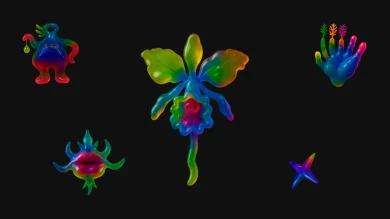
This series is organised by equipoMotor, a group of teenagers, young people and older people who have participated in the Museo Reina Sofía’s previous community education projects, and is structured around four themed blocks that pivot on the monstrous.
This fourth and final session centres on films that take the museum away from its axis and make it gaze from the edges. Pieces that work with that which is normally left out: peripheral territories, unpolished aesthetics, clumsy gestures full of intent. Instead of possessing an institutional lustre, here they are rough, precarious and strange in appearance, legitimate forms of making and showing culture. The idea is to think about what happens when central authority is displaced, when the ugly and the uncomfortable are not hidden, when they are recognised as part of the commons. Film that does not seek to be to one’s liking, but to open space and allow other ways of seeing and inhabiting the museum to enter stage.
![Joseph Kosuth. One and Three Chairs [Una y tres sillas]](https://recursos.museoreinasofia.es/styles/small_landscape/public/Actividades/joseph_kosuth.jpg.webp)
The (legal) person and the legal form. Chapter III
Monday 11, Wednesday 13 and Thursday 14 May 2026 - Registration deadline extended
As part of the Studies Constellation, the Study Directoship’s annual fellowship, art historian and theorist Sven Lütticken leads the seminar The (Legal) Person and the Legal Form: Theoretical, Artistic, and Activist Commitments to foster dialogue and deepen the hypotheses and questions driving his research project.
The seminar consists of eight sessions, divided into three chapters throughout the academic year. While conceived as non-public spaces for discussion and collective work, these sessions complement, nourish, and amplify the public program of the Studies Constellation.
First session of the third chapter focuses on the transformation of the artwork in the context and wake of Conceptual art. The very notion of the artwork, together with its ownership and authenticity, is reconsidered from a broad perspective open to new and alternative models of management, which could ultimately transform the relationship between artist, artwork and owner. Can some of the practices in question serve as critical models? To what extent is it possible to think and act with them, and extrapolate from them, beyond a beautiful niche?
The second session turns to the question of representation. While many (but not all) human natural persons can, in principle, represent themselves in legal matters, other needs representatives. This goes for minors as well for adults who have been placed under legal guardianship; it applies to fictitious persons such as corporations and states, who need human representatives to sign contracts or defend them in court. We will look into the question of legal representation in conjunction with other forms of representation, in the cultural as well as political register—taking cues from Spivak’s distinction between portrait (Darstellung) and proxy (Vertretung), which is an unstable and historically mutable one.
The seminar concludes with a closing session dedicated to collectively revisiting and reflecting on the themes and discussions that have emerged throughout the first Studies Constellation Residency Program.
Collection. Contemporary Art: 1975–Present
Miércoles 13 de mayo, 2026 - 19:00 h
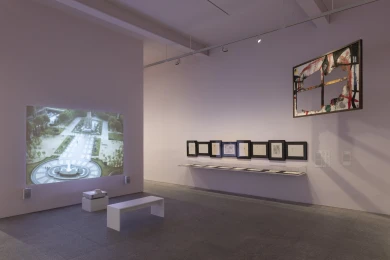
In this lecture, Museo Reina Sofía director Manuel Segade outlines the key readings of the new presentation of the Collection on Floor 4 of the Sabatini Building. This new arrangement is framed inside an ambitious rehang that harnesses the uses of the Museo’s architecture, in a plan that will continue in 2027 with the opening of Floor 3 in the same building, culminating with Floor 2 in 2028.
The new rehang of the Collections, unveiled on 16 February 2026, sets forth a journey through contemporary art history over the past fifty years in Spain. Rather than an unambiguous narrative, the floor recounts the same period — from the Transition to democracy in Spain to the present — in three different ways, starting back at the 1970s time and again.
The exhibition route gets under way with a prologue that travels through the affections, material culture and institutionalism of the Spanish Transition, serving as a starting point for the three routes that follow. The first, A History of Affect in Contemporary Art, advances from affective systems in artmaking linked to the second wave of feminism, arriving at grief as a tool to interpret new realities. The second route, The Powers of Fiction: Sculpture, New Materialisms, and Relational Aesthetics, is conceived as a sculpture gallery in which the artworks engage with the public, focusing on the performance side of the discipline. This route shows, among other aspects, how Spanish sculpture has gained significant international visibility since the 1980s, with women artists playing a key role in this display. The third route, A New Framework. The Institution, the Market, and the Art that Transcends Both, zooms in on the origins of the Museo and its role in the process of art’s institutionalisation in Spain. In May 1986 the Centro de Arte Reina Sofía opened, occupying the first and second floors of the former hospital: the forty years that have elapsed since then enable a re-evaluation of the effects of the Museo on Spanish art and art on the institution.
This talk strengthens the goal of socially integrating the narratives produced by the Museo at a time when the Collections are under permanent review.
Patricia Falguières
Tuesday May 12th 2026 – 19:00 h
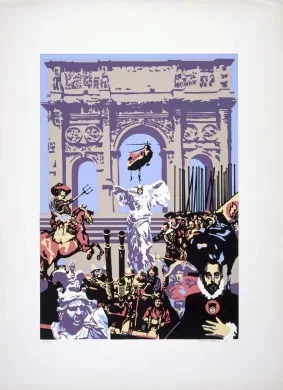
Art historian Patricia Falguières inaugurates the María Luisa Caturla Chairwith the lecture Art History in Dark Times. This Chair, dedicated to the reflection on art in times «sick with uncertainty», is aimed at dismounting, digressing and imagining multiple temporalities and materialities in art history and cultural studies from an eccentric gaze, in the sense of being displaced, off-centre or with a centre that is different.
The lecture’s title references Hannah Arendt’s collection of essays Men in Dark Times, which in turn paraphrases a Bertol Brecht poem. In it, Arendt asserts «dark times are not only not new, they are no rarity in history».
Patricia Falguières also claims history knows many periods when the public realm has been obscured, when the world becomes so uncertain that people cease to ask anything of politics except to relieve them of the burden of their vital interests and their private freedom. The art historian —whose expertise is in the field of Renaissance art and philosophy but paying close attention to contemporaneity— invites us to a «chaotic and adventurous journey», from the Italian Renaissance to Fukushima, through which to delve into the questions: What can the practice of art history mean today, in a world ablaze with ominous glimmers and even more ominous threats, if not as mere entertainment or social ornament? Of what vital interests, of what freedom can it bear witness and serve as an instrument?