-
March 26, 2015 Nouvel Building, Auditorium 200
Unmasking the Author: Art and Activism in the Internet Age
Margarita Padilla. What Do Network Machines Want and Not Want?
A change of paradigm is no small thing, and this change is going hand in hand with networks of computers, storming into a model that invites the social sphere to imitate it. Networks of people, machines, and, chiefly, changes in the distribution of power. What are the founding and genetic characteristics of this transformation? In emulating the net, social, creative, productive and critical processes search for better conditions for their proliferation; new tools, innovative methods and elements of original organisation. How do we distinguish what is new, radically new, from mere market trends? How do we distinguish what we have to nurture (what makes the network inside the network) and what we have to discard (what’s inside the network that destroys the network)?
Geert Lovink. The Politics of Designing Masks: Internet Culture after Snowden
What options do we have now that doubts hang over the radical transparency of the protection against surveillance? This lecture offers a general panoramic view of the activist and artistic strategies over the last two years, developed in response to the Edward Snowden revelations. Against the widespread depression of hackers, artists have become involved in a broad array of experiments to speak out against surveillance and Internet control. What can we learn from the tragic story of Anonymous? Why are so many people suspicious of the anonymous browser Tor? Julian Assange could, with difficulty, be a model: what went wrong? Could art represent some way out of all this?
Round table: Geert Lovink, Margarita Padilla and Alberto López Cuenca
-
March 27, 2015 Nouvel Building, Auditorium 200
Digital Commons: Towards other Ecologies of Art
Felix Stalder. The Artist at the End of the Gutenberg Galaxy: Challenges for Art in Digital Culture
The modern artist figure is a product of the 18th and 19th centuries, the heyday of literary culture. Although the majority of twentieth-century avant-garde movements rebelled against this idea, it became a model that endured and still serves as a regulatory foundation of copyright, as a powerful commercial attraction in the art market and as a structural principle for the majority of art institutions. Nevertheless, the experience of the network society for artists and audiences not only calls this model into question, it also offers a new one focused on notions such as information, shared resources and commons, through which both artists and non-artists interact and redefine their roles and functions.
Marcell Mars. A Public Library
In the catalogue of History, the public library institution appears listed in the category of the phenomena human beings feel most proud of, along with education and public health care, the Universal Declaration of Human Rights and free software… A public library is one of those practically invincible infrastructures we only start to notice when it disappears. Due to the Internet, today it is easy to imagine a public library as part of a global infrastructure of universal access to knowledge for every member of society. Yet the appearance and development of the Internet is occurring at a time when institutional crisis, with traumatic and unpredictable consequences, has started to happen.
The digital project Public Library is an example of the defence of the public library and its principle of universal access to knowledge, as well as being an exploration of the infrastructure distributed for use by amateur librarians. In truth, it is a crossover between both.
Round table: Marcell Mars, Daniel García Andújar, Felix Stalder and Alberto López Cuenca
-
March 26 - 27, 2015 Medialab Prado
Workshop
Geert Lovink and Alberto López Cuenca. March 26
Marcell Mars, Felix Stalder and Daniel García Andújar. March 27
This workshop is set up as an open encounter, whereby different participants from Open Source introduce their work and debate common notions with a community of artists, activists, theorists and Medialab users. The workshop aims to horizontally complement this seminar with a back-and-forth exchange of information and with work prior to the lectures enabling subsequent debate to be articulated. Furthermore, it looks to recover working environments far-removed from academic production and linked to other forms of knowledge emerging out of hacklabs and medialabs.
Open Source. The Art System after the Net

Held on 26 Mar 2015
The Internet has produced new behaviours, subjectivities and institutions linked to another way of being and doing. This seminar debates how these changes throw established categories of art, the author and the circulation of unique work off balance, whilst also forming profound contradictions – from creativity as an economic value to indistinct work time. Is considering another artistic ecosystem possible from these ambiguities?
The assumption was that a transition from the author's text to hypertext would make the funeral of these modern notions possible, replacing them with a new contemporary language. With the arrival and expansion of the net, these predictions, which decades earlier were nothing more than academic speculations, could be found in the right condition to overcome the logic of individual authorship and originality, in practice. However, these desires, which had to be validated by technological displacement in the modes of producing knowledge and generating subjectivity, are today being answered in the survival and statism of a model that ignores the challenges and powers of the net. With the aim of defending the author and their originality, in some cases in a space of resistance, access, production and the circulation of knowledge in digital media, including those the museum participates in, are restricted.
There do not seem to be any doubts about the place taken up by intellectual property in the new productive environment. It also seems to be increasingly more difficult to revert the fact that symbolic production, and with it artistic production, is today part of the so-called creative industries, and which must, therefore, work under strict market logic. Nevertheless, culture and knowledge in the digital environment continue to manifest qualities that had not been characteristic of consumer goods: they are not scarce, do not run out with use and cannot be possessed exclusively. At this point a whole series of fractions arise between legal regulations, financial capitalization and the practices of access and free circulation this seminar looks to unravel. In this complex framework, there is a need to track how the work of the artist is inscribed in the environment of new digital production, to see what the regulations of authorship are after the net, how to defend the singularity of art in the face of the expansion of the creative economy and how to bring about the so-called digital commons in a new form of shared learning.
In collaboration with
Medialab Prado
Organised by
Museo Reina Sofía
Workshop
At Medialab Prado. March 26 - 27, 2015. 11:00 p.m.
Participants
Daniel G. Andújar. Visual artist, long-time member of irational.org and a reference point in net.art. In 1996 he founded the platform Technologies To The People. He has exhibited internationally and set up other public sphere projects on the Internet, such as e-barcelona.org o e-valencia.org. Furthermore, he has run workshops with artists and social collectives and actively participated in the debate on the artist’s status in the immaterial economy. The Museo Reina Sofía recently presented his work in the solo exhibition Daniel G. Andújar. Operating System (21 January - 4 May, 2015).
Alberto López Cuenca. Professor at the Universidad de las Américas Puebla. He has co-edited the books Propiedad intelectual, nuevas tecnologías y libre acceso a la cultura (Intellectual Property, New technologies and Free Access to Cultures) (Universidad de las Américas Puebla and Centro Cultural de España in Mexico, 2008) and ¿Desea guardar los cambios? Propiedad intelectual y tecnologías digitales: hacia un nuevo pacto social (Do you Want to Save the Changes? Intellectual Property and Digital Technologies: Towards a New Social Pact (Centro Cultural España-Córdoba, 2009). His articles have featured in international publications such as ARTnews, Lápiz, Curare, Afterall and Revista de Occidente.
Geert Lovink. Professor at the European Graduate School in Saas-Fee, Switzerland and the University of Amsterdam, where he founded the Institute of Network Cultures. He was also a founding member of ADILKNO (Foundation for the Advancement of Illegal Knowledge). He is the author of Dark Fiber: Tracking Critical Internet Culture (MIT Press, 2002), My First Recession: Critical Internet Culture in Transition (NAi Publishers, 2003) and Tactical Media, the Second Decade (Brazilian Submidialogia, 2005), as well as numerous other essays.
Marcell Mars (Nenad Romić). A cultural researcher, artist and hacker, he is one of the founders of the open repository on shared knowledge Public Library and co-creator of Multimedia Institut [mi2] in Zagreb.
Margarita Padilla. Computer engineer and activist. Co-founder of the space Sindominio.net and the free radio Radiopwd from her operations in hacklabs. She has published several articles such as Agujeros negros en la red (2002) in the magazine Archipiélago and Penélope, tejiendo y destejiendo la red en el libro Ciberguerrilla de la comunicación (Virus, 2000). She is also the author of El kit de la lucha en Internet (Traficantes de Sueños, 2013).
Felix Stalder. Professor at the University of the Arts, in Zurich, where he co-directs the Media Arts programme, and researcher at the Institute for New Culture Technologies, Vienna. Since 1995 he has participated as a moderator of the encounters of Nettime, a space for debate and critique. He is the author of the books Open Cultures and the Nature of Networks (New Media Center_ kuda.org , Deep Search: The Politics of Search Beyond Google (Transaction Publishers, 2009) and Digital Solidarity (PML Mute, 2014).
Más actividades
Rethinking Guernica
Monday and Sunday - Check times
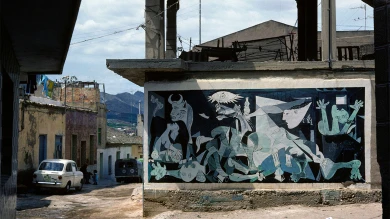
This guided tour activates the microsite Rethinking Guernica, a research project developed by the Museo Reina Sofía’s Collections Area, Conservation and Restoration Department and the Digital Projects Area of the Editorial Activities Department, assembling around 2,000 documents, interviews and counter-archives related to Pablo Picasso’s painting Guernica (1937).
The visit sets out an in-situ dialogue between the works hung around the painting and a selection of key documents, selected by the Museo’s Education Team and essential to gaining an idea of the picture’s historical background. Therefore, the tour looks to contribute to activating critical thought around this iconic and perpetually represented work and seeks to foster an approach which refreshes our gaze before the painting, thereby establishing a link with the present. Essentially revisiting to rethink Guernica.

CLINIC 2628. A Community of Writing and Research in the Arts
February – October 2026
Clinic 2628 is a project which supports and brings together writings which stem from the intention to offer a space and sustainable time for research work in art and culture. Framed within an academic context which is increasingly less receptive to the forms in which thinking happens and is expressed, the aim is to rescue the academic from its neoliberal trappings and thus recover the alliance between precision and intuition, work and desire. A further goal is to return writing to a commons which makes this possible through the monitoring of processes and the collectivisation of ideas, stances, references and strategies.
The endeavour, rooted in a collaboration between the Museo Reina Sofía’s Studies Directorship and the Artea research group, via the i+D Experimenta project, is shaped by three annual editions conceived as spaces of experimentation, discussion and a demonstration of writings critical of what is put forward by today’s academia.
What forces, forms and processes are at play when writing about art and aesthetics? In academia, in museums and in other cultural institutions, the practice of writing is traversed by productivist logics which jeopardise rhythms of research and experimentation. The imposition of both scientism inherent in the structure of “the paper” and the quantifying of results which demand a criterion of quality and visibility sterilise and smoothen, from the outset, the coarseness that is particular to writing understood from the concrete part of language: phonic, graphic, syntactic and grammatical resistance connecting the language user to the community the language unites and activates. They also sterilise the roughness enmeshed in the same desire to write, the intuitive, clear and confusing pathways that once again connect the writer to those reading and writing, participating in a common good that is at once discovered and produced.
The progressive commercialisation of knowledge propelled by cognitive capitalism moves further away from the research and production of knowledge in artworks and artistic languages and practices. The work of curators and archive, criticism, performances and essays formerly saw a horizon of formal and emotional possibilities, of imagination that was much broader when not developed in circumstances of competition, indexing and impact. Today, would it be possible to regain, critically not nostalgically, these ways; namely, recovering by forms, and by written forms, the proximity between art thinking and its objects? How to write in another way, to another rhythm, with no more demands than those with which an artwork moves towards different ways of seeing, reading and being in the world?
Dear Felix:
Saturdays at 6pm
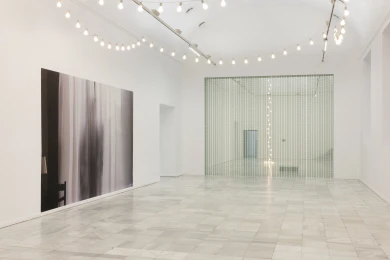
The immediately recognisable art of Felix Gonzalez-Torres, which is on display, from May to October 2026, in the show Sweet Revenge, moves beyond the transmission of messages laden with poetic evocation, vital or biographical reflection, or even a clear political or ethical positioning. Rather, it seeks an active response by visitors to the exhibition. His work invites engagement with these messages so that, whether delighting, moving or challenging, it still prompts viewers to participate in the dialogue and complete the artistic undertaking with their own actions.
Thus, the guided tour Dear Felix: offers a shared, dialogue-inflected tour through the show, with the aim of collectively thinking and feeling the gestures the artist’s work puts forward. Ostensibly simple actions such as crossing through a beaded curtain to take a sweet and eat it, taking a poster from a stack of paper or simply observing a billboard closely, all contain ways of understanding life, loss, love, injustice or the passing — never linear — of time. The tour’s ultimate aim is not to set meanings or create an overload of interpretations of the work, nor does it seek to crystallise an image of the artist and his life in a response to questions which are not there. It looks instead to provide a space to open shared meaning in these apparently simple objects and to attempt a possible correspondence of return from the here and now. A lumbering attempt at responding which starts with a simple Dear Felix:
Robert Capa
Friday, 26 June 2026 – 6pm
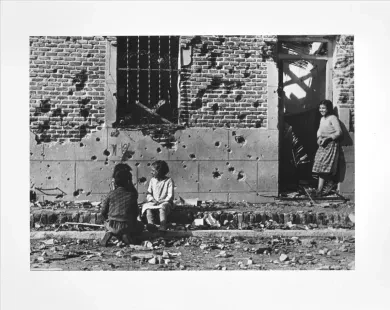
This international encounter centred on the figure of Robert Capa (Budapest, 1913 — Thai Binh, Vietnam, 1954), one of photojournalism’s pre-eminent figures, is held within the framework of the government initiative Spain and Freedom. Fifty Years and in conjunction with a cluster of three locations — the building on number 10 Calle Peironcely, the Plaza del Fotógrafo Robert Capa and the San Carlos Borromeo Parish in Vallecas — declared as a Place of Democratic Memory.
The emblematic photo Robert Capa took in 1936 of this area of Republican Madrid, featuring anonymous children talking in front of a bullet-riddled building attacked by Nazi-fascist air forces, has, in recent years, become a catalyst for impassioned collective action vindicating memory and denouncing the horrors and brutality of wars, past and present.
Within this context, representatives from cultural and academic spheres and civil society organisations from Germany, the USA and Spain discuss the legacy of Capa and photojournalism in European democratic memory, exploring in greater depth two citizen initiatives constructed by Europe from its shared memory: #SalvaPeironcely10 (#SavePeironcely10), in Entrevías (Puente de Vallecas), and the Capa Haus Initiative in the Lindenau neighbourhood of Leipzig, both united by the protection and conservation of historical heritage and by the defence of peace.
The round-table discussion features the participation of Cynthia Young, Juan Miguel Sánchez Vigil, Ulf-Dietrich Brumann and José María Uría Fernández and is moderated by Myriam Soto Lucas. Carmina Gustrán Loscos, the commissioner of Spain and Freedom. Fifty Years, will also join the discussion.
equipoMotor
Jueves alternos, 23 de octubre, 2025 - 11 de junio, 2026 - 17:30 h
El programa equipoMotor regresa en su edición 25-26 con un aire espectral y mutante para lanzar la pregunta: ¿y si el Museo fuera «un poco más Frankenstein»? Inspirándose en dicho monstruo y en todas aquellas criaturas que desafían la norma desde los márgenes, el proyecto de mediación cultural Galaxxia diseña y acompaña una edición incisiva, intergeneracional y descentralizadora, donde saberes invisibilizados, cuerpos raros y deseos molestos se entrelazan para generar nuevas formas de imaginación crítica y radical. En los sótanos y corredores del Museo —un particular laboratorio— las dudas no se esconden: son materia prima.
Así, para este curso el equipoMotor convoca a personas de todas las edades que hayan participado en ediciones anteriores de los distintos equipos del Área de Educación a recorrer el Museo como quien manipula un cuerpo abierto: descoyuntando algunas de sus categorías teóricas y artísticas —la necropolítica, lo crip-cuir, la lucha de clases, las políticas del malestar, la decolonialidad, la temporalidad cuir, la descentralización institucional o el feísmo— para articular un relato díscolo, remendado y palpitante.
El programa se estructura en bloques temáticos sobre lo freak como metodología, el trabajo cultural, la intergeneracionalidad y la diversidad territorial. Cada bloque a su vez se despliega en sesiones que combinan disparadores teóricos y estéticos, visitas a exposiciones y espacios liminales del Museo, talleres artísticos con artistas, ejercicios de curaduría audiovisual colectiva y de relatoría radiofónica, así como instancias de activación pública, mediante proyecciones de cine experimental y coloquios compartidos con el público, en complicidad con el archivo Hamaca y el Área de Cine y Nuevos Medios del Museo.
De este modo, la presente edición incorpora una particularidad: el grupo de participantes irá transformándose en un «colectivo curatorial audiovisual temporalmente autónomo», con capacidad de incidir en la programación del Museo y de abrir la conversación de equipoMotor al público general, cuestionando y expandiendo así los límites entre las cabezas que deciden, las manos que producen y los cuerpos y presencias que habitan la institución. Las personas seleccionadas en la modalidad oyente serán invitadas a las proyecciones públicas, así como a otras activaciones y momentos de apertura del equipoMotor.
Frente al relato de un museo homogéneo, pulcro y lineal, apostamos por un Museo disidente, contradictorio y lleno de vida residual. Un Museo que no tema hacerse preguntas incómodas ni mostrar sus cicatrices. equipoMotor. Un poco más Frankenstein no busca repensar el cuerpo de la institución, sino habitarlo en sus desgarros, tal como es: híbrido, inacabado, infecto, fantasmagórico… y cargado de esporas y chispas por venir.