-
February 22, 2013 ECAM (Calle Juan de Orduña, 3. Ciudad de la Imagen. 28223 Pozuelo de Alarcón, Madrid)
Eduardo Coutinho. Masterclass
Time: 12 noon
The filmmaker looks back at his work, which he has built over the years with the idea that documentary is always a marginalized genre. On the one hand, in the sense of it being a minor genre that is usually side-lined with respect to fiction film; and on the other hand, because of its ability to merge with an idea about reality and the subject that is very distinct from the resources of deception and idealization that characterise fiction film.
Presented and moderated by Sergio Oksman
-
February 23 and March 11, 2013 Sabatini Building, Auditorium
Cabra marcado para morrer
1984, colour/BW, 116’. Screening format: 35mm and DVD
Time: 7 p.m.
*February 23: Encounter with Eduardo Coutinho and Berta SichelAt the beginning of the 1960s, the peasant leader João Pedro Teixeira was killed by order of the landowners of north-eastern Brazil. Coutinho decided to make a film about his life, starring the peasants themselves, but he had to stop filming because of the military coup that took place in 1964. Seventeen years later he returned to the project, seeking out Teixeira's widow and ten children, and examining the lives of each of them during the long years of the military regime.
-
February 27 and March 20, 2013 Sabatini Building, Auditorium
Santa Marta – Duas semanas no morro and Boca do Lixo
Time: 7 p.m.
Santa Marta – Duas semanas no morro
1987, colour, 54’. Screening format: DVD
and
Boca do Lixo. 1993, colour, 49’. Screening format: Blu-ray
Coutinho and his crew spent two weeks in Morro Santa Marta, a favela in the southern part of Río de Janeiro, filming the daily lives of its inhabitants. Religiosity, music, violence, racism and the dreams of young people are treated with the sensitivity characteristic of Coutinho's interviews.
Boca do Lixo reveals the extreme economic inequalities existing in Brazil, with its portrayal of the waste pickers of the region of São Gonçalo, 40km from Río de Janeiro. There, the lack of any real employment opportunity leads many families to try to make a living from garbage, in deplorable conditions.
-
March 1 and March 21 Sabatini Building, Auditorium
Santo Forte
1999, colour, 49’. Screening format: DVD
Time: 7 p.m.
In the time elapsing between the Pope's visit to Río de Janeiro and, a few months later, the festivities of the Christmas season, Coutinho interviews Catholics, Evangelicals and practitioners of Umbanda, all from a favela in Rio. They talk about their communication with the supernatural through intervention by saints, deities or orishas.
-
March 2 and April 1 Sabatini Building, Auditorium
Babilônia 2000
2000, colour, 80’. Screening format: DVD
Time: 7 p.m.
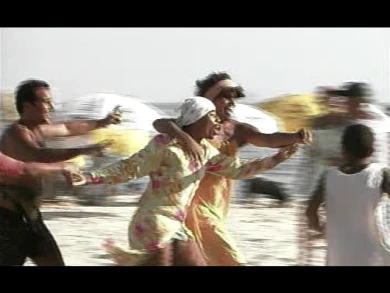
Babilônia 2000, a documentary filmed on the last day of 1999, shows the preparations underway for New Year's Eve in the favelas Chapéu Mangueira and Babilônia. With over 4000 inhabitants, these are the only favelas located on the edge of Copacabana Beach where, at midnight, nearly one million people gather to watch the fireworks and celebrate. The people in the film talk about their expectations for the year 2000.
-
March 6 and April 3 Sabatini Building, Auditorium
Edifício Master
2002, colour, 110’. Screening format: DVD
Time: 7 p.m.
Over a period of seven days, a film crew recorded the lives of the residents of Edifício Master, an apartment building located one block from Copacabana Beach. The building has 12 floors and 23 units on each floor, with a total of almost 500 residents. Thirty-seven of these residents share their life stories, opening the doors to their homes and their private lives for the cameras.
-
March 7 and April 4 Sabatini Building, Auditorium
Peões
2004, colour, 85’. Screening format: DVD
Time: 7 p.m.
Documentary about the former metallurgical workers of the ABC Region of São Paolo, who took part in the strikes of the 1980s along with Luiz Inácio Lula da Silva. They talk about their origins, their participation in the workers' rights movement, their lives since then and their personal vision of the Lula government.
-
March 9 and April 5 Sabatini Building, Auditorium
O Fim e o Princípio
2005, colour, 110’. Screening format: DVD
Time: 7 p.m.
Coutinho and his crew travel to the inland areas of Paraíba – in north-eastern Brazil – in search of people who have a story to tell. Thanks to the mediation of a young man from the region, the inhabitants (mostly elderly people) talk about their lives, marked by popular Catholicism, hierarchy, the sense of family and honour - reflecting a world that has almost disappeared.
-
March 13 and April 6 Sabatini Building, Auditorium
Jogo de Cena
2007, colour, 106’. Screening format: DVD
Time: 7 p.m.
Responding to a newspaper ad, eighty-three women came to a film studio to tell their life-stories. Coutinho selected twenty-three of these testimonies and sent them to well-known Brazilian actresses who had been chosen to interpret these women's stories.
-
March 15 and April 8 Sabatini Building, Auditorium
Moscou
2009, colour, 78’. Screening format: DVD
Time: 7 p.m.
A film of the rehearsing process of Anton Chekhov's work The Three Sisters by the theatre group Galpão, directed by Enrique Díaz. The film includes fragments of workshops, improvisations and rehearsals of a play that did not, and never will, have a premiere.
-
March 16 and April 12 Sabatini Building, Auditorium
As Cançoes
2011, colour, 94’. Screening format: DVD
Time: 7 p.m.
Eduardo Coutinho and his crew go in search of ordinary people in downtown Río Janeiro, asking them to talk and sing the songs that have marked their lives. At the end, an interview with 42 people in a theatre, who tell stories related to those songs.
Held on 22, 23, 27 Feb, 01, 02, 06, 07, 09, 11, 13, 15, 16, 20, 21 Mar, 01, 03, 04, 05, 06, 08, 12 Apr 2013
Eduardo Coutinho (São Paulo, 1933) is an essential name in Latin American documentary film. His work is shaped by political issues but manages to avoid propaganda, as he addresses the everyday lives and the subjectivities of marginal majorities with a sensibility not altered by melodrama. Coutinho has performed his professional activity in several fields, including law, theatre, and both print and television journalism. His first contact with film occurred when he was the editor of the magazine Visão. His work with the television staff of Globo Repórter, for decades the most popular documentary program in Brazil, enabled him, despite the censorship in place at the time, to conduct in-depth documentation on numerous topics: the drought and the harshness of agricultural work, the banditry plaguing the north-eastern part of the country, the lives of public figures, such as Colonel Teodorico Bezerra and the painter Cándido Portinari, among others.
After the success of his documentary Cabra marcado para morrer (1984), highly praised by critics all over the world (and the winner of the Grand Coral, the top prize at the Havana Film Festival as well as the Golden Toucan in Río de Janeiro), Coutinho left the staff of Globo Repórter to work in the production of video documentaries and to write scripts for series made by TV Manchete. At the same time, he made his own documentaries, creating works such as O Fio da Memória which, coinciding with the centennial of the abolition of slavery, analyses the presence of black people in Brazilian culture and history. Other films of his include Boca do Lixo, Santa Marta-duas semanas no Morro, O Jogo da Dívida and Romeiros do Padre Cícero. Starting in 1999, Coutinho returned to feature-length films in digital video (later transferred to 35 mm) and he directed films such as Santo Forte, Babilônia 2000, Edifício Master, Jogo de cena and As Cançoes.
Coutinho's cinema has been defined by Consuelo Lins from the perspective of "the ethics of cruelty" but not in the sense of maintaining or showing suffering, but rather in that of rejecting complacency in his relationship with the subjects or situations he shows throughout his filmmaking career.
Distributed by
Videofilmes, Brasil
35 mm copy of Cabra marcado para morrer from the Cinemateca Brasileira
Organised by
Museo Reina Sofía
In collaboration with
Festival Punto de Vista, the Embassy of Brazil, Spanish-Brazilian Culture Foundation and ECAM (Film and Audiovisual School of the Community of Madrid)
Curatorship
Berta Sichel

Más actividades
Files of Tropical Revolutions
Sábado 20 y 27 de junio, 2026 - 19:00 H
The Reframing Banana Imagery series concludes with two works that condense the height and twilight of this period in history, epic sagas that cross borders and registers to embody experiences of armed struggle in the region. Cameras mix with firearms, borders between nations blur and patience reaches breaking point. This is where the tipping point lies, where the bloodshed weighs heavy and the murmurings of regional brotherhood are buried in the ground again.
Pan y dignidad (Carta abierta de Nicaragua) [Bread and Dignity (An Open Letter to Nicaragua)] recounts the historical records and process of national reconstruction in Nicaragua via the Sandinista popular uprising. Historias prohibidas de Pulgarcito (Forbidden Tales of Tom Thumb) places the camera at the heart of the El Salvador revolutionary struggle, interspersing testimonies of daily violence with the verses of the poet Roque Dalton.
Both works understand the armed revolution as an open file under construction. The insurgent brotherhood, although dissolved, still resounds in regional history.
Circling Over Exploited Bodies
Friday, 19 and 26 June 2026 - 7pm
When forms of violence are inflicted on society, film responds from urgency. Images become abstract, sounds fade and the register of dissidence comes from the gut. La zona intertidal (The Intertidal Zone) is an essayistic and poetic approach to the repression of teachers in El Salvador in the 1970s — a teacher studies the biodiversity of the El Salvador coast as a boy finds a body on the same beach. A propósito de la mujer (About Women) interweaves testimonies of misery and rage towards patriarchal structures with fictional scenes of a symbolic procession through a harsh desert.
Both films understand the body as a target of violence and a territory of insurrection, a space where the blood shed by militancy and the patriarchal yoke turn pain into denouncement and existence outside the status quo into an act of political dissidence.
Central American Designation of Origin
Thursday, 18 and 25 June 2026 - 7pm
Fertile lands, farmers’ hands, rural faces. This first programme in the series Reframing Banana Imagery understands the foundations of the Central American experience from exploitation, extractivism and displacement, and from the organisation and resistance that emerged as a reaction. The four films within extend from a lyrical documentary on farmers’ solidarity to the playful subversion of the institutional format of the United Fruit Company.
Bananeras (Banana Growers) is a combative portrait of the inhumane conditions of the American banana plantations located in Nicaragua through much of the twentieth century. Costa Rica Banana Republic is a perspicacious satire via an institutional documentary of banana production, spotlighting the extractive nature of this agro-exporting model in the 1970s. Organización Campesina (Farmers’ Organisation) frames rural resistance in Honduras from a direct depiction and lyrical documentary, while Dos veces mujer (Two Times a Woman) dissects the invisibility of the double-shift working day Central American women farmers endure: working in the countryside and working in the home. As a whole, the works here present the earth at once as a wounded body and a space of dignity.

Aesthetics of Peace and Desertion Tactics
8 October 2025 – 24 June 2026
The study group Aesthetics of Peace and Tactics of Desertion: Prefiguring New Pacifisms and Forms of Transitional Justice proposes a rethinking—through both a theoretical-critical and historical-artistic lens—of the intricate network of concepts and practices operating under the notion of pacifism. A term not without contestation and critical tension, pacifism gathers under its name a multiplicity of practices—from anti-militarism and anti-war movements to non-violence activism—while simultaneously opening urgent debates around violence, justice, reparation, and desertion. Here, pacifism is not conceived as a moral doctrine, but as an active form of ethical and political resistance capable of generating aesthetic languages and new positions of social imagination.
Through collective study, the group seeks to update critical debates surrounding the use of violence and non-violence, as well as to explore the conflict of their representation at the core of visual cultures. In a present marked by rearmament, war, genocide, and the collapse of the social contract, this group aims to equip itself with tools to, on one hand, map genealogies and aesthetics of peace—within and beyond the Spanish context—and, on the other, analyze strategies of pacification that have served to neutralize the critical power of peace struggles. Transitional and anti-punitive justice proposals will also be addressed, alongside their intersections with artistic, visual, and cinematic practices. This includes examining historical examples of tribunals and paralegal activisms initiated by artists, and projects where gestures, imaginaries, and vocabularies tied to justice, reparation, memory, and mourning are developed.
It is also crucial to note that the study programme is grounded in ongoing reflection around tactics and concepts drawn, among others, from contemporary and radical Black thought—such as flight, exodus, abolitionism, desertion, and refusal. In other words, strategies and ideas that articulate ways of withdrawing from the mandates of institutions or violent paradigms that must be abandoned or dismantled. From feminist, internationalist, and decolonial perspectives, these concepts have nourished cultural coalitions and positions whose recovery today is urgent in order to prefigure a new pacifism: generative, transformative, and radical.
Aesthetics of Peace and Tactics of Desertion, developed and led by the Museo Reina Sofía’s Studies Management, unfolds through biweekly sessions from October to June. These sessions alternate between theoretical discussions, screenings, work with artworks and archival materials from the Museo’s Collection, reading workshops, and public sessions. The group is structured around sustained methodologies of study, close reading, and collective discussion of thinkers such as Judith Butler, Elsa Dorlin, Juan Albarrán, Rita Segato, Sven Lütticken, Ruth Wilson Gilmore, and Franco “Bifo” Berardi; historical episodes such as the anti-nuclear and anti-arms race movement in Spain; and the work of artists and activists including Rojava Film Commune, Manuel Correa and the Oficina de Investigación Documental (Office for Documentary Investigation), and Jonas Staal, among other initial cases that will expand as the group progresses.

equipoMotor
Jueves alternos, 23 de octubre, 2025 - 11 de junio, 2026 - 17:30 h
El programa equipoMotor regresa en su edición 25-26 con un aire espectral y mutante para lanzar la pregunta: ¿y si el Museo fuera «un poco más Frankenstein»? Inspirándose en dicho monstruo y en todas aquellas criaturas que desafían la norma desde los márgenes, el proyecto de mediación cultural Galaxxia diseña y acompaña una edición incisiva, intergeneracional y descentralizadora, donde saberes invisibilizados, cuerpos raros y deseos molestos se entrelazan para generar nuevas formas de imaginación crítica y radical. En los sótanos y corredores del Museo —un particular laboratorio— las dudas no se esconden: son materia prima.
Así, para este curso el equipoMotor convoca a personas de todas las edades que hayan participado en ediciones anteriores de los distintos equipos del Área de Educación a recorrer el Museo como quien manipula un cuerpo abierto: descoyuntando algunas de sus categorías teóricas y artísticas —la necropolítica, lo crip-cuir, la lucha de clases, las políticas del malestar, la decolonialidad, la temporalidad cuir, la descentralización institucional o el feísmo— para articular un relato díscolo, remendado y palpitante.
El programa se estructura en bloques temáticos sobre lo freak como metodología, el trabajo cultural, la intergeneracionalidad y la diversidad territorial. Cada bloque a su vez se despliega en sesiones que combinan disparadores teóricos y estéticos, visitas a exposiciones y espacios liminales del Museo, talleres artísticos con artistas, ejercicios de curaduría audiovisual colectiva y de relatoría radiofónica, así como instancias de activación pública, mediante proyecciones de cine experimental y coloquios compartidos con el público, en complicidad con el archivo Hamaca y el Área de Cine y Nuevos Medios del Museo.
De este modo, la presente edición incorpora una particularidad: el grupo de participantes irá transformándose en un «colectivo curatorial audiovisual temporalmente autónomo», con capacidad de incidir en la programación del Museo y de abrir la conversación de equipoMotor al público general, cuestionando y expandiendo así los límites entre las cabezas que deciden, las manos que producen y los cuerpos y presencias que habitan la institución. Las personas seleccionadas en la modalidad oyente serán invitadas a las proyecciones públicas, así como a otras activaciones y momentos de apertura del equipoMotor.
Frente al relato de un museo homogéneo, pulcro y lineal, apostamos por un Museo disidente, contradictorio y lleno de vida residual. Un Museo que no tema hacerse preguntas incómodas ni mostrar sus cicatrices. equipoMotor. Un poco más Frankenstein no busca repensar el cuerpo de la institución, sino habitarlo en sus desgarros, tal como es: híbrido, inacabado, infecto, fantasmagórico… y cargado de esporas y chispas por venir.