-
Monday to Saturday – from 12 noon to 8pm and Sundays – from 11am to 1:30pm Sabatini Building, Floor 3
Instant Narrative, 2006–2008
Sabatini Building, Floor 3, exhibition rooms from the Dora García. Second Time Around show
A person, sat discreetly at a table in an exhibition room, writes what is happening on a computer in a space they share with visitors. Their writings are projected onto a screen as they are typing, so that visitors, playing the leading role in this narrative, can read and grant them continuity (or not) with their actions.
Participants: Michelangelo Miccolis (regidor), Jean Capeille, Geoffrey Carey, Lyncoln Dinix, Maria Elena Fantoni, Néstor García, Ilaria Genovesio, Esperanza Gómez, Paulina Lara, Mickey Mahar, Oisin Monaghan, Paula Noya, Ana Serna, Tom Smith and Nicholas Von Kleist.
-
Wednesday and Thursday – 7:30pm, Friday and Saturday – 16:30pm Sabatini Building, Rooms 206.05, 206.06 and 206.10
Meeting point: access to Room 206The Artist Without Works: A Guided Tour Around Nothing, 2009
Sabatini Building, Rooms 206.05, 206.06 and 206.10 Meeting point: access to Room 206
In a tone of direct inquiry with the audience, this monologue is set up as a guided tour around non-existent works, with five “discourses” (or “stations”) and four stops, with the last one the same as the first.The best description of this performance can be found at the beginning of the monologue: “The Artist Without Works: A Guided Tour Around Nothing is exactly what the title says: a guided tour around the works of an artist who does not produce any works. An artist who rejects the most basic rule of the art game: to teach something”.
Participants: Michelangelo Miccolis, Geoffrey Carey and Nicholas Von Kleist.
-
Friday and Saturday – 6:30pm
Rehearsal / Retrospective, 2010
Sabatini Building, Hall
A performance for five performers which takes on the format of a theatre rehearsal. One of the performers plays the role of director or teacher, while the other four act as “apprentices” rehearsing four performances from Dora García’s “repertoire”: El artista sin obra (The Workless Artist, 2009), La Esfinge (The Sphinx, 2005), Rezos (Prayers, 2007), and El mensajero (The Messenger, 2002).
Participants: Michelangelo Miccolis (regidor), Jean Capeille, Geoffrey Carey, Lyncoln Dinix, Maria Elena Fantoni, Néstor García, Ilaria Genovesio, Esperanza Gómez, Paulina Lara, Mickey Mahar, Oisin Monaghan, Paula Noya, Ana Serna, Tom Smith and Nicholas Von Kleist.
-
Monday to Thursday – from 1pm to 2pm and from 5pm to 6:30pm; Fridays and Saturdays – from 4pm to 6:30pm and Sundays – from 11am to 1:30pm
The Sinthome Score, 2013
Sabatini Building, Floor 3, exhibition rooms from the Dora García. Second Time Around show
This performance, in reference to the text Séminaire XXIII. Le Sinthome (1975-1976), by Jacques Lacan, is devised to be carried out between a body and a language: two performers, a reader-lector and a mover-movedor, with interchangeable roles, act for one another, adapting text and body. The Sinthome Score is Lacan’s text for the first and a board of movements for the second.
Participants: Michelangelo Miccolis (regidor), Jean Capeille, Geoffrey Carey, Lyncoln Dinix, Maria Elena Fantoni, Néstor García, Ilaria Genovesio, Esperanza Gómez, Paulina Lara, Mickey Mahar, Oisin Monaghan, Paula Noya, Ana Serna, Tom Smith y Nicholas Von Kleist.
-
Monday, Wednesday and Thursday – from 12 noon to 8pm, Fridays and Saturdays and Sundays – from 12 noon to 6:30pm and Sundays – from 11am to 1:30pm
Two Planets Have Been Colliding for Thousands of Years, 2017
Sabatini Building, Floor 3, exhibition rooms from the Dora García. Second Time Around show
Upon a drawing of a slow and drawn-out collision of two planets-circles — one white, one black — two performers agree on the balance and distances between them, thus exploring the possible variations in this consensus.
Participants: Michelangelo Miccolis (regidor), Jean Capeille, Geoffrey Carey, Lyncoln Dinix, Maria Elena Fantoni, Néstor García, Ilaria Genovesio, Esperanza Gómez, Paulina Lara, Mickey Mahar, Oisin Monaghan, Paula Noya, Ana Serna, Tom Smith y Nicholas Von Kleist.
-
Sundays – 12 noon
Real Artists Don’t Have Teeth, 2009
Sabatini Building, Floor 3, exhibition rooms from the Dora García. Second Time Around show
A dialogue between three toothless creators, Antonin Artaud, Lenny Bruce and Jack Smith, concerning the capacity of the artist to effectively intervene in the social and historical reality surrounding them.
Performers: Eric Balbàs, Jean Capeille, Geoffrey Carey, Lyncoln Dinix, Maria Elena Fantoni, Ilaria Genovesio, Paulina Lara, Mickey Mahar and Nicholas Von Kleist.
-
Thursday, 26 April – 7pm
Performance, 2016
Sabatini Building, Floor 3, exhibition rooms from the Dora García. Second Time Around show
Inspired by the film under the same title made by Donald Cammell and Nicolas Roeg between 1968 and 1970, this piece of “read theatre” is made up of six scripts which are activated by each actor.
Script: Peio Aguirre; mise en scène: Dora García
Participants: Jaime Conde-Salazar, Dora García, María Jerez, Itziar Okariz, Aimar Pérez Galí, and Javier Pérez Iglesias
Admission: Limited capacity. Prior ticket collection from the Express Ticket Offices of Sabatini Building on Thursday April 26 from 10am. Maximum of 2 tickets per person. Access from 6:15pm -
Wednesday 9 May, 13 June, 11 July, and Monday 3 September – 7pm
The Joycean Society, 2013
Sabatini Building, Floor 3, exhibition rooms from the Dora García. Second Time Around show
Exhausted Books, one of the works featured in the exhibition Second Time Around, is not stationary and is activated when displayed with collective readings of James Joyce’s Finnegans Wake (1939). The activation will begin on Wednesday 9 May at 7pm, with the Bloomsday Society of Madrid, in a collective reading open to everyone — in this case everyone is a reader; there is no audience. Therefore, those who wish to participate must bring a copy of Finnegans Wake or use one of the photocopies available for readers without a book.
Participants: The Bloomsday Society of Madrid
-
Thursday, 28 June – 7pm
On Reconciliation, 2016
Sabatini Building, Floor 3, exhibition rooms from the Dora García. Second Time Around show
A public reading of a selection of letters by German thinkers Martin Heidegger and Hannah Arendt, followed by the presentation of Dora García’s book On Reconciliation, and a subsequent discussion with the attendees. The reading of letters and the discussion will be presented by Galerie (Adriano Wilfert Jensen and Simon Asencio), with an installation in the exhibition rooms.
Participants: Dora García, Anna-Sophie Springer and Galerie (Adriano Wilfert Jensen and Simon Asencio).
-
From Monday to Saturday – from 12 noon to 1pm Edificio Sabatini, Sala de Protocolo
Respiración artificial [Artificial Respiration], 2016
Sabatini building, Protocol Room
The protocol of this performance, inspired by a passage from Ricardo Piglia’s novel, is the following: various collaborators of the artist will travel to sites of interest in Madrid, where they will describe what they see and hear, before reciting their descriptions as a prayer and recording it as an audio archive to be later transcribed as text. Different scenes, understood as shots or a storyboard, will be selected from the text and “pondered”, mixed and numbered. Once in the exhibition rooms, two performers, located on different levels, will act for each other, alternately reading scenes and, through their litany, invoking the situations described.
Participants: María Jesús Aragoneses, Nur Banzi, Lorena Benéitez, Amaia Bono, Carla Canseco, Geoffrey Carey, Diana Delgado-Ureña, Michela Depetris, Dunia Díaz, Lyncoln Dinix, Elsa Duhaut, Maria Elena Fantoni, Néstor García, Ilaria Genovesio, Rocío Gutiérrez, Esperanza Gómez, Bárbara Hang, Raúl Hidalgo, Jessica Huerta, Irene Izquierdo de la Gala, Beatriz Jordana, Paulina Lara, Katty López, Anna Katarina Martin, María Menchaza Paz, Michelangelo Miccolis, Eliana Murgia, Paula Noya, Cris Rodríguez, Ana Serna.
-
Mondays – from 6pm to 7:30pm Edificio Sabatini, Planta 3
Prayers, 2007
Sabatini Building, Floor 3, terrace and exhibition rooms from the Dora García. Second Time Around show
A person approaches some of the visitors of the exhibition and seems to whisper in their ears a monotonous and continuous monologue, like a prayer. Only the one to whom this monologue is addressed knows exactly what it is about.
Participants: Ilaria Genovesio, Paulina Lara, Paula Noya, Ana Serna and Nicholas Von Kleist.
-
Wednesdays – from 6:30pm to 7:30pm Edificio Sabatini, Planta 3
The Sphinx, 2005
Sabatini Building, Floor 3, terrace and exhibition rooms from the Dora García. Second Time Around show
A young woman chooses one of the visitors to the exhibition with her magnetic gaze. She approaches him/her, and with a confidential voice proposes a series of questions. Each question can only be answered with yes or no.
Participants: Ilaria Genovesio, Paulina Lara, Paula Noya and Ana Serna.
-
Thursdays – from 6:30pm to 7:30pm Edificio Sabatini, Planta 3
The messenger, 2002
Sabatini Building, Floor 3, terrace and exhibition rooms from the Dora García. Second Time Around show
A young man tries to find among the visitors of the exhibition, with great urgency and sometimes with despair, someone who can reveal to him the meaning of a message he is carrying, in a language that he neither identifies nor understands.
Participants: Lyncoln Dinix, Mickey Mahar y Nicholas Von Kleist.

Held on 18, 19, 20, 21, 22, 23, 25, 26, 27, 28, 29, 30 Apr, 02, 03, 04, 05, 06, 07, 09, 10, 11, 12, 13, 14, 16, 17, 18, 19, 20, 21, 23, 24, 25, 26, 27, 28, 30, 31 May, 01, 02, 03, 04, 06, 07, 08, 09, 10, 11, 13, 14, 15, 16, 17, 18, 20, 21, 22, 23, 24, 25, 27, 28, 29, 30 Jun, 01, 02, 04, 05, 06, 07, 08, 09, 11, 12, 13, 14, 15, 16, 18, 19, 20, 21, 22, 23, 25, 26, 27, 28, 29, 30 Jul, 01, 02, 03, 04, 05, 06, 08, 09, 10, 11, 12, 13, 15, 16, 17, 18, 19, 20, 22, 23, 24, 25, 26, 27, 29, 30, 31 Aug, 01, 02, 03 Sep 2018
The exhibition devoted to Dora García (Valladolid, 1965) is accompanied by a specific programme of performances by the artist. Carried out during the exhibition period, this initiative seeks to vindicate performance as a privileged medium, moving closer to the core strands in García’s work. In this vein, three main ideas will be illuminated: fiction as a construction of situations, readings understood as a collective process which redefines works and the relationships between readers, and narration as a critical exercise in terms of the roles undertaken. Ultimately, these ideas stress how the capacity for giving form, transforming and dismantling accounts that pass through us is an action of resistance.
* All performances will be conducted in Spanish, with the exception of Instant Narrative, which will be adapted to the language of the performer; The Artist Without Works: A Guided Tour Around Nothing which will be bilingual in English and Spanish, and On Reconciliation, with simultaneous interpretation English-Spanish.
Organised by
Museo Reina Sofía

Más actividades
![Blake Edwards, The Party [El guateque], 1968, película](https://recursos.museoreinasofia.es/styles/small_landscape/public/Actividades/ciclocine-piscinas-14.jpg.webp)
Blake Edwards. The Party
Thursday, 20 August 2026
In The Party, actor Hrundi V. Bakshi (Peter Sellers) is mistakenly invited to a glamorous dinner party in Hollywood. His curiosity and two left feet lead to one funny mishap after the other. During the soiree he consoles Michèle, a young actress who has been fired by her producer, and the chaos gathers momentum when Bakshi accidentally opens a retractable floor, making the guests fall into a swimming pool. A small hippie-style elephant gatecrashes the party, brought by a group of young people, and Bakshi asks the guests to wash the elephant as it is a sacred animal in his country. The house fills with soap suds, culminating in a wackily chaotic party.
When Stanley Kubrick was once asked who Peter Sellers was, he replied: “There is no such person as Peter Sellers”. The Party is one of the most widely recognised comedies in the history of film, its director Blake Edwards and the English actor making an entertaining critique of a fading conservative society. The cultural revolutions of the 1960s fit into the container of a choppy swimming pool: people from high society, an elephant, a Russian ballet, waiters, beatnik youth… similar to Sellers’s own identity: an empty vessel that can be refilled. In the film, Edwards tapped into the ingenious actor’s innate improvisation and the swimming pool as a container for revolutionary intent.
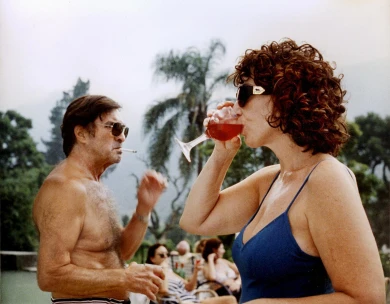
Lucrecia Martel. La ciénaga (The Swamp)
Viernes 21 de agosto, 2026
A couple of families spend the summer in a country cottage. The relationship between them exposes a crisis. The alcoholism of Mecha (Graciela Borges) and Gregorio (Martín Adjemián) becomes clear, leading to a drift in the education of their children and impacting relationships of respect and affect. Weariness expresses the lackadaisical environment.
In La ciénaga Lucrecia Martel approaches the decadence of a middle-class Argentinian family. The pool of dirty, stagnant water reflects the economic and social collapse of a whole country, yet reflects more than economic crisis as it becomes a murky well feeding off the pain of those living in the house. An erstwhile space of joy, the swimming pool becomes a reflection of adult depression, resulting in apathy. And the children, especially the girls, seem to be the only people awake in this drift. Barring a flicker of unawareness, the young people immerse themselves in rainwater or the water from the river, in water that flows, but are cautious of getting too close to the swimming pool.
![Yorgos Lanthimos, Kynodontas [Canino], 2009, película](https://recursos.museoreinasofia.es/styles/small_landscape/public/Actividades/ciclocine-piscinas-16_00.jpg.webp)
Yorgos Lanthimos. Dogtooth
Saturday, 22 August 2026
A couple with three adult children live in a modern country cottage. A large swimming pool takes centre stage in a sizeable garden. The property is skirted by a large fence that blocks a view of the outside. Here, the father has educated his children without outside contact, maintaining their belief in a false world: aeroplanes fall in the garden like toys and they must act like dogs to defend themselves from the ferocious cats that surround the house. The promise of going out into the world when they lose their dogtooth is proof of their maturity.
Lanthimos builds a world that is surreal, comical and terrible. The swimming pool is the house’s central element, a limited, controlled space assimilated like the sea, yet under the father’s supervision. A space of imagination, but with sinister intentions: the children are indoctrinated under the water as they believe in a better world. Far from reality. The swimming pool’s limits are the limits of their freedom, a false state of well-being expressed in the weightless bodies in the water. The liquid element is an analgesic magma with the power to educate offspring under the latent fear of a shark bite.
![Binka Zhelyazkova, Baseynat [La piscina], 1977, película](https://recursos.museoreinasofia.es/styles/small_landscape/public/Actividades/ciclocine-piscinas-17_00.png.webp)
Binka Zhelyazkova. The Swimming Pool
Viernes 28 de agosto, 2026
The young, bright Bella (Yanina Kasheva), after unforeseen heartbreak at her graduation party, meets Apostol (Kosta Tsonev), a reserved architect, and Boyan (Kliment Denchev), a comedy actor who is cynical about his country. The three characters climb up to a diving board in a municipal swimming pool, where they begin a strange relationship of friendship, love and despair which reflects a generational clash.
Binka Zhelyazkova, the great enfant terrible of Eastern European cinema, critic of the communist system and widely acclaimed film-maker beyond Bulgarian borders, made in The Swimming Pool a masterly metaphor for a country in decline. The public pool symbolises a closed, immovable enclosure where society is festering. From the height of a diving board she sees, in a panoptic view, the different generations living underneath a limited space. On one side, older people attempt to preserve the old revolutionary spirit with constant collective swimming exercises while, on the other, young people don’t hide the desire for freedom that remains unrealised. The result is an ideological clash in how to act and move in the enclosure, unearthing vast hypocrisy in the lost ideals of socialism, reflected in the total apathy of youth. The Swimming Pool for Zhelyazkova is a reflection of the disillusionment and existential void of a whole country and system.
![Jacques Deray, La piscine [La piscina], 1969, película](https://recursos.museoreinasofia.es/styles/small_landscape/public/Actividades/ciclocine-piscinas-18.jpg.webp)
Jacques Deray. The Swimming Pool
Saturday, 29 August 2026
The characters played by Alain Delon (Jean-Paul) and Romy Schneider (Marianne) experience their love in apparent splendour. A sun-drenched house, a blissful swimming pool, beautiful bodies, sexuality in abundance. The visit of Harry (Maurice Ronet), a successful musician, friend of Jean-Paul and ex-lover of Marianne, accompanied by his young and beautiful daughter Penélope (Jane Birkin), rocks their relationship, bringing to light the jealousy and insecurities of each one in a dark game of possession and male rivalry.
If there was a definition of the glistening blue pool in this sexual thriller, it would be the paradise of Adam and Eve, represented by the shots of happiness of Romy Schneider and Alain Delon in this swimming pool on France’s Côte d’Azur. The appearance of these two beautiful creatures kissing semi-naked by the water is one of film’s resonant images. The paradise cannot be fractured, not even by death. As in the crossing of the Tigris and Euphrates rivers, where humanity’s first lovers bathed naked in the water, innocent to their imminent end, the reflection of the crystalline water of The Swimming Pool shows this game, and the deep traumas which, under this mantle, are hidden in the amorous relationships and limits that only love is capable of breaking to solve.
In this session both endings to the film are screened: the original version, open and symbolic, and the Spanish version, marked by censorship during Francoism, and its sequence for a Spanish premiere — a stereotypical and reductive vision reflecting the sociological condition of the country.