-
December 11, 2015 Nouvel Building, Protocol Room
Presentation of the archive participants
Moderator: Marisa Pérez Colina (Fundación de los Comunes)
Those interested in attending must register beforehand at: centrodeestudios@museoreinasofia.es
-
December 11, 2015 Nouvel Building, Auditorium 200
Conferences
Nancy Kranich. Reclaiming the Commons: Countering Enclosure of our Archival Heritage [30 min]
Digital technologies offer unprecedented possibilities for human creativity, global communication, innovation, and access to information and knowledge. Yet these same technologies also provide new opportunities to control—or enclose— intellectual products, threatening to erode political discourse, scientific inquiry, free speech, and the creativity needed for healthy democratic discourse. To counter such enclosure, scholars, technologists, and research institutions are working together to develop information commons that promise new models for stimulating innovation, fostering creativity, and building a movement that embodies knowledge as a shared resource.
Librarians and archivists have spearheaded this movement to counter enclosure of information commons by not only opposing access controls but also developing and adopting new, exciting approaches to sharing information and advancing knowledge. They are developing new structures that promote more open access to information resources across collections, platforms and repositories. Through these efforts, they are harnessing the power and potential of technology to democratize access, thereby realizing both the metaphor and reality of information commons. To move forward, a multidisciplinary collaborative effort is needed to advance information commons that adopt open standards and collaborative governance structures in order to enable sustainable global resource sharing in the 21st century.
Ariella Azoulay. Procedurally Speaking: No Archives of the Common Without Trans-Border Restitution [30 min]
With the creation of state archives, we have been made foreign, often untrusted guests to the archives. Performing our right to these archives is one way to demonstrate that archives are not about the past but about the common. Under five centuries old imperial condition, this right can practically be performed mainly by citizens or residents of sovereign states. It can hardly be practiced by people living in formerly colonized countries in which, during centuries of imperial rule, cultural treasures were looted and expropriated, and much of this plunder was transferred and continued to be stored and displayed in archives and museums of the former imperial powers. Under the imperial condition, the dispossession of those people from their art objects and cultural infrastructures and from archival documents they have right to use, has been followed by system of borders and fences that deprive former colonized subjects from access to the sites where these treasures are stored. Under this condition, a claim to have archives of the commons, should be inseparable from the claim to restitute portions of these archives to the countries where the looting, plunder, and expropriation took place.
Break
Jorge Reina Schement. Meeting the Challenge of Meaningful Access: Connectivity, Capability, Content, and Context [30 min]
Digital technologies offer unprecedented opportunities to share information in new and expanded ways. But making information available in any given format will not, by itself, guarantee meaningful access, especially for those groups lacking or not familiar with the technologies of access necessary to retrieve the information. A community must marshal resources to make the most of the potential offered by access. For communities to exploit the benefits of access, they must mobilize connectivity, capability, content, and context—the 4C's of access.
By conceptualizing the Internet as a pluralistic domain that includes the broader context in which technical components are embedded, we explicitly connect social with technical to conceptualize the Internet as an interdependent, socio-technical network. In so doing, we emphasize the importance of context in determining community-level interventions, as well as recognize the inherent difficulty in developing “best practices” that can be applied validly across diverse settings. Thus, the goal of connectivity, which is at the heart of most policies aimed at increasing access and, represents but a small first step toward functional access and empowerment. Capability, content, and context must be woven into any strategy seeking to achieve a better informational future for all.
William Gambetta. Archives of movement: between cultural reflection and social unrest [30 min]
If memory is a way of building social domination in the field of the imaginary and the symbolic, then the archive of movements, which has played a vital role in history but has also been defeated as a political actor capable of organising the prevalent institutionalism in production and its conservation, must operate with diverse constructed logics. These are defined and implemented in the specific conditions in which this dispute is disentangled by a sense of past and present. In these times of marked social unrest, of vast technological innovations and intense mutations in social actors’ political subjectivity, the archive of movements becomes a greater problem in inventing the future in terms of collective action and the activation of social energy. Therefore, this memory of movements is paramount to debating the possible lines of action aimed at inventing other forms of institutional, social and political organisation and other models of co-existence and human relationality.
The task of archives of movements is to keep spaces for reflection and social constitution open - these have been historically opened in order to use the repository of experience in the debate on the possible directions of social transformation in the present. The activation of these repositories of experience has ties to cartography, commitment and the accessibility of the materials, narratives and micro-histories belonging to those involved in their existence. The fragmentary nature and dispersion of movements have not historically implied either a lack of coherence or intelligibility in contributions to social transformation; thus the archive of movements represents a basic mechanism of social constitution today.
Question and answer session
-
December 12, 2015 Nouvel Building, Protocol Room
Workshop Sessions
Archive policies and forms of institution
10:00 - 12:00 a.m.
Moderator: Mela Dávila (Museo Reina Sofía)
The archives of the commons must be imagined beyond the principles of exclusive and identity heritage, simultaneously combining the reality of being founded in local and politically positioned experience and the chance to be appropriated, activated and distributed in different modes, without its value being spuriously perverted. Accordingly, it must redefine its institutional structure and conceptual architecture, adapting to this collective, conceivable, open and variable nature.
Archive economies
12:30 - 2:30 p.m.
Moderator: Mabel Tapia (Red Conceptualismos del Sur)
The State has traditionally been the guarantor of material continuity and the archive economy, with this presence one of its defining characteristics. The archives of the commons is based on the withdrawal of this guarantee, yet it also has to search for logics of continuity and dissemination in a context of institutional instability, economic insecurity and the discontinuity of the specific agents it is founded upon.
Techno-political mechanisms of the common archive
4:30 - 6:30 p.m.
Moderator: Roxu Álvarez (Fundación de los Comunes)
Technological forms of archive cannot be separated from their political dimension; the Internet has become an archive in one of the central battlefields in contemporary societies. The generation of technological devices enabling exposure, hybrid and changeable taxonomies, and their collective production, as well as universal access, is a condition of possibility for the archives of the commons.
-
December 12, 2015 Nouvel Building, Auditorium 200
Round-table Discussion. The future of memory and the expropriation of the political sense of the present
Participants: Nancy Kranich, Ariella Azoulay, Jorge Reina Schement, William Gambetta and representants of the archives participants
Moderator: Carlos Prieto del Campo (Museo Reina Sofía)
Archives of the commons
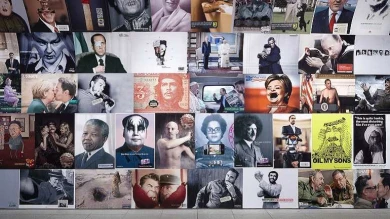
Held on 11, 12 Dec 2015
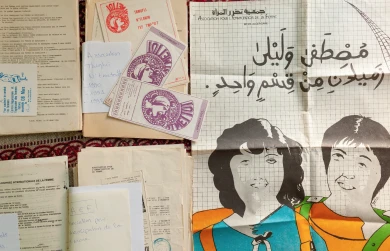
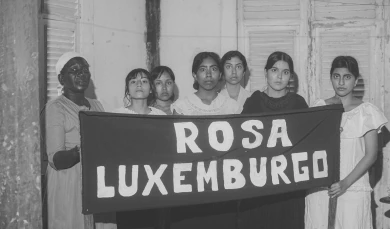
In this seminar, Fundación de los Comunes, Red de Conceptualismos del Sur and Museo Reina Sofía put forward a reflection on issues of social, cultural and political memory through the work of archives that guard, transmit and produce public memory generated by the current forms of social action conservation, which also shuts out major parts of collective experience from dominant discourse. This line of research into the archive and memory of subordinate and dominant groups sets forth a powerful line of reflection on new political rights and the new characteristics of a genuinely democratic sphere that is currently traversed by a multifactorial sense of crisis with far-reaching effects on the types of collective behaviour in our societies.
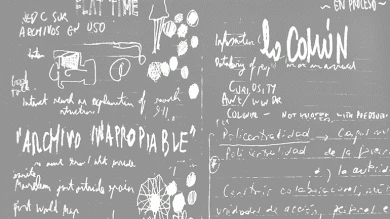
Archives of the commons shines a spotlight on these debates and lines of work in an international seminar organised into tables for discussion and public presentations. It is structured around three core principles of reflection: the archive models and institutional forms that make it possible, laying out a broad cartography of repository initiatives created between the 1970s and the present day; the economies of archive and the methods and protocols that ensure its dissemination and sustainability; the possible techno-political tools for undertaking its organisation, conceived as instruments that guarantee exposure, dynamic taxonomies and universal access, an indispensable condition of common archives. Therefore, the seminar will address institutional, technological and economic models that promote the different archives brought together, transversally debating these divergent records of experience and thought via the synthesis of the local and international, the individual and the collective.
With support from the Foundation for Arts Initiatives (FfAI)
Organised by
Museo Reina Sofía, Fundación de los Comunes and Red Conceptualismos del Sur
With the support of
Más actividades
Rethinking Guernica
Monday and Sunday - Check times
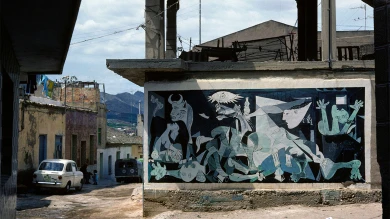
This guided tour activates the microsite Rethinking Guernica, a research project developed by the Museo Reina Sofía’s Collections Area, Conservation and Restoration Department and the Digital Projects Area of the Editorial Activities Department, assembling around 2,000 documents, interviews and counter-archives related to Pablo Picasso’s painting Guernica (1937).
The visit sets out an in-situ dialogue between the works hung around the painting and a selection of key documents, selected by the Museo’s Education Team and essential to gaining an idea of the picture’s historical background. Therefore, the tour looks to contribute to activating critical thought around this iconic and perpetually represented work and seeks to foster an approach which refreshes our gaze before the painting, thereby establishing a link with the present. Essentially revisiting to rethink Guernica.
Files of Tropical Revolutions
Sábado 20 y 27 de junio, 2026 - 19:00 H
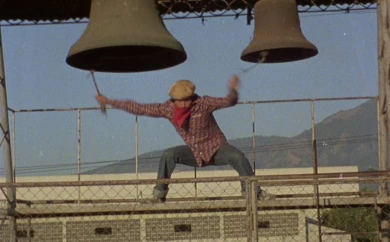
The Reframing Banana Imagery series concludes with two works that condense the height and twilight of this period in history, epic sagas that cross borders and registers to embody experiences of armed struggle in the region. Cameras mix with firearms, borders between nations blur and patience reaches breaking point. This is where the tipping point lies, where the bloodshed weighs heavy and the murmurings of regional brotherhood are buried in the ground again.
Pan y dignidad (Carta abierta de Nicaragua) [Bread and Dignity (An Open Letter to Nicaragua)] recounts the historical records and process of national reconstruction in Nicaragua via the Sandinista popular uprising. Historias prohibidas de Pulgarcito (Forbidden Tales of Tom Thumb) places the camera at the heart of the El Salvador revolutionary struggle, interspersing testimonies of daily violence with the verses of the poet Roque Dalton.
Both works understand the armed revolution as an open file under construction. The insurgent brotherhood, although dissolved, still resounds in regional history.
Circling Over Exploited Bodies
Friday, 19 and 26 June 2026 - 7pm
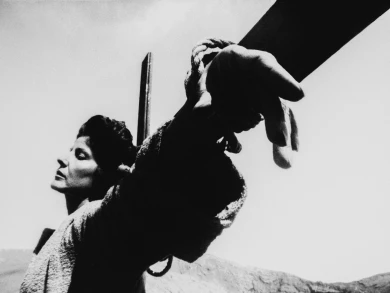
When forms of violence are inflicted on society, film responds from urgency. Images become abstract, sounds fade and the register of dissidence comes from the gut. La zona intertidal (The Intertidal Zone) is an essayistic and poetic approach to the repression of teachers in El Salvador in the 1970s — a teacher studies the biodiversity of the El Salvador coast as a boy finds a body on the same beach. A propósito de la mujer (About Women) interweaves testimonies of misery and rage towards patriarchal structures with fictional scenes of a symbolic procession through a harsh desert.
Both films understand the body as a target of violence and a territory of insurrection, a space where the blood shed by militancy and the patriarchal yoke turn pain into denouncement and existence outside the status quo into an act of political dissidence.
Central American Designation of Origin
Thursday, 18 and 25 June 2026 - 7pm
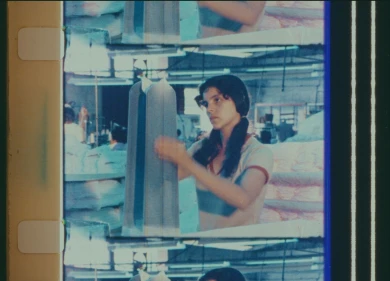
Fertile lands, farmers’ hands, rural faces. This first programme in the series Reframing Banana Imagery understands the foundations of the Central American experience from exploitation, extractivism and displacement, and from the organisation and resistance that emerged as a reaction. The four films within extend from a lyrical documentary on farmers’ solidarity to the playful subversion of the institutional format of the United Fruit Company.
Bananeras (Banana Growers) is a combative portrait of the inhumane conditions of the American banana plantations located in Nicaragua through much of the twentieth century. Costa Rica Banana Republic is a perspicacious satire via an institutional documentary of banana production, spotlighting the extractive nature of this agro-exporting model in the 1970s. Organización Campesina (Farmers’ Organisation) frames rural resistance in Honduras from a direct depiction and lyrical documentary, while Dos veces mujer (Two Times a Woman) dissects the invisibility of the double-shift working day Central American women farmers endure: working in the countryside and working in the home. As a whole, the works here present the earth at once as a wounded body and a space of dignity.

equipoMotor
Jueves alternos, 23 de octubre, 2025 - 11 de junio, 2026 - 17:30 h
El programa equipoMotor regresa en su edición 25-26 con un aire espectral y mutante para lanzar la pregunta: ¿y si el Museo fuera «un poco más Frankenstein»? Inspirándose en dicho monstruo y en todas aquellas criaturas que desafían la norma desde los márgenes, el proyecto de mediación cultural Galaxxia diseña y acompaña una edición incisiva, intergeneracional y descentralizadora, donde saberes invisibilizados, cuerpos raros y deseos molestos se entrelazan para generar nuevas formas de imaginación crítica y radical. En los sótanos y corredores del Museo —un particular laboratorio— las dudas no se esconden: son materia prima.
Así, para este curso el equipoMotor convoca a personas de todas las edades que hayan participado en ediciones anteriores de los distintos equipos del Área de Educación a recorrer el Museo como quien manipula un cuerpo abierto: descoyuntando algunas de sus categorías teóricas y artísticas —la necropolítica, lo crip-cuir, la lucha de clases, las políticas del malestar, la decolonialidad, la temporalidad cuir, la descentralización institucional o el feísmo— para articular un relato díscolo, remendado y palpitante.
El programa se estructura en bloques temáticos sobre lo freak como metodología, el trabajo cultural, la intergeneracionalidad y la diversidad territorial. Cada bloque a su vez se despliega en sesiones que combinan disparadores teóricos y estéticos, visitas a exposiciones y espacios liminales del Museo, talleres artísticos con artistas, ejercicios de curaduría audiovisual colectiva y de relatoría radiofónica, así como instancias de activación pública, mediante proyecciones de cine experimental y coloquios compartidos con el público, en complicidad con el archivo Hamaca y el Área de Cine y Nuevos Medios del Museo.
De este modo, la presente edición incorpora una particularidad: el grupo de participantes irá transformándose en un «colectivo curatorial audiovisual temporalmente autónomo», con capacidad de incidir en la programación del Museo y de abrir la conversación de equipoMotor al público general, cuestionando y expandiendo así los límites entre las cabezas que deciden, las manos que producen y los cuerpos y presencias que habitan la institución. Las personas seleccionadas en la modalidad oyente serán invitadas a las proyecciones públicas, así como a otras activaciones y momentos de apertura del equipoMotor.
Frente al relato de un museo homogéneo, pulcro y lineal, apostamos por un Museo disidente, contradictorio y lleno de vida residual. Un Museo que no tema hacerse preguntas incómodas ni mostrar sus cicatrices. equipoMotor. Un poco más Frankenstein no busca repensar el cuerpo de la institución, sino habitarlo en sus desgarros, tal como es: híbrido, inacabado, infecto, fantasmagórico… y cargado de esporas y chispas por venir.